'Self-Reliance' Faction's Joint Exit, Foreign Affairs and Security Shake-Up... Is Power Shifting to Wi Sung-lac?
- Input
- 2026-11-23 17:10:45
- Updated
- 2026-11-23 17:13:03
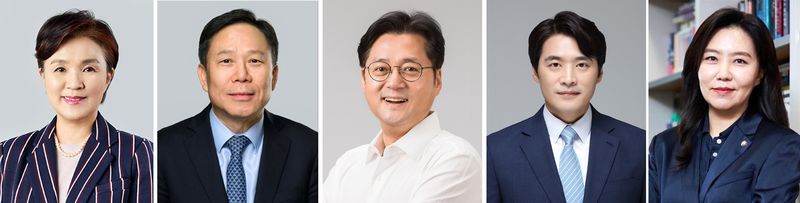
[Financial News] President Lee Jae Myung carried out a mid-sized cabinet reshuffle on the 23rd and overhauled the foreign affairs and security team, where reports had emerged of tensions between the so-called “self-reliance” and “alliance” factions. Lee Jong-seok, director of the National Intelligence Service (NIS), and Jeong Dong-young, minister of unification, both classified as members of the “self-reliance” faction, are leaving their posts. Kang Kum-sil, former justice minister, was nominated as NIS chief, while Im Woong-sun, second deputy director of the National Security Office, was nominated as foreign minister. The move is seen as putting close aides and staff who have worked closely with the president in key positions.
■ First female NIS chief, full overhaul of foreign affairs and security
Presidential Chief of Staff Im Gwang-hyeon briefed reporters at the Chunchugwan Press Center at the Blue House that day, announcing nominees for NIS chief and for the posts of minister of foreign affairs, minister of unification, minister of the interior and safety, and minister of culture, sports and tourism. In the foreign affairs and security fields, Hong Ik-pyo, former senior presidential secretary for political affairs at Cheong Wa Dae, was also nominated as minister of unification, alongside Kang Kum-sil and Im Woong-sun.Since then-Minister of Unification Jeong's remarks about nuclear facilities in Kusong, North Korea, the United States has partially restricted intelligence sharing on North Korea, and controversy over discord between South Korean and U.S. intelligence agencies has continued. With NIS Director Lee and Minister Jeong, who have emphasized improving inter-Korean relations, leaving together, attention is also focused on the impact on North Korea policy and South Korea-U.S. relations. Im nevertheless described the appointments as “personnel decisions aimed at maximizing the national interest by responding to changes in the rapidly shifting international situation with new leadership.”
Kang, nominated as NIS chief, is a figure who embodies the significance of this reshuffle. A former judge, she served as the first female justice minister under the Roh Moo-hyun administration. Even looking back to the NIS's predecessor, the Korean Central Intelligence Agency, founded in 1961, this is the first time a woman has been nominated to head the intelligence agency. She has maintained political ties with Lee, including serving as chair of his fundraising committee when he was the Democratic Party's presidential candidate in 2021. Cheong Wa Dae cited the neutrality and democratic oversight of powerful institutions, as well as international cooperation, as reasons for selecting Kang. Im explained that “with the conviction with which she has upheld the neutrality of powerful institutions, she is the right person to strengthen democratic oversight of the National Intelligence Service and decisively address new security challenges, including cyber threats, through international cooperation.”
Kang also has a connection to Wi Sung-lac, having chaired his fundraising committee when he was a proportional-representation member of the National Assembly. However, since she lacks direct experience in intelligence and counterintelligence, her expertise in leading the organization is expected to be a key issue in the vetting process.
Foreign minister nominee Im Woong-sun is a career diplomat who served as minister at the South Korean Embassy in Washington, among other posts, and has experience in diplomacy with the United States. In the current administration, he served President Lee as second deputy director of the National Security Office. Im said Im Woong-sun is “the right person to further strengthen cooperation between South Korea and the United States on the basis of the ironclad ROK-U.S. Alliance, broaden the scope of diplomacy across security, trade, industry and advanced technology, and maximize the results of pragmatic diplomacy centered on the national interest.” The nominee has also worked closely with Wi Sung-lac.
Unification minister nominee Hong Ik-pyo is a foreign affairs and unification expert who previously worked at the Korea Institute for International Economic Policy (KIEP). He has served as a member of the National Assembly's Foreign Affairs and Unification Committee, floor leader of the Democratic Party, and senior presidential secretary for political affairs at Cheong Wa Dae. Im said Hong is “the right person to lead diverse and practical measures to build an era of peaceful coexistence on the Korean Peninsula at this crucial turning point in easing tensions and building trust between the two Koreas.”
Asked whether the effectiveness of North Korea policy and discord in diplomacy with the United States had influenced the appointments, Im said, “A strong ROK-U.S. Alliance is the policy stance of not only the United States but also our government, and establishing peace on the Korean Peninsula is also our government's policy.” He added, “We are determined to pursue these consistently.”
■ Three ministerial nominees from Cheong Wa Dae, pro-Lee faction given key roles
Of the four ministerial nominees named this time, three—Im Woong-sun, Hong Ik-pyo and Kang Yu-jeong—are current or former Cheong Wa Dae aides. Han Jun-ho, the nominee for minister of the interior and safety, is also considered a pro-Lee figure; he served on the party's Supreme Council when Lee was party leader. The lineup is seen as an effort to speed up coordination between ministries and the implementation of policies by appointing people familiar with President Lee's policy direction and decision-making process.Han Jun-ho, nominated as minister of the interior and safety, is a two-term lawmaker and former journalist who has gained legislative experience in areas including land, transportation and artificial intelligence (AI). Im described Han as “a next-generation leader with an understanding of the administration's governing philosophy and the ability to put it into practice.” He added, “We expect him to protect public safety more robustly while injecting new vitality into locally led growth.”
Kang Yu-jeong, a culture and arts critic and former university professor, entered the National Assembly as a proportional-representation lawmaker in the 22nd general election and served as a Democratic Party lawmaker. After serving on the National Assembly's Culture, Sports and Tourism Committee, she is now senior spokesperson for Cheong Wa Dae. Cheong Wa Dae gave her high marks for combining an understanding of the cultural scene with experience in government. Im said she is “the right person to strengthen the roots of the foundational arts with a deep understanding of culture and the arts and a fresh perspective, significantly increase the public's sense of tangible impact across the work of the Ministry of Culture, Sports and Tourism, and lead Korea as a cultural powerhouse that leads the world with K-Culture.”
Cheong Wa Dae said it would also move quickly to select a successor to the education minister, a post not included in this announcement. Im said the government was making every effort to address follow-up measures related to the CSAT under the prime minister's leadership, adding, “We will also speed up the selection of a successor.”
[email protected] Choi Jong-geun, Seong Seok-woo Reporter