Six Economic Groups Visit Ruling and Opposition Parties... “Legislative Support Is Urgently Needed”
- Input
- 2026-11-23 16:48:08
- Updated
- 2026-11-23 16:48:08
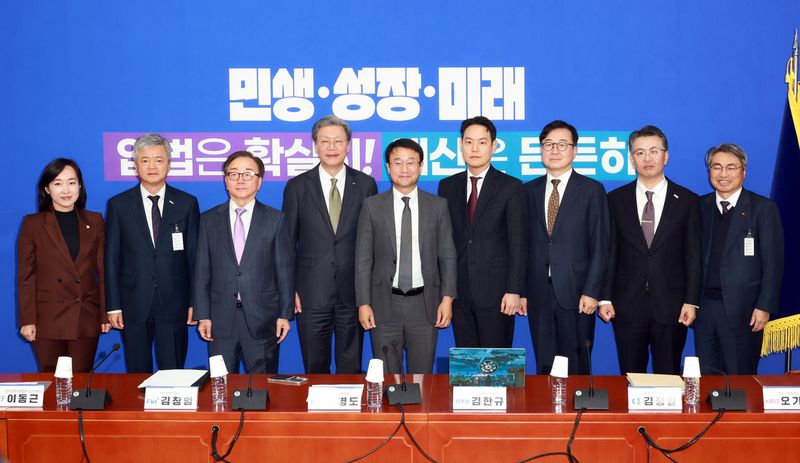
Han Byung-do, floor leader of the DPK, met with vice chairmen of six economic organizations at the National Assembly that day and said, “The DPK will maintain continuous communication with and listen to the business community, and swiftly advance the legislation and policies needed on the ground.”
Han stressed, “We must spread the benefits of economic growth to people’s everyday lives and every corner of their neighborhoods so that they can feel them, while steadily building future growth engines that can lead to sustainable growth.”
He said, “Last week, our economy reached a historic milestone. We achieved the record of $1 trillion in exports, a path only three countries in the world—the United States, Germany and China—had previously taken,” adding, “Behind this achievement were the people who have quietly worked hard in their respective roles, and the dedication of businesses and the business community, which have opened up global markets through constant innovation.”
Kim Chang-beom, executive vice chairman of the Federation of Korean Industries, said, “Last week, South Korea achieved a historic first in its export history, with annual exports reaching $1 trillion.” He nevertheless expressed concern that “the shadow of external uncertainties still looms heavily over our economy amid changes in trade and industrial policies driven by tariffs and artificial intelligence (AI), concerns over the prolonged Middle East war, and the global trend of high interest rates.”
He added, “Strong support and cooperation from the National Assembly are urgently needed on legislative and institutional matters,” noting, “Key bills that will shape the business environment are now under discussion in the National Assembly, including the Special Act on Super-Regional Special Zones, the Framework Act on Service Industry Development, the Class Actions Act, amendments to the Inheritance and Gift Tax Act, and an extension of the retirement age.”
Kim Chang-beom added, “Some bills need to be processed quickly, while others could have adverse effects if passed as they are. I hope this meeting will provide a forum for sharing businesses’ difficulties and concerns through communication and putting our heads together with the National Assembly.”
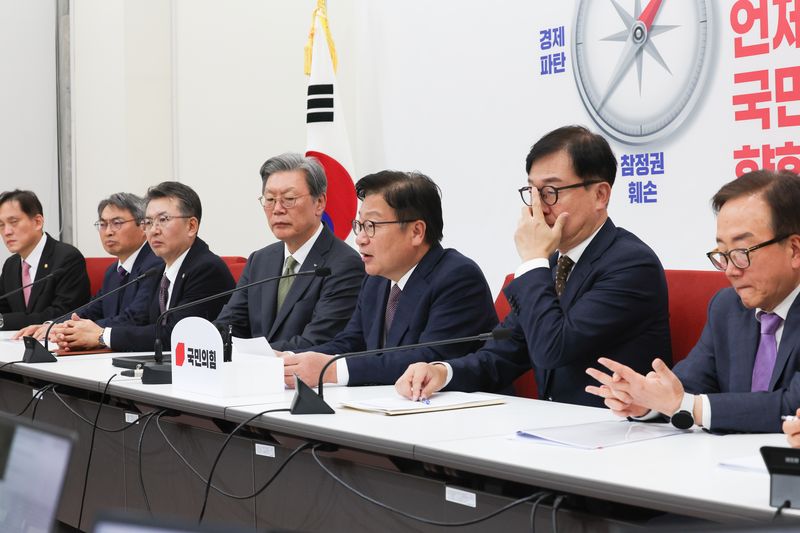
In particular, the party vowed to repeal the Yellow Envelope Act (amendments to Articles 2 and 3 of the Trade Union and Labor Relations Adjustment Act), citing repeated disruptions at industrial workplaces since the law, which the DPK pushed through, took effect.
Jeong also stressed, “If it is extended uniformly and hastily without social discussion and consensus, youth employment could be constrained and generational conflict could grow. Comprehensive discussions on labor reform must take place, including improving the labor market’s dual structure and shifting from seniority-based pay systems to systems based on job duties and performance.”
Kim Jong Il, vice chairman of the Korea Chamber of Commerce and Industry, said, “The United States, China and the European Union view corporate competitiveness as a matter of national survival and are introducing support legislation that would have been difficult to imagine in the past.” He noted, “We are also preparing measures such as the Semiconductor Special Act and the Special Act on Super-Regional Special Zones, but the reality is that the scale and scope of support fall short of those offered by competing countries.”
He also called for efforts by the National Assembly to boost corporate investment and create jobs. Kim Jong Il added, “I ask that legislative measures to support investment and jobs be discussed swiftly, and that the effects on the ground be thoroughly considered before making institutional changes that could place an excessive burden on business activity.”
Among those attending the meeting between the ruling and opposition parties and the six economic organizations that day were Kim Chang-beom, executive vice chairman of the FKI; Kim Jong Il, executive vice chairman of the KCCI; O Gi-ung, executive vice chairman of the Korea Federation of SMEs (KBIZ); Kim Hyun-cheol, executive vice chairman of the Korea Federation of Mid-sized Enterprises; Lee Dong-geun, executive vice chairman of the KEF; and Lee In-ho, executive vice chairman of the Korea International Trade Association.
[email protected] Kim Hyeong-gu, Lee Hae-ram Reporter