K-Bio Bets on ‘Novel Cancer Drugs’...From Global Talent to Combination Therapy and mRNA [fn Market Watch]
- Input
- 2026-11-24 10:18:08
- Updated
- 2026-11-24 11:49:07
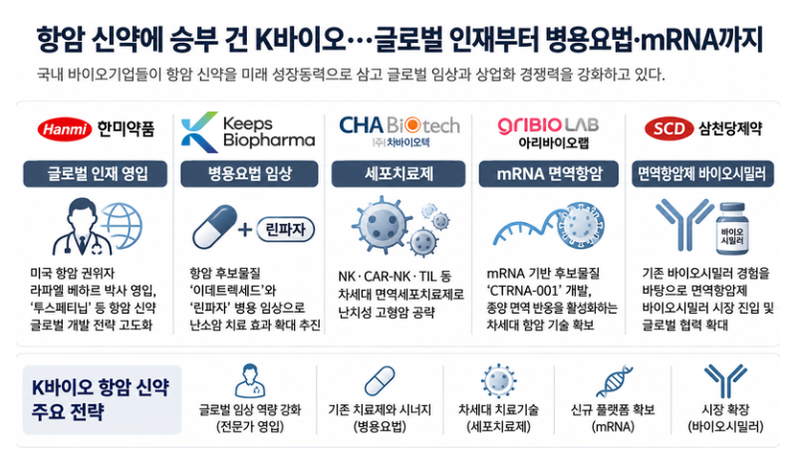
[Financial News] South Korea’s pharmaceutical and biotech industries are moving quickly to strengthen their competitiveness in developing new cancer drugs. Companies are pursuing increasingly diverse strategies, from recruiting global clinical experts to combining existing cancer drugs with other treatments and developing next-generation immune cell therapies and mRNA technologies. Analysts say the focus is shifting beyond simply securing drug candidates to improving the chances of clinical success and laying the groundwork for entering global markets.
According to the pharmaceutical and biotech industries on the 24th, Hanmi Pharmaceutical has recruited Dr. Rafael Behar, a global expert in cancer drug development, to its Oncology Center in the Future Growth Division. Dr. Behar is a physician-scientist who conducted research on blood cancers at institutions including the Dana-Farber Cancer Institute and the University of California, San Diego. He is an authority in oncology who published research on genetic mutations in myelodysplastic syndromes (MDS) in the prestigious medical journal The New England Journal of Medicine (NEJM).
The appointment means more than simply securing overseas talent. As chief medical officer (CMO) of U.S.-based Aptose Biosciences, Dr. Behar has led the global development of tuspetinib, a treatment for acute myeloid leukemia developed by Hanmi Pharmaceutical. Hanmi plans to refine its clinical development strategy—including patient selection, biomarker discovery and combination therapies—by bringing on an expert with an in-depth understanding of its existing pipeline.
Kips Pharma is focusing on combination strategies involving existing cancer drugs. In a European Phase 1b/2a trial combining its key cancer drug candidate idetrexed with Lynparza, an ovarian cancer treatment from AstraZeneca and MSD, the company is assessing the potential to expand treatment benefits.
The company is particularly focused on the possibility of expanding treatment to patients without BRCA gene mutations. In South Korea, it has also received approval for a Phase 2 trial of idetrexed in patients with ovarian cancer and other groups. The company plans to flesh out its global out-licensing and follow-on development strategies based on data from monotherapy and combination trials. CHA Biotech Co., Ltd. is seeking to differentiate itself in next-generation immune cell therapies. It has a range of pipeline treatments, including cancer therapies using natural killer (NK) cells and treatments based on tumor-infiltrating lymphocytes (TILs). It is also targeting the market for hard-to-treat solid tumors, including by working with global biotech companies to develop CAR-NK-based cancer therapies.
Aribio Lab, an affiliate of Aribio Group, has also joined the effort to develop next-generation immuno-oncology technologies. Its mRNA-based cancer drug candidate CTRNA-001 was selected this year for the National New Drug Development Project. The approach uses lipid nanoparticles (LNPs) to deliver mRNA and activate immune cells in the tumor microenvironment, targeting solid tumors such as head and neck cancers. The company aims to establish a foundation for developing follow-on drugs by securing an immune-regulating mechanism distinct from those of existing cancer drugs.
Sam Chun Dang Pharm. Co., Ltd. is also looking to expand its business into oncology. Its strategy is to enter the market for immuno-oncology drug biosimilars, drawing on its experience commercializing biosimilars for ophthalmic diseases globally. The company aims to find opportunities for joint development and commercialization with global pharmaceutical companies and secure a new growth driver in oncology.
Analysts say the competitive focus in cancer drug development is expanding beyond securing drug candidates to include clinical strategy and global commercialization capabilities. As development approaches diversify, particularly with combination therapies, immune cell therapies and mRNA-based drugs, differentiated clinical data and overseas partnerships are expected to determine companies’ competitiveness going forward.
A biotech industry source said, “The cancer drug market is structured so that competitiveness depends not only on the technological strength of drug candidates but also on patient selection, combination strategies and the ability to conduct global clinical trials.” The source added, “It is becoming increasingly important for Korean biotech companies, too, to connect research results to actual commercialization and technology transfers.”
[email protected] Kim Gyeong-a Reporter