“Retail Investors Have Lost Years’ Worth of Salary” ... Anxiety Despite KOSPI Closing Above 4,700
- Input
- 2026-11-23 16:31:43
- Updated
- 2026-11-23 16:31:43
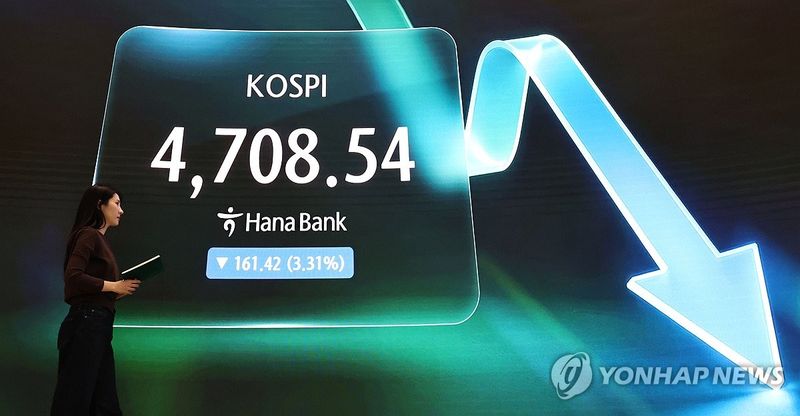
[Financial News] Losses among individual investors are mounting as South Korea’s stock market has plunged for two consecutive trading days. The KOSPI fell below the 4,600 level intraday on the 23rd, triggering sell-sidecars for a second straight day. It later pared its losses and recovered above 4,700, but online, investors repeatedly posted that they had lost sums equivalent to several years’ worth of salary.
According to the Korea Exchange, the KOSPI opened at 4,734.90 on the 23rd, down 135.06 points (2.77%) from the previous trading day. Selling pressure then intensified, pushing the index below 4,700 in the morning and, at one point, down to 4,586.80 intraday—below 4,600 as well.
As losses widened, the Korea Exchange triggered a sell-sidecar on the KOSPI market at around 11:33 a.m. that day. It was the second consecutive trading day, following the 20th. A sell-sidecar is a measure that suspends the effectiveness of sell orders for program trading for five minutes if the KOSPI 200 futures price remains at least 5% below its reference price for one minute.
The KOSPI narrowed its losses in the afternoon, closing at 4,708.54, down 161.42 points (3.31%) from the previous trading day. Although it fell below 4,600 intraday, it held above 4,700 at the close.
The KOSDAQ Index also closed at 635.45, down 10.23 points (1.58%) from the previous trading day. This was its lowest closing level in about two years, since December 9, 2024. Earlier, on the 20th, the KOSPI had closed at 4,869.96 after plunging 5.21%.
The sharp decline was largely driven by a plunge in U.S. semiconductor stocks. On the 20th (local time), Nvidia fell 14.01% on the New York stock market, while Micron and AMD dropped 13.89% and 13.25%, respectively. Major semiconductor companies all posted double-digit declines, and selling pressure continued in South Korean semiconductor stocks.
Samsung Electronics and SK hynix, after falling 7.01% and 5.92%, respectively, on the 20th, also dropped more than 5% intraday on the 23rd. Samsung Electronics fell at one point to around 172,000 won, while SK hynix dropped to around 1.05 million won, deepening losses in South Korea’s stock market. Both stocks later pared some of their losses in the afternoon.
As the market decline continued, posts lamenting investment losses appeared on online stock forums and anonymous message boards for office workers.
After one investor wrote, “Two years’ worth of salary is gone,” other users shared similar experiences, saying, “Mine is three years’ worth” and “Six years’ worth of salary has evaporated.”
Some posts also expressed fear of further declines. Some investors responded self-deprecatingly, saying, “I was so afraid it would fall further that I deleted my brokerage app altogether” and “The crash-market train has left the station, so buckle up tight.”
There were also accounts of people who had suffered heavy losses after cashing out their installment savings to invest in stocks.
One poster who identified as an office worker wrote, “I closed my 20 million won Youth Leap Account, which I’d built up by putting in 700,000 won a month, added money I had on hand, and invested 40 million won in Samsung Electronics, SK hynix and others. Now I have only 24 million won left.” The poster added, “I envy my boyfriend, who kept his savings account and invested only part of his money. I should never have cashed out my savings.”
The poster lost 16 million won of the 40 million won invested, a loss of 40%.
Other users also voiced anxiety about stock investing, saying, “As expected, bank deposits and installment savings are all you can trust” and “Only now have I realized how great bank interest is.”
The securities industry expects it will be difficult for investors’ anxiety to ease in the short term. Analysts say that falling major technology stocks have dampened buying sentiment despite positive factors such as Nvidia’s strong earnings and Anthropic’s initial public offering (IPO).
Some advise investors to avoid excessive trading and keep an eye on market conditions, given that market anxiety is having a greater effect on share prices than corporate earnings and valuations.
[email protected] Han Seung-gon Reporter