Toss Bank CEO Eunmi Rhee: “AI Payments Must First Have Clear Identity, Authority and Responsibility”
- Input
- 2026-11-23 16:48:01
- Updated
- 2026-11-23 16:48:01
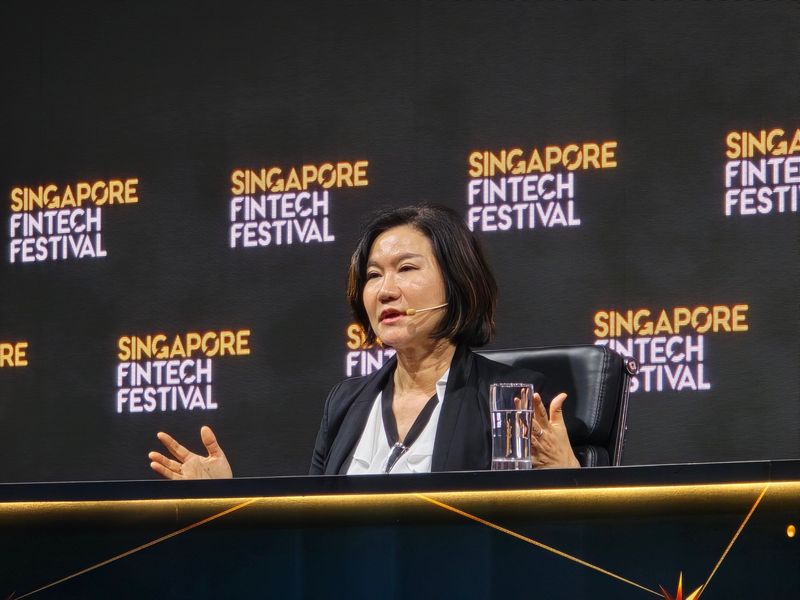
[Financial News] Toss Bank CEO Eunmi Rhee took part in the Singapore FinTech Festival (SFF) 2026, held over three days starting on the 18th, and laid out the “conditions for trust” ahead of an era in which artificial intelligence (AI) makes payments on people’s behalf. She explained that financial transactions need controls suited to their nature, such as assigning different permissions to a transaction for buying a cup of coffee and one for purchasing a house.
Financial industry sources said on the 23rd that Rhee attended the Singapore FinTech Festival as an official panelist for the second consecutive year, following last year. She discussed the future of commerce and finance with leaders of global financial and technology companies, including how AI will change them.
Rhee attended the “Uneven Map: Where AI Is Changing Commerce First” session on the 20th. Kunal Guha, head of commerce partnerships for Google Asia-Pacific, and Prasanna Varadarajan, CEO of FinLabs Singapore, joined the panel.
Rhee said, “AI agents should work for people, not for the sake of the technology itself,” adding, “That is why trust, not technology, will be the most valuable asset going forward.”
She cited identity verification, permission-setting and accountability as conditions for the wider adoption of AI agent payments. Agents carrying out transactions must be verified as legitimate, permissions must be differentiated according to the size and nature of each transaction, and the party responsible if something goes wrong must be clearly identified.
She likened safeguards for AI payments to a car’s braking and steering systems. “A car with only an accelerator and no brakes, traffic lights or steering wheel can’t run,” she said. “AI payments, too, can be widely used in finance only if control mechanisms and an accountability framework are in place.” She also called for preparations for exceptional situations such as software errors and surges in usage.
She said the “KYA (Know Your Agent)” role of verifying agents, beyond banks’ existing know-your-customer (KYC) checks, would become increasingly important. Banks can draw on the verification procedures and financial expertise they have built up, she explained. She also forecast that stablecoins and new payment technologies would coexist with fiat currencies and existing payment networks, complementing them.
Rhee also shared Toss Bank’s experience. Without acquiring an existing bank, Toss Bank built all its systems from scratch and grew into a bank with 17 million customers in about five years after launching in October 2021. Rhee said, “As a digital bank that makes active use of AI, we are putting even more effort into designing safeguards.”
Rhee said, “If last year at SFF we talked about protocols and this year about trust, now it’s time to build an ecosystem that encompasses them all,” adding, “Toss Bank will use technology to make finance easier and more transparent, while becoming a bank that designs permissions and responsibility end to end so that AI always works for people.”
Meanwhile, Rhee also contributed to THE FIRST WORD, a collection of essays by global leaders published by GFTN. In her essay, titled “The Capability Gap Lies with Executives, Not Employees,” she stressed that executives’ decision-making and systems of accountability must change to meet the AI transition. She also identified financial fraud involving deepfakes and voice cloning as an issue executives must take direct responsibility for rather than leaving it to a particular department.
[email protected] Lee Hyun-jung Reporter