Government Pulls Out Market Stabilization Fund Card as Stocks Plunge... Korea Investment & Securities: Holding Is Better Than Further Selling
- Input
- 2026-11-23 15:17:16
- Updated
- 2026-11-23 15:17:16
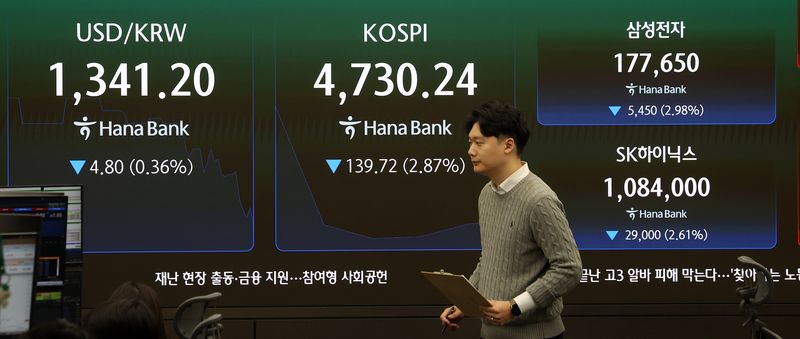
In a report released on the 23rd titled “Oversold and the Market Stabilization Fund: Time to Refrain From Panic Selling,” Daejun Kim, a researcher at Korea Investment & Securities Co., Ltd., attributed the recent sharp market decline to a combination of weakened investor sentiment, foreign investor selling and supply-demand uncertainty, rather than a broad-based increase in credit risk across the domestic financial system.
South Korea’s credit default swap (CDS) premium is in fact holding steady in the low-to-mid 20-basis-point range. The CDS premium is an indicator reflecting the risk that a country or company will default on its debt; a higher reading means the market has grown more concerned about credit risk.
Global stock markets fell across the board last week amid weakening sentiment toward AI investment. All three major U.S. indexes in New York declined, while the PHLX Semiconductor Sector Index (SOX) plunged 17.1%. Taiwan’s Capitalization Weighted Stock Index (TAIEX) also fell 17.5% over the week, and South Korea’s KOSPI weakened, particularly in the semiconductor and hardware sectors.
In particular, Taiwan’s stock market had fallen 46.6% from its peak, surpassing the 43.9% maximum decline during the COVID-19 pandemic. As risk aversion spread in the domestic market as well, the KOSPI 200 Volatility Index (VKOSPI) surged to 53.2 on the 20th. This corresponds to about 3.4% when annualized volatility is converted to a daily basis.
Against this backdrop, financial authorities began preparing a market stabilization fund. A total of five such funds have been established in South Korea in the past. The first was introduced in 1990 at a size of 4.86 trillion won, and funds were also deployed in 2003 and 2008. Funds worth 10.76 trillion won and 10 trillion won, respectively, were established in 2020 and 2022, but no money was actually deployed.
Kim said the fund “could serve as a psychological backstop to limit further losses in the stock market, even if it is not deployed immediately.” However, he predicted that “policy measures will help ease short-term downward pressure rather than drive a sustained rebound.”
He went on to say that “with the KOSPI already having fallen excessively and market stabilization measures also becoming visible, there is little to be gained from further selling.” Volatility may persist for the time being, but the analysis is that maintaining existing positions is a better strategy than joining the sell-off.
[email protected] Kim Hyun-jung Reporter