Google Korea to Support 'K-Space' Global Expansion...Public-Private-Academic Cooperation Gets Into High Gear
- Input
- 2026-11-23 14:42:38
- Updated
- 2026-11-23 14:42:38
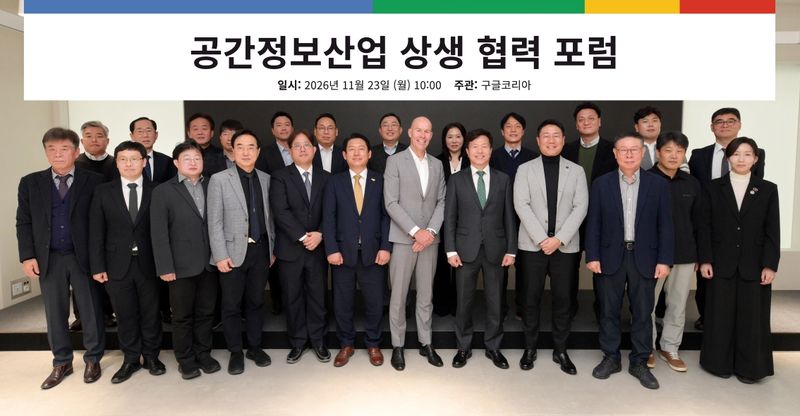
[Financial News] Google Korea will make strategic investments in domestic geospatial information companies and support their entry into global markets. It plans to build a cooperation framework with the government, industry and academia and use advanced technologies such as extended reality (XR) and artificial intelligence (AI) to strengthen the competitiveness of Korea’s geospatial information industry.
According to industry sources on the 23rd, Google Korea held the 2026 Spatial Information Industry Win-Win Cooperation Forum that day and announced its vision for the 'K-Space Initiative' to support the growth of Korea’s geospatial information industry. Some 40 people attended, including Google Korea President Yun Gu and Kirk Mitchell, Google’s vice president of global product partnerships, as well as representatives from the Ministry of Land, Infrastructure and Transport, the National Geographic Information Institute, the Korea Spatial Information Industry Association, the Korea Spatial Information Industry Cooperative and other government and related organizations, industry and academia.
The initiative will proceed along two tracks: core partnerships and strategic investment, and support for the public sector and the ecosystem.
First, Google Korea will support Korean developers’ expansion overseas through the Android XR ecosystem, a next-generation computing environment. It plans to expand business cooperation with Korean companies in geospatial data areas such as public transportation, parking and electric vehicle charging, and to make strategic investments in competitive companies.
Google Korea will also develop support measures to help domestic developers and startups use technology. It will improve access to the Google Maps Platform and expand developer training programs to strengthen the foundation for Korean companies’ entry into global markets. In addition, it plans to introduce Google’s sustainability solutions in Korea—including Greenlight, which optimizes traffic signals to reduce carbon emissions, and Solar API, which supports the use of solar energy—to help address urban and environmental issues.
In his keynote presentation, Vice President Mitchell introduced the global platform capabilities of Google Maps, which is used in some 250 countries and regions around the world. In particular, he outlined how data-use partnerships with local governments, public institutions, startups and small and medium-sized enterprises in Korea could help boost local tourism and commercial districts. He also shared plans to expand developer training and exchanges with local communities.
The following panel discussion covered growth opportunities for the geospatial information industry arising from the convergence of AI and emerging technologies, as well as cooperation needed to help Korean companies expand overseas. Google Korea plans to incorporate feedback gathered that day from the government and industry into its future action plans and continue expanding technology exchanges with Korean companies and developers.
[email protected] Choi Hye-rim Reporter