“ChatGPT Got It Wrong, Too”...CSAT World History Question 2, With a 92.6% Wrong-Answer Rate, Draws a Record-High Number of Appeals
- Input
- 2026-11-23 15:51:55
- Updated
- 2026-11-23 15:51:55
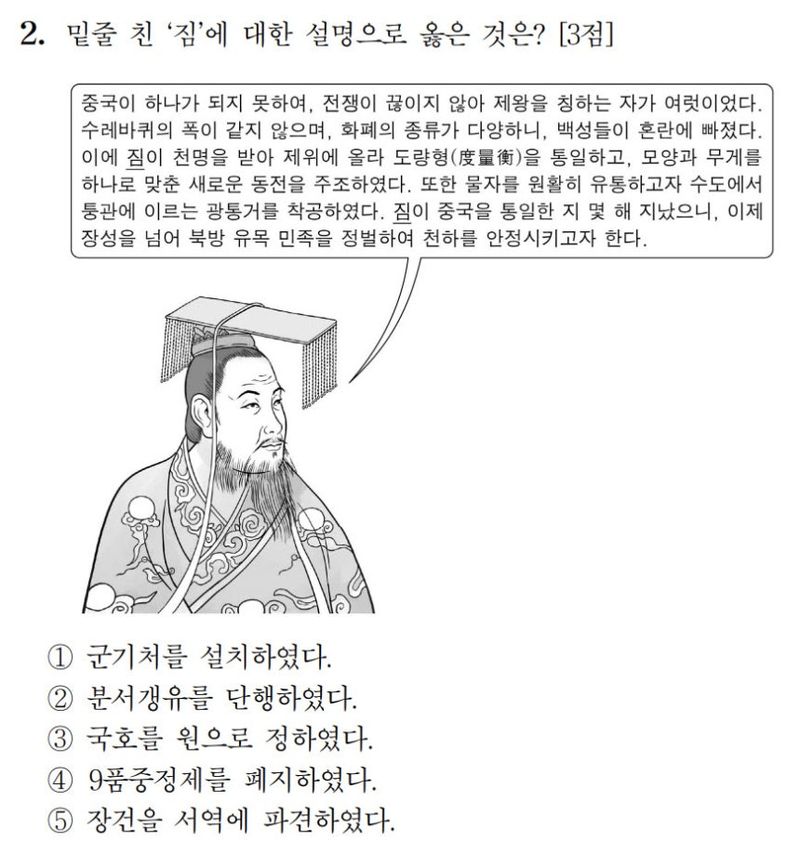
[Financial News] Appeals are pouring in over Question 2 in World History, which had a 92.6% wrong-answer rate on the 2027 College Scholastic Ability Test (CSAT). Some test-takers are claiming the question was flawed, saying that even generative AI came up with a different answer. The question has also spread across Chinese social media and into education circles, drawing unusual attention.
Since the CSAT was held on the 19th, Question 2 in World History has received the most appeals on the Korea Institute for Curriculum and Evaluation’s “Questions and Answers Appeals” board. The controversial question asks test-takers to read a passage in which a Chinese emperor describes his achievements in the first person, using the pronoun “I,” and choose the correct statement about him.
When the passage mentioned such things as “unifying currency and weights and measures” and “subjugating nomadic peoples in the north,” most test-takers thought of Qin Shi Huang, China’s first emperor to unify the country. In EBSi’s preliminary grading tally, 87.7% of all respondents chose option 2, “carried out the burning of books and burying of scholars,” an achievement of Qin Shi Huang. Just 7.4% chose the correct answer announced by the Institute: option 4, “abolished the Nine-Rank System of Official Selection.”
The decisive clue was the “start of construction on the Guangtong Canal” mentioned in the passage. The canal was built from the capital to Tongguan by Wendi (Yang Jian), the first emperor of the Sui Dynasty—not by Qin Shi Huang.
The controversy grew as test-takers cited AI’s answers to argue that the question was flawed. Complaints continued to appear on the appeals board, including, “Even ChatGPT says the answer is option 2.” When the question was entered into major AI models such as ChatGPT, Claude and Gemini, basic and lightweight models with lower computing capacity latched onto the familiar clue of unified weights and measures and incorrectly chose option 2, associated with Qin Shi Huang. Only top-tier models with advanced reasoning enabled picked up on the Guangtong Canal clue and identified the Sui emperor in option 4 as the correct answer.
Experts noted that accuracy varied with the computing capacity and depth of reasoning of each AI model, but stressed that an error in the question itself was unlikely. Professor Byung-Ho Choi of Korea University’s AI Research Institute said, “Models with stronger reasoning can generate and rule out multiple hypotheses and verify their answers, but lightweight models have a shallow deliberation process and are less accurate.” He expressed concern about a new learning gap arising from differences in how people use AI.
Admissions experts likewise said, “It is possible to criticize the quality of a question that raises its ability to distinguish among test-takers by hiding obscure clues, but since the Sui emperor’s achievement is explicitly indicated, the answer is unlikely to be overturned.”
The question has also become a hot topic in China. After Chinese media outlets such as Zhonghua Net reported it under headlines like “Fewer Than 10% Got the Korean CSAT Chinese History Question Right,” reactions poured in on local social media alongside Chinese translations of the question. Users called it “so extremely difficult that most Chinese high school students would get it wrong too” and “an unfamiliar historical source that is not even covered in depth in Chinese textbooks.”
China’s education circles viewed the episode as an example of the limits of history education focused on memorization. In a column on a local portal, a university professor in China’s Heilongjiang Province said, “Simple labels like ‘Qin Shi Huang unified weights and measures’ and ‘Emperor Yang of Sui built the Grand Canal’ became a trap.” The professor said the episode “taught us that history education should teach students to reason by checking evidence in historical sources one piece at a time, rather than relying on easy-to-memorize formulas.”
The Institute will accept appeals until 6 p.m. today (the 23rd), then review them and announce the final answers at 5 p.m. on the 1st of next month.
[email protected] Moon Young-jin Reporter