Education Aid for Developing Countries to Shift to an 'AI-Enabled, Self-Reliant' Model
- Input
- 2026-11-23 14:30:06
- Updated
- 2026-11-23 14:30:06
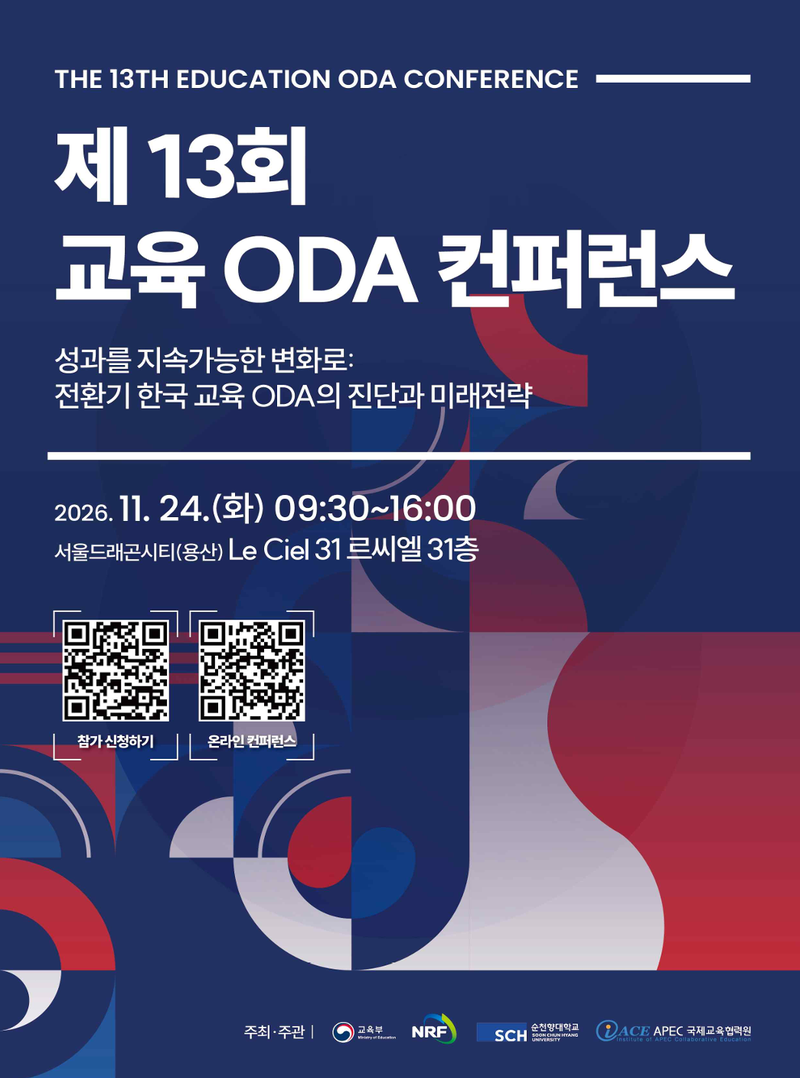
[Financial News] The Ministry of Education said on the 23rd that it would shift the direction of its “educational official development assistance (ODA)” for developing countries away from existing one-off and short-term aid toward a “locally self-reliant” model that integrates artificial intelligence (AI) and edtech. The plan is to build recipient countries’ capacity to run their own education systems even after projects end, and to embed South Korea’s digital education technology and university expertise in local education settings.
The Ministry of Education said on the 23rd that, together with the National Research Foundation of Korea, it would hold the 13th Education Official Development Assistance (ODA) Conference on the 24th at Seoul Dragon City in Yongsan District, Seoul, to flesh out this future strategy. About 200 people, including domestic and international experts in education development cooperation and representatives of related institutions, will attend the event, which is themed “Beyond Results to Sustainable Change: An Assessment and Future Strategy for Korea’s Education ODA.”
The central themes of this discussion are the “sustainability” of education aid and its “local uptake.” International development cooperation projects have generally focused on short-term results, making it difficult for their effects to continue locally after projects end. The Ministry of Education plans to reshape its strategy to strengthen partner countries’ education systems and foundations themselves.
The breakout sessions will focus on the conditions needed to embed AI and edtech in educational settings in developing countries. Participants will also share plans to formalize the International Cooperation Leading Universities program, which draws on resources at South Korean universities to help universities in developing countries establish departments and revise curricula, as well as examples of efforts to strengthen teachers’ capacity.
Discussions will also address how to reflect the actual needs of recipient countries. Lee Gyu-ho, director general of the Development Cooperation Bureau at the Ministry of Foreign Affairs (MOFA), who will deliver the keynote address, will be joined by an education specialist at the Indonesian Embassy in Korea and officials from the World Bank (WB), among others, to examine partner-country ownership and public-private cooperation issues.
Based on ideas presented at the conference, the Ministry of Education plans to develop new projects that meet partner countries’ needs and further strengthen coordination between projects and performance management. The ministry currently runs various education ODA programs, including the Global Korea Scholarship (GKS), which invites talented people from developing countries and supports them in earning degrees at South Korean universities, as well as support for digital education infrastructure and teacher training.
“Education is a key foundation that supports a country’s sustainable development,” said Seol Se-hun, director general of the Ministry of Education’s Planning and Coordination Office. “Building on the expertise we have accumulated, we will support partner countries so they can shape their own futures and further expand the scope of international cooperation in education.”
[email protected] Kim Man-gi Reporter