“Is Now a Chance to Buy the Dip?” ... Retirement Pension Accounts Still Favor “Semiconductor ETFs” Despite the Market Rout
- Input
- 2026-11-23 15:54:47
- Updated
- 2026-11-23 15:54:47
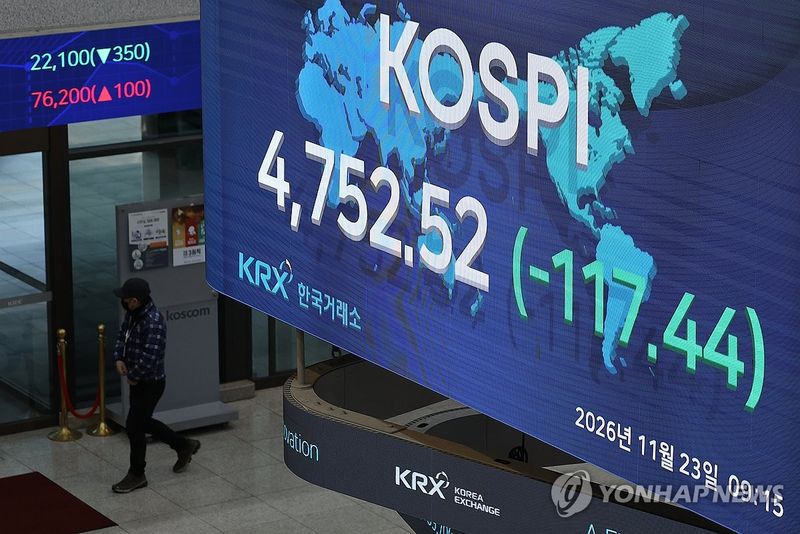
[Financial News] South Korea’s stock market plunged, led by semiconductor stocks, but retirement pension subscribers continued buying semiconductor-related exchange-traded funds (ETFs), according to the data. However, with total net purchases falling sharply in the second half of the year, investment enthusiasm appears to have cooled somewhat.
According to financial industry sources on the 23rd, net purchases of ETFs in retirement pension accounts at the country’s five major banks—KB Kookmin, Shinhan, Hana, Woori and NH Nonghyup Bank—totaled 156.4 billion won from the 1st to the 19th of this month (purchases minus sales). Net buying continued even as the stock market underwent a sharp correction.
The top net-purchased ETF this month was TIGER US S&P 500, at 22 billion won, followed by RISE Samsung Electronics-SK Hynix Bond Balanced 50 (18.4 billion won), Samsung KODEX 200 ETF (17.4 billion won), Mirae Asset TIGER Fn Semiconductor TOP 10 ETF (13.1 billion won) and Samsung KODEX US Nasdaq 100 ETF (9.8 billion won).
Six of the Top 10 Net-Purchased ETFs Are Semiconductor Funds
Notably, six of the 10 ETFs with the highest net purchases in major banks’ retirement pension accounts this month were semiconductor-related products. After combining the monthly top 10 products by net purchases at the five banks, grouping identical products together and reranking them, six semiconductor-related ETFs made the list. This includes bond-balanced products related to Samsung Electronics and SK hynix.
Among the products that made the top 10 were RISE Samsung Electronics-SK Hynix Bond Balanced 50, ranked second overall; Mirae Asset TIGER Fn Semiconductor TOP 10 ETF; HANARO Fn K-Semiconductor ETF (8.9 billion won); KODEX AI Semiconductor TOP2 Plus ETF (7.8 billion won); SAMSUNG KODEX AI Semiconductor Core Equipment ETF (7.4 billion won); and SOL AI Semiconductor TOP2 Plus ETF (7.4 billion won).
The net purchases of these six products totaled 63 billion won, or about 40% of all ETF net purchases this month.
Semiconductor ETFs began emerging as a mainstay in retirement pension accounts this spring. In January and February, the top monthly net purchase was KODEX 200 U.S. Treasury Bond Balanced 50, an index-linked bond-balanced product. From March onward, semiconductor-related products ranked first for five consecutive months.
Mirae Asset TIGER Fn Semiconductor TOP 10 ETF took first place in March, and HANARO Fn K-Semiconductor ETF did so in April. RISE Samsung Electronics-SK Hynix Bond Balanced 50 topped the rankings in May and June, before HANARO Fn K-Semiconductor ETF returned to first place in July.
The number of semiconductor products in the top 10 actually increased. In January, three of the top 10 ETFs by combined net purchases at the five major banks were semiconductor-related: KODEX Samsung Electronics Bond Balanced, Mirae Asset TIGER Fn Semiconductor TOP 10 ETF and HANARO Fn K-Semiconductor ETF. The number doubled this month, when stock prices plunged.
Index Funds Took the Top Spot... Net Purchases Fell to One-Tenth
However, after stock prices plunged in the second half of the year, the top spot went to products tracking major indices in Korea and abroad. TIGER US S&P 500 ranked first in August (about 50.5 billion won) and September (about 32.1 billion won), while Samsung KODEX 200 ETF took first place in October (about 30.2 billion won).
TIGER US S&P 500 also ranked first this month, with about 22 billion won in net purchases. Net purchases of the top-ranked product itself fell to about one-thirteenth of the roughly 282.9 billion won recorded in May.
Overall buying enthusiasm also cooled. Net purchases of retirement pension ETFs at the five major banks totaled 12.0831 trillion won in the first half of the year, averaging more than 2 trillion won a month. They reached 2.4365 trillion won in June, but then fell to 602.4 billion won in July, 731.1 billion won in August, 206.3 billion won in September and 298 billion won in October. In September and October, the monthly level was around one-tenth of June’s.
Purchases fell about 75%, from 6.7651 trillion won in June to 1.6941 trillion won in October. Over the same period, sales also declined about 68%, from 4.3286 trillion won to 1.3961 trillion won. Because purchases fell faster than sales, the ratio of sales to purchases rose from 50.4% in January to 64.0% in June and as high as 86.1% in September. It remained in the 80% range this month as well, at 82.8% from the 1st to the 19th.
Experts advise investors to take a long-term view and diversify their assets rather than be swayed by price movements in a particular industry, since retirement pensions are funds intended to be invested over a long period for retirement. Joo Hyun-ji, a manager in Woori Bank’s Pension Business Division, stressed, “Rather than sharply changing your investment allocation in response to short-term market fluctuations, it is important to spread your assets across stocks, bonds and other investments in line with your investment horizon and the level of risk you can tolerate.” Joo Hyun-ji added, “ETFs also differ in their risks and potential for losses, so you should check each product’s risk rating and underlying assets.”
Kim Seo-hee, a wealth management specialist at NH Nonghyup Bank, said that amid increased stock market volatility, investors should check whether their investments are evenly distributed across growth, value and dividend ETFs. He explained, “If investments are concentrated in growth stocks, it is an effective strategy to manage volatility with high-quality corporate bond ETFs and broaden your investment options with value and dividend ETFs.”
[email protected] Kim Hee-sun Reporter