Hope Bridge and Korea Arboreta and Gardens Institute to Cooperate for Five Years on Restoration of Wildfire-Damaged Areas and Aftercare
- Input
- 2026-11-23 13:52:33
- Updated
- 2026-11-23 13:52:33
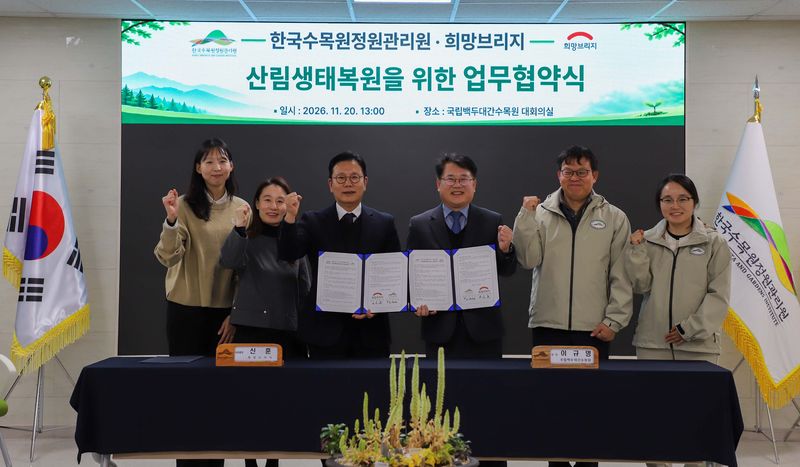
According to Hope Bridge on the 23rd, the two organizations signed an agreement on forest ecosystem restoration on the 20th at Baekdudaegan National Arboretum in Bonghwa County, Gyeongsangbuk-do. Attendees included Shin Hoon, secretary-general of Hope Bridge; Lee Gyu-myeong, director of Baekdudaegan National Arboretum; and officials from the Korea Forest Service (KFS).
The project will draw on private donations and KAGI’s forest restoration expertise. The two organizations will provide hands-on training for university students and others to develop professional talent, and share information gathered during the restoration process. They also plan to publicize the project’s results together.
Hope Bridge and KAGI have continued forest restoration work in Uljin County, Gyeongsangbuk-do, where a major wildfire broke out in 2022, and in Cheongsong, which was hit by a wildfire last year. The areas targeted cover 9 hectares in Uljin and 4 hectares in Cheongsong.
On the 17th of last month, about 80 citizens took part in the second cohort of the “Forest of Hope Acorn Volunteer Group” in Uljin. Participants scattered “seed balls,” made by mixing seeds of native plants such as cork oak with soil, on slopes damaged by the wildfire. They also planted oak and azalea saplings.
The restoration site in Cheongsong is a protected area around Juwangsan National Park. Baekdudaegan National Arboretum and Hope Bridge began restoration work there in June under the KFS’s “Basic Plan for Forest Ecosystem Restoration in Protected Areas Damaged by Wildfires.” The project will continue through May 2029.
The first cohort of “Green Hope,” a hands-on training program for university students that began on August 19, includes 41 students from 10 universities across the country, organized into 14 teams. The students travel between the wildfire-damaged area in Cheongsong and Baekdudaegan National Arboretum, learning the entire restoration process, from preliminary surveys and collecting native plant seeds to growing and planting saplings and conducting follow-up inspections. The training will run through May next year, with eight sessions totaling 80 hours.
With guidance from experts, the participating students carry out restoration projects in teams and create social media content introducing the restoration sites and training program. After the agreement-signing ceremony on the 20th, they presented and discussed the research findings they had gathered so far, team by team.
KAGI Chairman Shim Sang-taek said that restoring biodiversity and ecosystem functions in wildfire-damaged areas takes a long time, and that the restoration projects in Uljin and Cheongsong would be developed into a model in which the public and future generations can participate together. Shin Hoon, secretary-general of Hope Bridge, said, "We will bring together the warm hearts of donors and the restoration capabilities of specialized organizations, and work with KAGI until the forest has fully recovered."
[email protected] Jang In-seo Reporter