Kim Keon Hee and Yoon Han-hong Deny ‘Preferential Treatment in Presidential Residence Relocation’ Allegations... Special Counsel Says ‘There Is Other Evidence’
- Input
- 2026-11-23 14:32:03
- Updated
- 2026-11-23 14:32:03
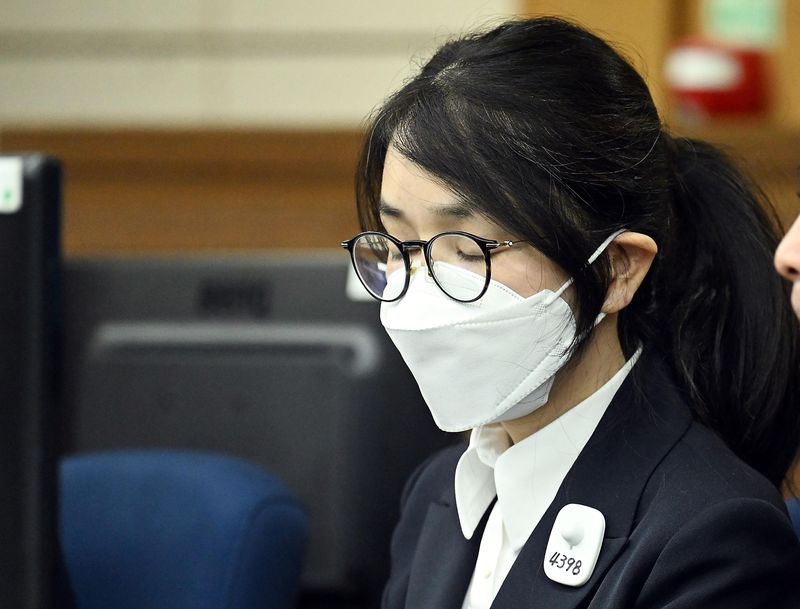
[Financial News] Kim Keon Hee and People Power Party lawmaker Yoon Han-hong, indicted on charges including improperly intervening in construction work to relocate the presidential residence under the Yoon Suk Yeol administration and accepting money and valuables, denied all the charges at the first formal hearing of their first-instance trial. The defense cited the acquittal on abuse-of-authority charges in a separate trial of officials who handled the relocation, a ruling handed down on the 20th. The special counsel team, meanwhile, set out to prove guilt with newly obtained evidence.
The Seoul Central District Court’s Criminal Division 22, presided over by Judge Cho Hyung-woo, held the first trial hearing on the 23rd for Mrs. Kim, who was indicted on charges of receiving bribes through mediation under the Act on the Aggravated Punishment of Specific Crimes and obstructing another’s exercise of rights by abuse of authority, and lawmaker Yoon, who faces charges of obstructing another’s exercise of rights by abuse of authority and violating the Framework Act on the Construction Industry.
The special counsel team believes that in early April 2022, Mrs. Kim awarded the work to CEO Kim, an acquaintance, instead of using the residence design plan prepared by the original contractor. When 21 Grams had difficulty securing the contract because it held only an interior construction license, lawmaker Yoon allegedly instructed former Vice Minister of Land, Infrastructure and Transport Kim Oh-jin—then an administrative secretary at the presidential office—to find a way forward while concealing the close ties between Mrs. Kim and 21 Grams. The special counsel team believes that Kim and others then pursued contracts signed in the name of another general construction company, effectively lending that company’s name, and split the approximately 4.1 billion won project into negotiated contracts. According to the indictment, Mrs. Kim received valuables worth 10.12 million won from Mr. Cho in return, including Dior clothing and the price difference in an exchange involving a Chanel bag.
As at the earlier pretrial hearing, the defense denied all the charges outright. In particular, it emphasized a precedent from last week in which a court acquitted the defendant of abuse of authority on the same set of facts.
Earlier, the Seoul Central District Court’s Criminal Division 24, presided over by Judge Lee Young-seon, found former Vice Minister Kim Oh-jin not guilty of abuse of authority on the 20th in a separate case indicted by Special Counsel Min Joung-kie’s team. The court found that it had not been proven that Kim knew 21 Grams was unqualified and conspired to award it the contract, and that there had been no further coercion after a construction company refused to lend its name. However, it found him guilty of violating the Framework Act on the Construction Industry and of charges including preparing false official documents, sentencing him to 18 months in prison, suspended for two years.
Mrs. Kim’s lawyer argued, “The essence of this case is simply a preliminary site visit and an introduction,” adding, “All the defendant did was look around the new residence where she would live and introduce a reliable contractor she knew well.” The lawyer stressed that she had neither asked anyone to find a way for 21 Grams to get the work nor played any role in the name-lending or negotiated-contract process.
The defense also disputed the charge of receiving bribes through mediation, saying records showed that Mrs. Kim asked Mr. Cho to buy Dior clothing on her behalf and then reimbursed him by bank transfer with 7 million won—more than the items’ 6.88 million won cost.
Yoon’s lawyer also denied that he had directed the selection of the contractor, saying, “All he did was give former Vice Minister Kim the 21 Grams business card so he would know it was an interior design firm accompanying Mrs. Kim.”
The special counsel team maintains that it can separately prove signs of collusion and other matters, notwithstanding the acquittal on abuse-of-authority charges for the officials who handled the residence relocation. In the written ruling in former Vice Minister Kim’s case, the court also stated, “The president’s spouse has no authority to choose a contractor for work on the presidential residence at will, and it is not proper performance of official duties for the government to arrange a negotiated contract with 21 Grams simply because Kim Keon Hee wants it.” This is understood to leave open the possibility of a separate ruling on whether higher-ups were involved.
The special counsel team set out to prove the charges using newly collected evidence, including a project report documenting three site visits, an estimate in the range of about 4 billion won, and meeting minutes.
The special counsel team emphasized, “The presidential residence is the country’s highest-security facility and the center of domestic and foreign affairs, and public procedures must be followed more rigorously than in any other matter.” It added, “In relocating the presidential residence for the first time since the nation’s founding, the government must not make pleasing the president’s spouse its top priority, leading to the selection of an unqualified company and the privatization of state power.”
The court will hold its first witness examination on December 7. Mrs. Kim and lawmaker Yoon are expected to attend the hearing on January 11 next year.
[email protected] Lee Chang-hoon Reporter