“Even Blocking Radio Signals Can't Stop AI Cheating”...People Power Party Moves to Draw Up Measures for Exam Fairness
- Input
- 2026-11-23 13:10:09
- Updated
- 2026-11-23 13:10:09
[Financial News] Amid concerns that cheating on exams using artificial intelligence (AI) could spread, the People Power Party has begun working on institutional reforms to ensure fairness in national exams, including the College Scholastic Ability Test (CSAT). With even “on-device AI,” which operates without an internet connection, now emerging, critics say that measures focused solely on conventional radio-wave detection are not enough to prevent cheating.
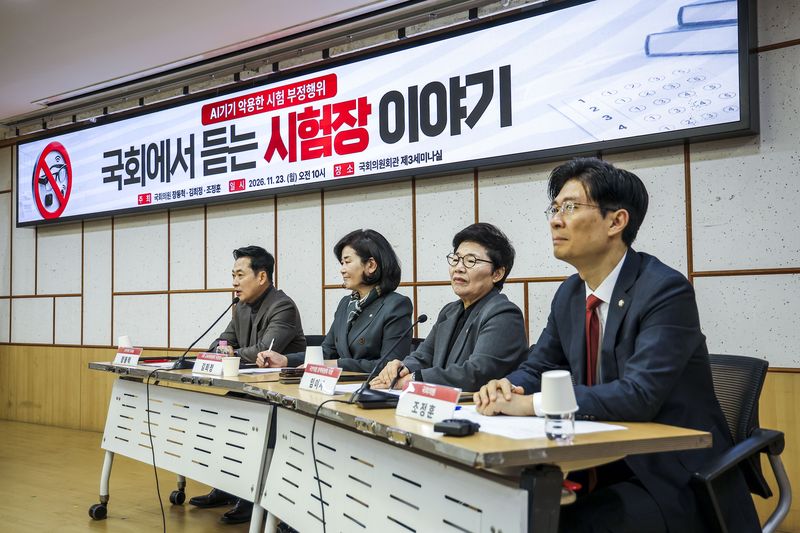
People Power Party leader Jang Dong-hyeok and lawmakers Cho Jung-hun and Kim Hee-jung held a roundtable titled “Stories from Exam Rooms at the National Assembly” at the National Assembly Members’ Office Building on the 23rd, listening to views from test-takers, parents and people in education. Participants agreed that the entire exam administration system should be reviewed, while also criticizing the government’s delayed response.
Twenty-four-year-old Park Seung-min said, “On-device AI is a technology that can be used without an internet connection or external radio signals,” and pointed out, “The government said it would detect cheating through radio-wave detection, but I wonder whether it has specific measures to prevent it.” He highlighted the limitations of exam administration methods that cannot keep pace with technological advances.
Rep. Kim Hee-jung said, “It is difficult to prevent cheating with on-device AI simply by blocking network access,” and stressed the need for cooperation among relevant ministries, including the Ministry of Education, the Ministry of Science and ICT, and the Ministry of Trade, Industry and Energy. She also proposed reaching agreements at the national level with foreign AI companies to prevent the uploading of exam papers and cheating using AI.
The party leader strongly criticized the government’s response. He said, “The hastily prepared measures, introduced with only three days to go before the CSAT, led to a spate of side effects,” criticizing the fact that “test-takers had to prepare pencils and parents had to get clothes without buttons.” He added, “If fairness collapses, it will become impossible to trust the national system as a whole,” and pledged that the People Power Party would draw up its own measures.
According to the Ministry of Education, 111 cases of cheating involving electronic devices were uncovered during this year’s CSAT. However, that figure is not the number of confirmed cases of AI-assisted cheating; it is the number of cases involving electronic devices. Ahead of the CSAT, the government implemented emergency measures such as requiring students to hand in smart devices and blocking public Wi-Fi.
There were also calls to change the exam format itself. An operator of an innovative education institution said, “AI can already do a better job of selecting the correct answer in five-option multiple-choice questions,” arguing that assessments should cover not only results but also students’ learning processes and growth. By contrast, a researcher in the CSAT Korean-language section stressed that the fairness and objectivity of multiple-choice exams also need to be maintained.
Jang said, “We need to consider why students should spend one to two hours solving problems that AI can solve in one minute,” adding, “We need to discuss the limitations of a uniform university admissions system and public education as a whole.” The People Power Party plans to continue discussions based on the views raised at the event.
[email protected] Kim Kyung-min Reporter