“One CSAT Exam Does Not Determine Your Life... Admissions Hell Will End When Universities Change”
- Input
- 2026-11-23 11:49:12
- Updated
- 2026-11-23 11:49:12
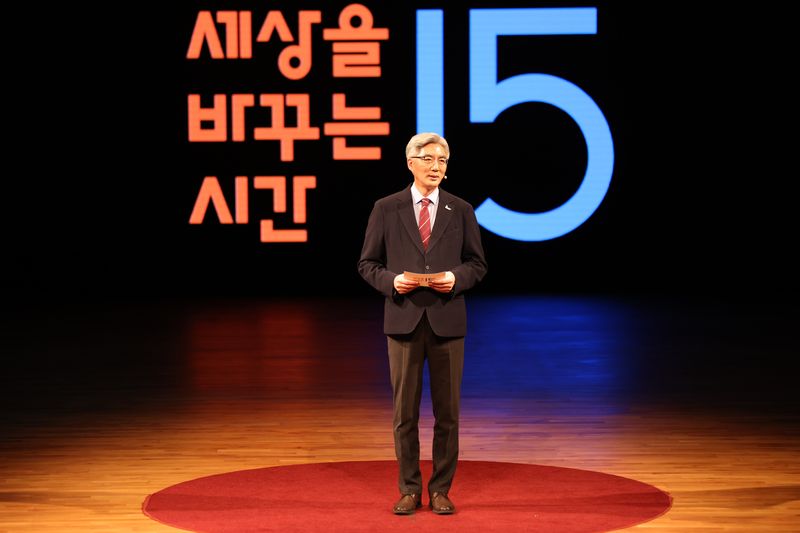
[Financial News] A proposal has emerged that universities must first change their admissions and education methods to end Korea’s chronic competition for university places.
On the 23rd, Ghent University Global Campus said that its president, Taejun Han, appeared on the talk program Sebasi (15 Minutes to Change the World) and pointed out, “If universities change, the entire chain of admissions competition, extending from high schools through middle and elementary schools to kindergartens, can change.” This is because the education methods of schools at lower levels are determined by what kind of students universities want. The talk, held on October 15, was posted on YouTube on the 20th and surpassed 420,000 views within three days, attracting considerable interest from students preparing for university entrance exams and their parents.
Han presented the actual operations of Ghent University Global Campus, where he has worked for 10 years, as an alternative. Instead of a single exam taken at age 18, like the CSAT, the university has broadened its admissions process so students can take the exam whenever they are ready throughout the year. In addition to test scores, it selects students with potential based on recommendations from school principals or education superintendents.
The university lowers the bar for admission but applies strict graduation requirements. Students can graduate only after completing the entire curriculum, which totals 240 credits. Rather than telling students who struggle to keep up with classes, “You can’t do it,” and making them give up, the university provides one-on-one tailored learning support (tutoring) to help them make up for gaps. It also gives them hands-on internship experience applying what they have learned in the real world. As a result, the employment rate among the university’s graduates exceeds 90%.
Han pointed out that the standards for judging a good university must change first. “Rather than asking how good the students a university admitted were, we should ask how much the students who entered it grew before they left,” he said, adding, “Students are people who grow, not just people to be selected.”
He also shared an example of a student who grew at the university. The student had failed after giving up just three weeks into their first coding class at university, but took on the challenge again with the school’s support. After finally experiencing the satisfaction of solving a problem that had stumped them, the student changed career paths and is now pursuing a career as an artificial intelligence (AI) researcher. The point, he explained, is that education helps people realize that failure is not the final answer in life.
Han compared the sight of children riding a private-academy shuttle bus at 10 p.m. to the pillar of caterpillars in the children’s book “Hope for the Flowers.” Like caterpillars pushing one another as they climb because others are doing so, without knowing what awaits at the top, our education system, he said, is fixated on “entrance-exam study” and finding the predetermined answers as quickly as possible.
He also emphasized that the true purpose of education is not to force knowledge from outside into people, but to draw out the potential already hidden within them. He recounted being deeply struck, during his doctoral studies in the UK, by a 20-year-old undergraduate he met at his supervisor’s request. The student effortlessly connected knowledge from entirely different fields and debated for more than three hours.
Han emphasized, “Rather than grand institutional overhauls, small but genuinely effective examples of university success should accumulate and drive change across education as a whole.” He also urged adults, “Let’s change the questions we ask children from ‘How many points did you get today?’ to ‘What were you curious about today?’”
[email protected] Kim Man-gi Reporter