“What Score Did You Get?” Instead, Ask “What Were You Curious About?” ... President Taejun Han Says Questions for Children Need to Change
- Input
- 2026-11-23 11:45:53
- Updated
- 2026-11-23 11:45:53
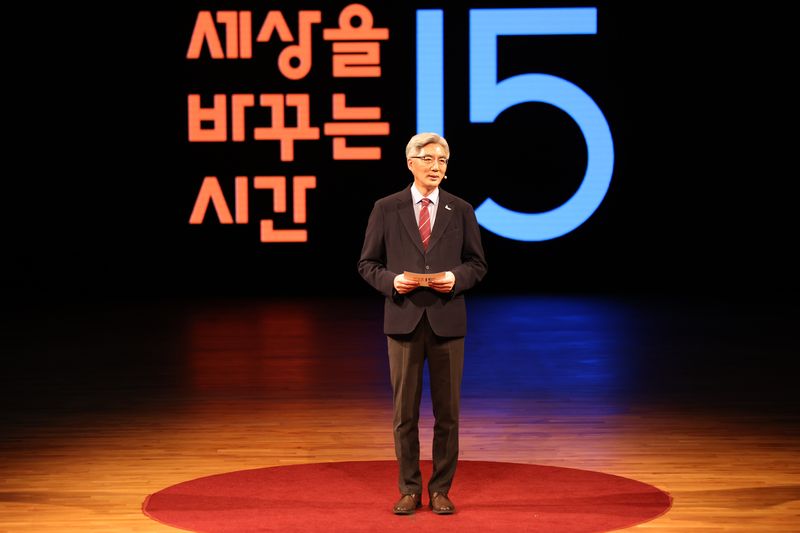
[Financial News] “Rather than asking, ‘How many points did you get today?’ please ask, ‘What were you curious about today? What did you learn for the first time today?’”
Taejun Han, president of Ghent University Global Campus, proposed to parents and teachers during a Sebasi (15 Minutes to Change the World) talk that they start by changing the questions they ask children.
Han emphasized that when the questions change, so does the direction children look in, and that people should focus on children’s curiosity and growth rather than grades and competition.
Han pointed out that South Korean education has long treated entrance exam preparation and education as the same thing.
At home, parents ask about homework and test scores, while at school, the emphasis is on whether students got the right answer rather than why they think the way they do.
He said, “Entrance exam preparation teaches you how to find predetermined answers quickly,” while “education, by contrast, is the process of cultivating people who can face questions that don’t yet have answers.”
The experience that led him to this way of thinking came during his studies in the UK. After studying at Seoul National University and in graduate school, Han was pursuing a doctorate in the UK when he ended up supervising the thesis of an undergraduate student who was around 20. A conversation he thought would take an hour lasted more than three. Each time the student was asked a question, they connected knowledge from different fields and came up with an unexpected answer.
Han recalled asking himself at the time, “Had I really received a proper education?”
He identified universities as the starting point for changing education. The reason, he said, is that the way high schools teach is determined by which students universities select, and that influence extends through middle and elementary schools all the way to kindergarten.
Han said it was also important to accept failure as part of the learning process. He cited the case of a student who failed the first coding class they took after entering university but, after trying again, went on to become an artificial intelligence researcher. He said, “Ultimately, education is about helping people realize that failure is not the final answer in life.”
Recalling children sitting on private academy shuttle buses between 9 and 10 p.m., Han said, “Parents and teachers all want children to do well, but we need to reflect on whether those good intentions are combining to drive children into endless competition. We need to raise children who know how to ask questions, who start again even after falling, and who can enjoy learning throughout their lives.” He added, “Changing education is a much bigger undertaking than tweaking a single college entrance exam system,” and emphasized, “It is about deciding what kind of people we will cultivate and, ultimately, what kind of South Korea we will create.”
[email protected] Lee Bomi Reporter