Youth Concentration in the Capital Region Came 15 Years Before the Overall Population Shift
- Input
- 2026-11-23 14:50:39
- Updated
- 2026-11-23 14:50:39
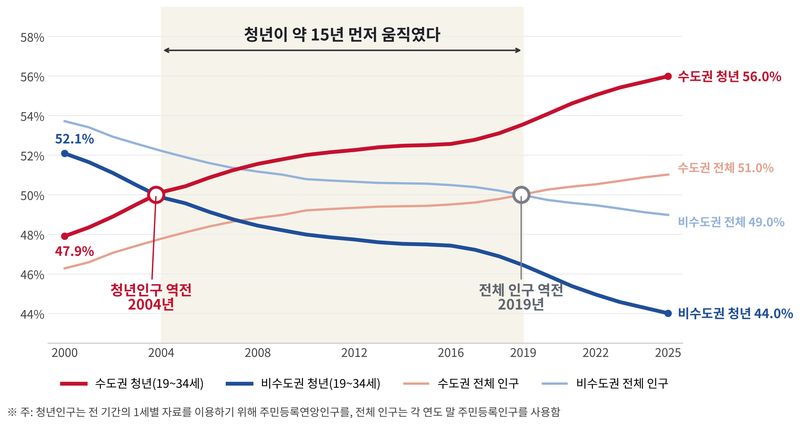
[Financial News] The youth population in the capital region had already surpassed that of the rest of the country around 2004, about 15 years before the overall population did so in 2019.
According to the National Assembly Research Service (NARS) on the 23rd, it announced that day at a press conference at the National Assembly Building the findings of a policy research study it had commissioned the Korea Research Institute for Human Settlements to conduct, titled “Developing Indicators for Analyzing Regional Inequality and Conducting an Empirical Analysis.” The agency’s Regional Inequality Mitigation Research Task Force participated throughout the study, from its design to its review. The research was prompted by concerns that existing indicators, which focus on rankings by population decline, make it difficult to identify the different causes and remedies in each region.
The researchers viewed the movement of young people (ages 19–34) as an early warning sign of regional crises. The share of young people nationwide living in the capital region rose from 47.9% in 2000 to 56.0% in 2025. This year, the gap between the capital region and the rest of the country in their shares of the youth population is 12.0 percentage points, about six times the gap for the overall population (around 2 percentage points). Of the population growth rate, total fertility rate and youth net migration rate, youth net migration was the indicator most consistently linked to conditions in five areas: jobs, transportation, daily life, culture and education. Outside the capital region, 15 of 16 key indicators of these conditions showed a clear relationship with the youth net migration rate. In the capital region, the number was just five.
The researchers paid particular attention to 38 places where local conditions and young people’s choices diverge. In 23 places classified as having insufficient pull for young people, conditions in all five areas were above the national median, yet 188,000 people aged 20–34 moved out on a net basis from 2020 to 2024. Of these, 78% left for other cities or provinces, and most were in their 20s. The list includes many autonomous districts in metropolitan cities and regional hub cities, such as Suseong and Dalseo districts in Daegu; Changwon and Gimhae; Dong and Jung districts and Ulju County in Ulsan; Haeundae District in Busan; Mokpo and Yeosu; and Gangneung. Only four of these are designated population-decline areas. The researchers warned that the population size is being maintained only by an “illusion” created by the influx of middle-aged and older people in the past, and that these places could soon become areas in crisis if young people continue to leave.
The reasons young people leave differed from one region to another. Daegu’s Suseong District has good elementary, middle and high school education and housing conditions, but lacks jobs and universities. The share of workers employed by large companies (10.7%) is less than half the average for Seoul’s autonomous districts (22.9%). Ulsan’s Dong District had the highest share of large-company employees in its category (43.3%), but its job-entry rate was the lowest, at 2.5%. In-house subcontracting accounts for 63% of the workforce at the three major shipbuilders. Of the young people who left Mokpo, 19.5% moved to neighboring Muan County.
By contrast, in 15 places classified as needing stronger settlement foundations, young people were relatively less likely to leave despite weaker conditions. But the examples of Muan County in South Jeolla Province and Dangjin in South Chungcheong Province show a pattern reliant on a single new town or factory. Muan County’s youth population grew each time residents moved into the Namak and Oryong new towns, but 46.5% of the young people who moved to Muan County from Gwangju and South Jeolla Province came from neighboring Mokpo. Dangjin had favorable job conditions thanks to its steel mill and industrial complex, but young people began leaving again from 2018 to 2021, when the steel industry slumped. The outflow of young people from this category was greater in the early 2000s, but the trends of the two categories reversed around 2005.
The researchers concluded that remedies should also differ by category. They said places needing stronger settlement foundations should provide transportation, medical care, childcare and schools in step with new-town move-ins and factory start-up schedules, and plan at the regional level to prevent “zero-sum” competition in which neighboring cities poach young people. The report put it this way: “Make hay while the sun shines.” For places with insufficient pull for young people, the researchers proposed remedies based on each city’s character: education cities should use the Regional Innovation-centered University Support System (RISE) to link university enrollment with employment; industrial cities should examine the gap between prime contractors and subcontractors, as well as new hiring; and old city centers should be managed together with nearby new towns as a single living area. The researchers said that the 19 places in this category that are not designated population-decline areas should be managed as “early-watch targets.”
[email protected] Jeong Gyeong-su Reporter