[Exclusive] Fear of the Reconstruction Excess Profit Recovery System Spreads to First-Generation New Towns... Bundang to See First-Ever Repeal Statement
- Input
- 2026-11-23 14:51:40
- Updated
- 2026-11-23 14:51:40
■Bundang to issue first statement calling for the system’s abolition
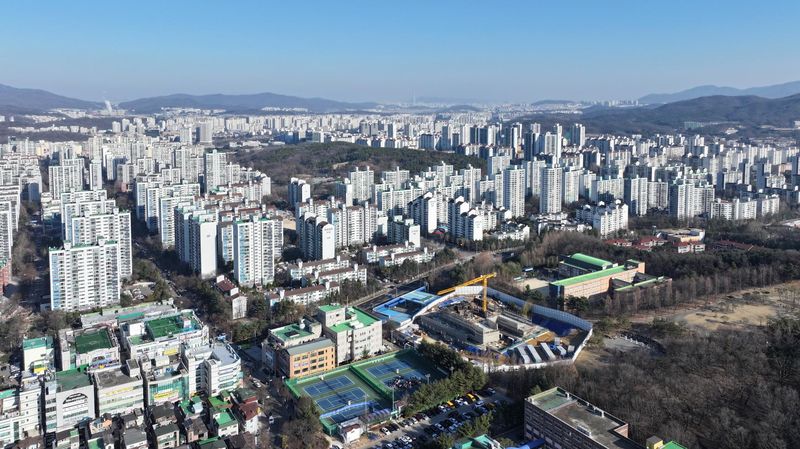
According to Financial News’ reporting on the 23rd, the Yangji Village Integrated Reconstruction Project Committee in Bundang will issue an official statement calling for the system’s abolition at its office opening ceremony scheduled for the 28th. The Yangji Village integrated reconstruction project is the largest among the leading districts for redevelopment in first-generation new towns. It will transform the existing 4,392 households into a complex with 6,839 units in buildings of up to 37 stories.
Dozens of committee members, including Kim Young-jin, chair of the Yangji Village Redevelopment Project Committee, are expected to attend the statement announcement that day, holding placards. Industry sources say that two or three other leading districts have also built some degree of consensus. This means the scale of participation could grow further, depending on the circumstances.
The main reason for issuing official statements calling for the system’s abolition in first-generation new towns is “uncertainty.” A senior official from one of Bundang’s leading districts said, “The levy amount has not been announced yet, but that only leaves us with even more uncertainty,” adding, “People are deeply dissatisfied because they’re worried they could face a levy under the system on top of their reconstruction contributions.”
■Could opposition spread as far as Suwon and Gwangmyeong?
There is also a possibility that opposition could spread to other first-generation new towns, starting with this statement. According to materials submitted by Gyeonggi Province to the office of People Power Party lawmaker Kwon Young-jin, Suwon’s Yeongtong District 2, Gwacheon’s Jugong complexes 4, 5, 8 and 9, and Gwangmyeong’s Cheolsan Jugong complexes 8 and 9 have already been notified of estimated levies under the system amounting to hundreds of millions of won.
A petition calling for the system’s abolition is also gaining support rapidly. As of this morning, the petition titled “Petition to Repeal the Act on the Recovery of Excess Profits from Reconstruction” on the National Assembly e-Petition System website had garnered more than 23,300 signatures since it was filed on the 17th. That is in about a week, or roughly 3,328 signatures a day. Typically, if at least 50,000 people support a petition within 30 days of its publication, it is formally accepted and referred to the relevant standing committee of the National Assembly.
The pace of signatures appears to be picking up further as complexes with confirmed levies emerge. At around 11 a.m. on the 23rd, the petition had 23,300 signatures, but it surpassed 24,400 just two hours later. The system recoups part of the profits earned by members of a reconstruction association when those profits exceed a certain level, in the form of a “reconstruction contribution.”
Meanwhile, following a recent legal review, the Ministry of Land, Infrastructure and Transport made clear that the deadline for imposing levies under the system cannot be extended through an amendment to the law. As a result, the deadline for imposing the levy on Seoul’s “Banpo Hyundai” has been set for later this year.
[email protected] Kwon Jun-ho Reporter