“AI Proposes and Planners Verify” ... KRIHS Shares Results of AI Urban Planning
- Input
- 2026-11-23 10:41:53
- Updated
- 2026-11-23 10:41:53
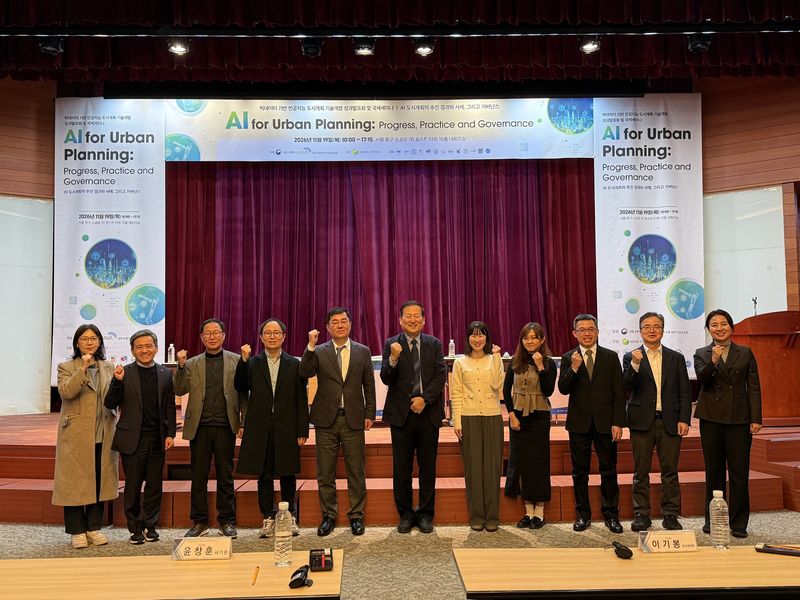
[Financial News] An urban planning technology that uses artificial intelligence (AI) to draft plans for human planners to review and finalize has completed field demonstrations with local governments.
According to the Korea Research Institute for Human Settlements (KRIHS) on the 23rd, the institute held the “Results Presentation and International Seminar on the Development of Big Data-Based AI Urban Planning Technology” at Seoul Post Tower on the 19th. The Ministry of Land, Infrastructure and Transport and the Korea Agency for Infrastructure Technology Advancement hosted the event, with KRIHS organizing it. The event provided an opportunity to share research and development (R&D) results to date and discuss the progress, case studies and governance of AI urban planning.
At the morning results presentation, research lead Kim Dong-han, a senior research fellow at KRIHS, presented “Current Progress and Future Challenges in AI Urban Planning Technology Development.” Kim introduced the work completed to date, including grid-based urban big data, 20 indicators for urban diagnosis and forecasting, an urban planning support model, and five support systems.
Results of the demonstrations in each local government were also shared. Professor Nam Gwang-woo of Kyungsung University, who headed the master planning team (MP) for each local government, presented plans for setting living-area zones in Busan; Professor Lee Hee-jung of the University of Seoul (UOS) presented the formulation of an AI-symbiotic urban plan for Cheonan; and Professor Kwon Young-sang of Seoul National University presented plans to develop Damyang County into a small but strong ecological city. Lee Seok-woo, former president of the Korea Association of Professional Engineers in Urban Planning, chaired the panel discussion.
The afternoon international seminar opened with welcoming remarks from Lee Ki-bong, director of urban policy at the Ministry of Land, Infrastructure and Transport (MOLIT). Kim presented the progress and outlook for AI urban planning in South Korea, and international speakers shared examples from their countries. Shiho Tanaka, a senior official at Japan’s Ministry of Land, Infrastructure, Transport and Tourism (MLIT), introduced the 3D city model project “PLATEAU,” while Ching Tuan Yi, head of Singapore’s Urban Redevelopment Authority (URA), introduced “Plan.AI.” Kyoto University Professor Chen Kuan-wei discussed transparency and accountability in AI-assisted urban planning. PLATEAU is a digital twin project launched by Japan’s MLIT in 2020 that creates and publicly releases 3D models of real-world cities. Starting with the release of data for 56 cities in 2021, it has expanded its coverage to about 250 cities.
Professor Lee Hee-jung chaired the panel discussion that followed. Experts from academia, public agencies, research institutions and the media discussed challenges facing AI urban planning and directions for institutional and technological development.
[email protected] Jung Kyung-soo Reporter