Shop at Traditional Markets and Make Local Dishes ... About 500 Take Part in Jeju Culinary Experience
- Input
- 2026-11-23 10:20:49
- Updated
- 2026-11-23 10:20:49
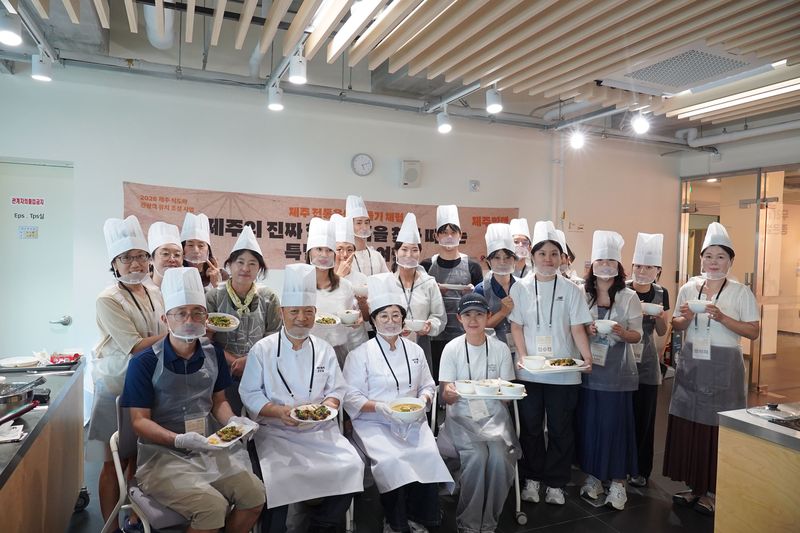
【Financial News, Jeju = Reporter Jeong Yong-bok】 About 500 people took part this year in a culinary tourism program where they bought ingredients at a traditional market in Jeju and made local dishes themselves. The program combined shopping with local currency and food experiences, connecting tourist spending with traditional markets.
According to the Jeju Special Self-Governing Province Tourism Association on the 23rd, Jeju Mihaeng, hosted by Jeju Province and organized by the association, completed 20 sessions from June through November. It comprised 16 regular sessions and four special sessions, with about 500 participants in total.
Jeju Mihaeng is an experiential tourism product designed to let tourists do more than taste Jeju's local cuisine: they take part themselves in everything from buying ingredients to cooking and tasting the food.
Participants bought seasonal ingredients at Jeju Dongmun Traditional Market in Jeju City, then made traditional Jeju dishes such as bracken fern yukgaejang, pork noodle soup and sangae-tteok with local cuisine experts. During the cooking process, they also learned about the lifestyles of Jeju residents and the local culture reflected in the food.
The program also introduced a way to shop using the local currency Tamnaneun Jeon. After taking part in the program, participants receive a full refund of the 10,000-won participation fee in Tamnaneun Jeon, which they then use to buy ingredients at traditional markets. This differs from existing tourism programs centered on food tastings by encouraging tourists to buy and consume ingredients produced and distributed locally.
The food experiences featured Kim Ji-sun, Jeju Province's No. 1 designated master of local cuisine; Bu Jeong-seon, a No. 6 local cuisine artisan; and Kim Tae-ja, a No. 7 local cuisine artisan. Kim Jin-gyeong, head of the Bejigeun Research Institute, and chef Mun Dong-il also introduced Jeju's food culture and cooking methods.
The special sessions offered programs combining local ingredients and culture. With Chef Song Hoon, participants made momguk, a traditional Jeju dish, using Nanchukmatdon, a breed developed from Jeju's native black pig. Nanchukmatdon was developed by the National Institute of Animal Science of the Rural Development Administration to preserve the meat-quality characteristics of Jeju's native black pig.
A haenyeo cooking experience was also held in collaboration with village fishing cooperatives. Participants learned about the everyday culture of Jeju's fishing villages and the food culture of haenyeo, and took part in making local holiday dishes or sharing lunch boxes.
A participant satisfaction survey conducted by the Jeju Tourism Association gave the program an overall rating of 4.78 out of 5. The association said satisfaction was particularly high with the hands-on experience of making traditional dishes and the local culinary guides, who shared stories connected to Jeju ingredients.
A participant who lives in Gyeongsang Province shared their impressions: “I mostly visited the sea and tourist attractions in Jeju, but this program gave me a new appreciation of the appeal of Jeju food,” adding, “I’d like to come back for a food-focused trip.”
The significance of this initiative lies in connecting tourist spending with traditional markets and local ingredients, and developing Jeju's distinctive food culture into an experiential tourism product. The challenge ahead is to turn tourists' satisfaction with these experiences into sustained local spending.
Kang Dong-hun, chair of the Jeju Tourism Association, said, “We will continue to develop content that draws on Jeju's food culture and seasonal ingredients,” adding, “We will make this a form of culinary tourism that enables local businesses and the tourism industry to thrive together.”
[email protected] Jeong Yong-bok Reporter