Kim Jong-chul Takes Office as Korean National Police Agency Chief... “AI Cheating Will Be Tracked to the End”; Unveils 12 Key Tasks
- Input
- 2026-11-23 10:30:00
- Updated
- 2026-11-23 10:46:08
[Financial News] Newly appointed Korean National Police Agency chief Kim Jong-chul officially took office on the 23rd, ending a prolonged vacancy at the helm of the police. He identified responding to relationship-related crimes and crimes with abnormal motives, establishing the new criminal justice system, and cracking down on crimes affecting people’s livelihoods as key priorities. He also said that those involved in exam cheating using artificial intelligence (AI), which has recently sparked controversy, would be tracked down to the end and subjected to legal action.
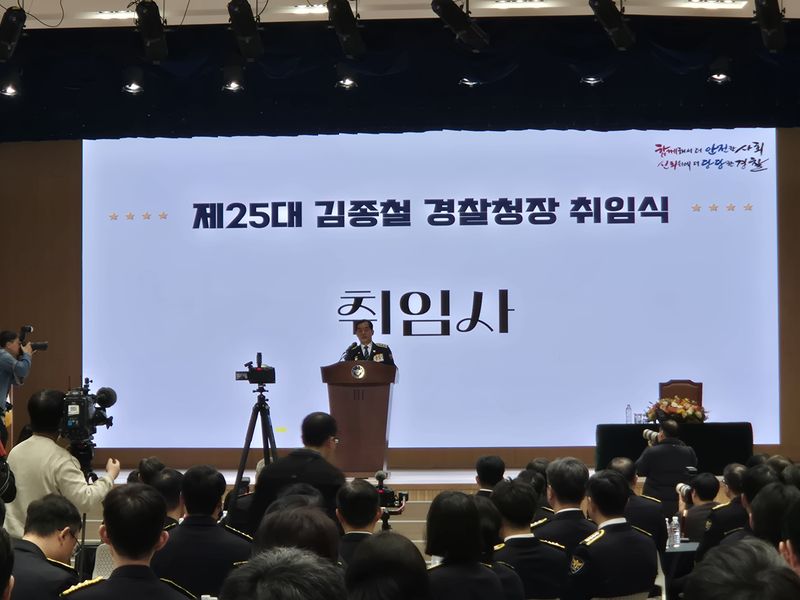
The Korean National Police Agency held Kim’s inauguration ceremony at 10:30 a.m. that day at Chamsuri Hall at its headquarters in Seoul’s Seodaemun District. Around 500 people, including invited guests and police officials, attended the event.
After President Lee Jae-myung approved his appointment on the 20th, Kim officially began his duties as the 25th chief of the Korean National Police Agency. The police have been operating under an acting leadership system since former chief Jo Ji-ho was suspended from his duties in December 2024 over allegations of involvement in the emergency martial law.
In his inaugural address, Kim said, “The police are now facing a serious test,” citing the changing investigative environment, a string of violent crimes and the spread of high-tech crimes as challenges facing the police. He particularly noted that misconduct by some officers had damaged public trust in the organization and stressed the need to restore its fundamentals and principles.
He went on to say, “We will view this reform of the criminal justice system not as an expansion of authority, but as an expansion of our grave responsibilities,” adding, “We will establish the new criminal justice system as soon as possible and make police investigations more trusted.”
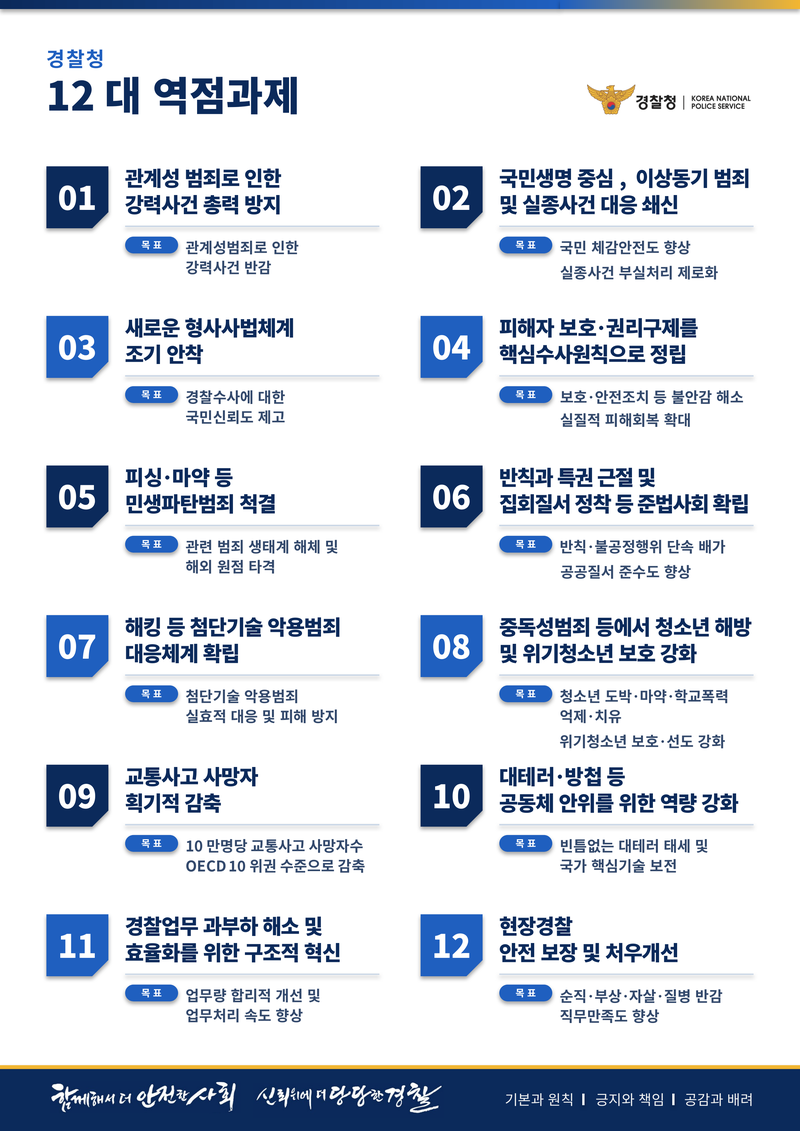
To that end, Kim set out “A safer society through working together, a more confident police force built on trust” as his vision and announced four goals and 12 key initiatives: “Everyday life where everyone feels safe,” “Fair, world-class investigations,” “A society of rules and common sense,” and “A vigorous, prepared police force.”
To prevent serious incidents stemming from relationship-related crimes, the police will establish a Women and Youth Bureau and unify the response system from prevention through investigation. They will strengthen their response to crimes with abnormal motives through scientific analysis and cooperation with local communities, and pursue institutional improvements to prevent mishandling missing-person cases.
He also emphasized protecting crime victims and ensuring redress of their rights as principles of police investigations. Kim said, “We will make protecting crime victims and securing redress of their rights the foremost principle of our policing, and help people who have been hurt get back on their feet as soon as possible.”
Strengthening investigative capabilities to meet the new criminal justice system is another key priority. Kim stressed, “We will build a fair and capable investigative system and turn the public’s ‘question marks’ into ‘exclamation marks.’” The police plan to reinforce internal and external checks to prevent inadequate or biased investigations, as well as increase investigative staffing and adjust ranks. They also aim to provide more transparent updates on the progress of cases and expedite processing procedures.
The police will also step up their response to crimes affecting people’s livelihoods. Kim said they would focus enforcement on unfair crimes, including local corruption, technology leaks and cheating that exploits AI, as well as drug crimes, voice phishing, illegal private lending, cyber gambling and sexual exploitation. They also plan to focus on helping victims recover by confiscating criminal proceeds. The response system for crimes that exploit advanced technology, such as hacking, will also be strengthened.
In particular, Kim visited the Korean National Police Agency’s press room that morning, ahead of the inauguration ceremony, and reiterated his hard-line stance on investigating exam cheating involving AI.
He said, “Fairness in the exams themselves is an important value, but I believe [cheating] is also a serious crime that affects trust in our society.” He added, “We will respond rigorously to cases for which complaints, accusations or requests for investigation have been filed so far, and if cheating occurs in other qualification exams as well, we will track it down to the end, establish the facts and take legal action.”
Asked what would change as he moved from acting chief to officially appointed chief, Kim said he intended to turn the policies he had presented so far into concrete results.
Kim explained, “I have worked closely with my staff for at least two and a half months during my time as acting chief and have presented various visions. I will make sure that the commitments we have made are implemented one by one on the ground and lead to tangible results.”
He also emphasized reducing the workload within the police force and improving officers’ working conditions. Kim pledged to address structural problems that cause excessive workloads for frontline officers and to actively reward outstanding performance. He also plans to protect officers from malicious complaints and unjust lawsuits, and provide institutional support for those injured in the line of duty and their recovery.
Other key priorities include eliminating rule-breaking and privilege, maintaining order at public gatherings, preventing youth gambling and drug use, reducing traffic fatalities, and strengthening counterterrorism and counterintelligence capabilities.
Kim said, “I will devote every bit of the ability I have built up during my 30 years in public service to fulfilling the mission entrusted to me.” He added, “Rather than leave a flashy but easily erased mark, I will quietly lay the foundations for police development that will endure.”
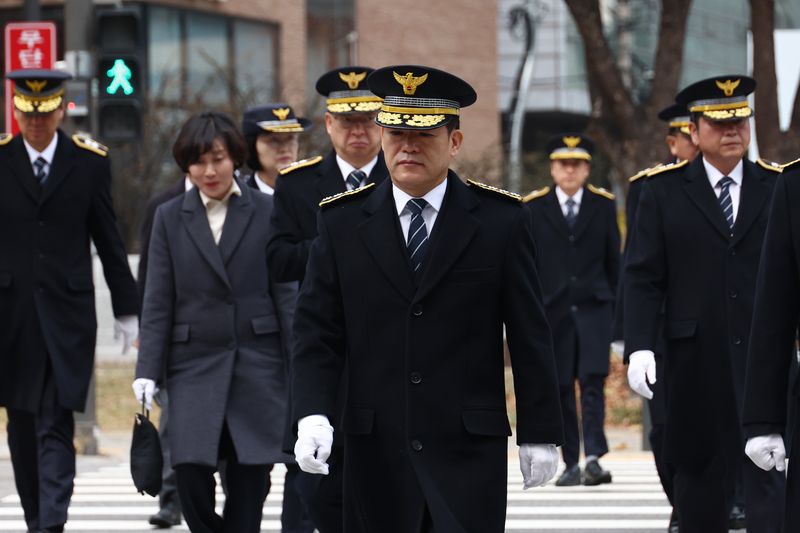
Ahead of the inauguration ceremony, Kim paid his respects at the National Cemetery and the Police Memorial Park, and laid flowers at a bust of Baekbeom Kim Gu. He also met with representatives of the Police Public Officials’ Council and labor unions and expressed his willingness to communicate with them.
After the ceremony, he held a video conference with police leaders from across the country to share the future direction of policing policy. Kim urged them, “Please pool your wisdom and capabilities and swiftly implement policies that people can feel the impact of on the ground.”
[email protected] Kim Ye-ji Reporter