Victory Ceremony Marking the 16th Anniversary of the Battle of Yeonpyeong Island: “Fighting Spirit That Struck Back in Just 13 Minutes Despite a Surprise Attack”
- Input
- 2026-11-23 11:44:28
- Updated
- 2026-11-23 11:44:50
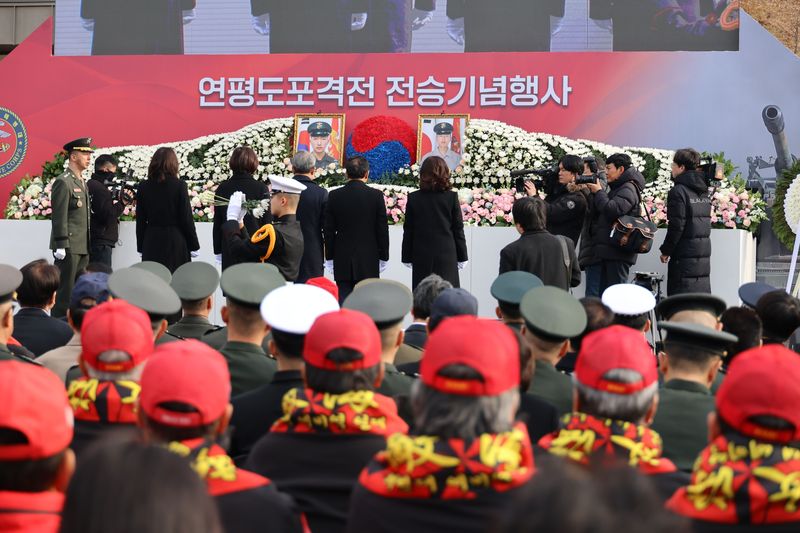
On the 23rd, the Republic of Korea Marine Corps Headquarters held the “16th Anniversary Ceremony Honoring the Battle Heroes and Commemorating Victory in the Battle of Yeonpyeong Island” at the National Daejeon Cemetery, presided over by Marine Corps Commander Ju Il-seok. About 300 people attended, including the families of the late Staff Sergeant Seo Jeong-woo and the late Private Mun Gwang-uk, fellow service members who fought in the battle, Vice Minister of National Defense Lee Doo-hee, former National Assembly member Yoo Seong-min, vice chiefs of staff of the Army, Navy and Air Force, Valerie Jackson, commander of U.S. Marine Corps Forces Korea, and former Marine Corps commanders, to pay tribute to the fallen heroes. Before the ceremony, Commander Ju paid his respects at the Memorial Tower, to those who died in the Marineon incident, and at the grave of the late Private First Class Chae Soo-geun.
In his commemorative address, Vice Minister of National Defense Lee Doo-hee said, “Our military will maintain a readiness posture that enables it to respond immediately to any enemy threat or provocation and ensure victory,” adding, “We will press ahead without disruption with reforms to the quasi-four-service system so that the Marine Corps, a national strategic maneuver force, can strengthen its joint operational capabilities and become a core force in national defense.” Commander Ju Il-seok also emphasized, “We will carry forward the honorable history built through the sacrifice of our two comrades and, through reforms to the quasi-four-service system, build a Marine Corps devoted to defending the nation and repaying the public’s trust with victory.”
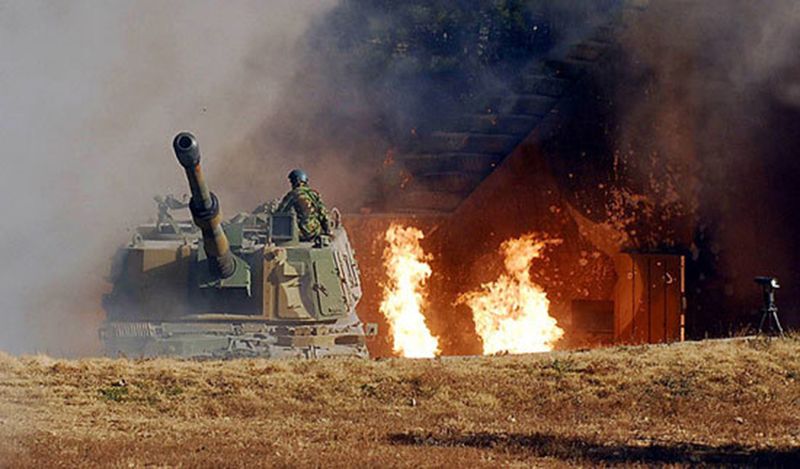
The Battle of Yeonpyeong Island, which broke out at 2:34 p.m. on November 23, 2010, was the first military provocation since the Korean War in which North Korea directly attacked South Korean territory and civilians. Even in the extreme conditions—with communications cut off and flames engulfing the gun positions—service members of the 7th Artillery Company of the Yeon-Pyeong Unit began counterfire with K9 Thunder self-propelled howitzers just 13 minutes after being hit, neutralizing the source of the enemy attack. The devotion to country shown by Staff Sergeant Seo, who was killed while returning to his unit during his final leave, and Private Mun, who completed his mission to the end in his third month of service, along with the fighting spirit of service members who loaded shells while wearing burning helmets, helped pave the way for the incident’s designation to be upgraded in 2021 from “artillery provocation” to the “Battle of Yeonpyeong Island.”
Above all, the Battle of Yeonpyeong Island is regarded as a watershed that drove a fundamental transformation in the military’s readiness posture, going beyond a mere tragic memory. In its wake, the Northwest Islands Defense Command (Seobangsa), the military’s first joint operations command to exercise unified control over Army, Navy, Air Force and Marine Corps forces, was established. Advanced capabilities—including K239 Chunmoo multiple rocket launchers, Spike missiles, counter-battery radars and counter-drone systems—were also substantially reinforced, enabling a multifaceted evolution in the military’s ability to defend the Northern Limit Line (NLL) in the Yellow Sea.
The Marine Corps has designated the period from the 23rd through the 27th as the “Battle of Yeonpyeong Island Remembrance Period” and will operate an online memorial. During this period, all units—including Marine Corps Headquarters, Seobangsa, and the 1st and 2nd divisions—plan to hold special mental readiness education led by their commanders, incident-response drills and resolve rallies to strengthen their determination to fight effectively in real combat.
[email protected] Lee Jong-yoon Reporter