Whip Up Classroom Apps Just by Talking, No Coding Required
- Input
- 2026-11-23 09:29:43
- Updated
- 2026-11-23 09:29:43
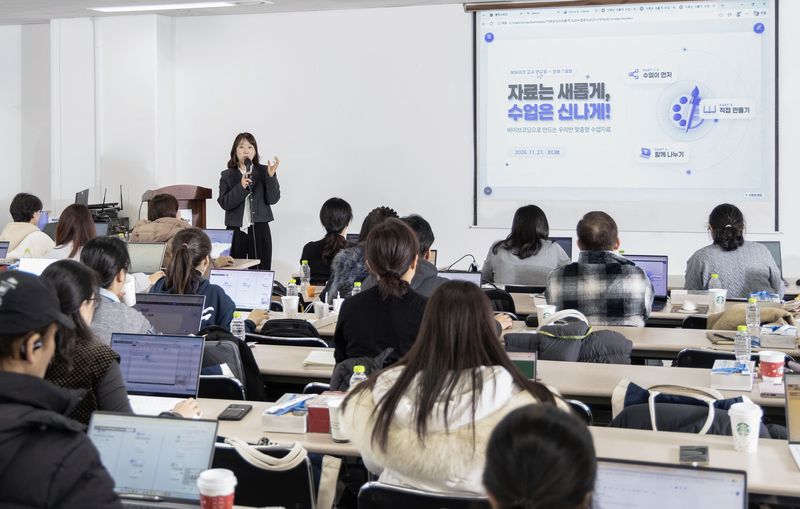
[Financial News] An era is dawning in which elementary, middle and high school teachers with no coding knowledge can converse with generative artificial intelligence (AI) in everyday language and create and use their own programs for lessons and classroom management. Chunjae Education and Chunjae Textbook said on the 23rd that TSHERPA (T-Sherpa), their teaching and learning support service, held the “First Vibe Coding One-Day Class” for in-service teachers at its headquarters in Geumcheon District, Seoul, on the 21st, together with an edtech teachers’ research group, and conducted a hands-on session on making apps without coding.
The training was designed to move beyond the traditional approach of edtech companies distributing software they had developed unilaterally to teachers, and to help teachers create tools tailored to their own classroom environments. The core technology, “Vibe Coding,” is a way to develop programs (web apps) that run directly on the web by telling AI what functions you want in everyday language, rather than using complex programming languages.
Teachers who took part in the workshop used Google’s generative AI Gemini and other tools to turn their ideas into working web apps, even without any coding knowledge. They asked AI for the functions they needed in everyday language, then revised and refined the results to create tools suited to their respective subjects and school levels. The apps they made can be uploaded to the online whiteboard Classboard, where teachers and students communicate in real time, for immediate use in class.
Three in-service teachers who served as speakers shared concrete examples of using Vibe Coding in schools. Jang Ye-rin, a teacher at Choji High School, shared tips on creating apps that reduce repetitive administrative work and improve the quality of English lessons. Choi Areum, a teacher at Simseok Elementary School, presented methods for creating digital learning materials tailored to each class’s characteristics, while Kim Dong-eun, a teacher at Beondong Middle School, shared examples of using AI in classroom management and history lessons.
A Chunjae Education official said, “There has been a strong positive response from teachers because even those without professional software development experience can turn their educational ideas into concrete results,” adding, “We plan to continue expanding hands-on programs focused on real classroom needs, lowering the barriers to adopting new technologies so teachers can respond proactively to the changing educational environment.”
[email protected] Kim Man-gi Reporter