"People Still Climb Mountains, Even With Helicopters" ... Quentin, the Writer Who Proposed an "AI-Free Sanctuary" for Schools [Hong Chae-wan's Global Profile]
- Input
- 2026-11-28 05:00:00
- Updated
- 2026-11-28 05:00:03
[Financial News] A helicopter can take you straight to a mountain summit. Still, people climb mountains on foot because reaching the summit under their own power brings a sense of joy.
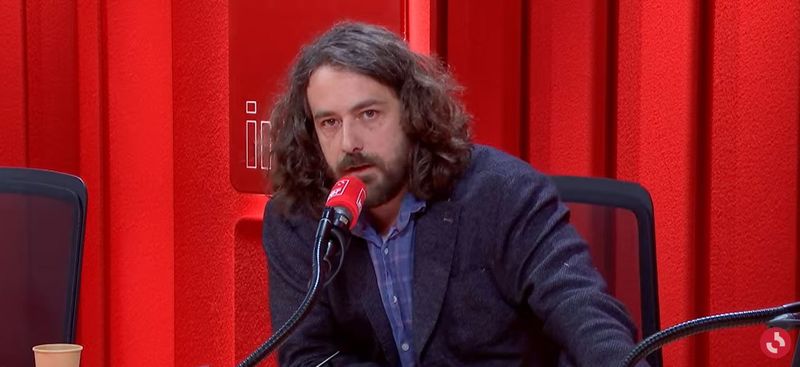
French novelist Abel Quentin likened generative artificial intelligence (AI) to a helicopter that drops hikers off at the summit. When AI provides an answer, the process of finding it for oneself can be skipped; when it writes a piece, so can the process of shaping one's thoughts into sentences. In his essay Sanctuaires (Sanctuaries), published in May, Quentin proposed creating “sanctuaries” at schools, publishers and other places where generative AI would not be used, in order to fully preserve these experiences.
A promise the writer made to readers
Quentin, a lawyer and novelist, first turned his attention to generative AI through conversations in literary circles. At the time, books written jointly by authors and AI were beginning to appear, and the literary figures he met seemed to accept the change with resignation. In an interview with the French outlet Aleteia in June, Quentin noted that the change extended beyond the style of a work to the question of who had written the book.
The first place Quentin identified as one that should be protected as a sanctuary, using his helicopter analogy, was the school. To write a piece, one must decide what to say, put one's thoughts into sentences and revise passages that do not make sense. If the entire process is handed over to generative AI, an assignment can be completed quickly, but students also lose the opportunity to develop their thinking through writing. For this reason, he said schools should be sanctuaries where students are guaranteed the opportunity to organize their thoughts on their own, even if they are still learning how.
The sanctuaries Quentin describes could be places such as schools, publishers or neighborhood movie theaters, but they could also be a work of art or childhood. That is why, as a writer, he promised his readers he would not use generative AI. The human creative process is slow, and its results may not be polished, but Quentin found value in creativity even in those qualities. He described his promise as “an act of expressing pride.”
Seeing the shadows of past growth in today's AI
Quentin says the rapid spread of generative AI reminded him of the past he explored while writing his earlier novel Cabane (The Cabin). Published in 2024, the novel was inspired by the 1972 report The Limits to Growth, commissioned by the Club of Rome. In the novel, four young researchers use computer simulations to find that society could collapse in the 21st century if industry and population continue to grow rapidly. Two researchers step forward to warn of the danger, while another sells their expertise to an oil company. The novel's central concern is arguably the choices people who receive the same results make in response to the warning.
Quentin saw the same mistake being repeated in today's generative AI boom as in the rapid growth of the past that led to an ecological crisis. The examples he cited were today's electricity and water use. At a time when industries need clean electricity to reduce carbon emissions, vast amounts of electricity and water are also being used to expand the AI industry. Quentin likened the attitude of increasing the strain on resources while expecting the technology to solve the problem in the end to “a gambler who has run out of money betting more.”
In this context, one phrase Quentin particularly takes issue with when discussing the spread of generative AI is “It's already here anyway.” He believes this phrase makes AI's spread seem like something people simply have to accept, like the weather. It also narrows the room for discussing where to use AI and where to leave the work to people.
Ultimately, schools can decide which assignments students should try to do on their own, and publishers can establish a principle of publishing manuscripts written by authors themselves. The sanctuaries Quentin proposes are both a call to decide, in each of our own settings, how far to let generative AI in and an appeal to preserve a way to climb mountains under our own power, even now that helicopters can take us to the summit.
[email protected] Hong Chae-wan Reporter