Record of Meju Shipments, Celadon Vase That Held Honey... Special Exhibition in Taean County Marks 50 Years of Underwater Excavation
- Input
- 2026-11-23 09:08:55
- Updated
- 2026-11-23 09:08:55
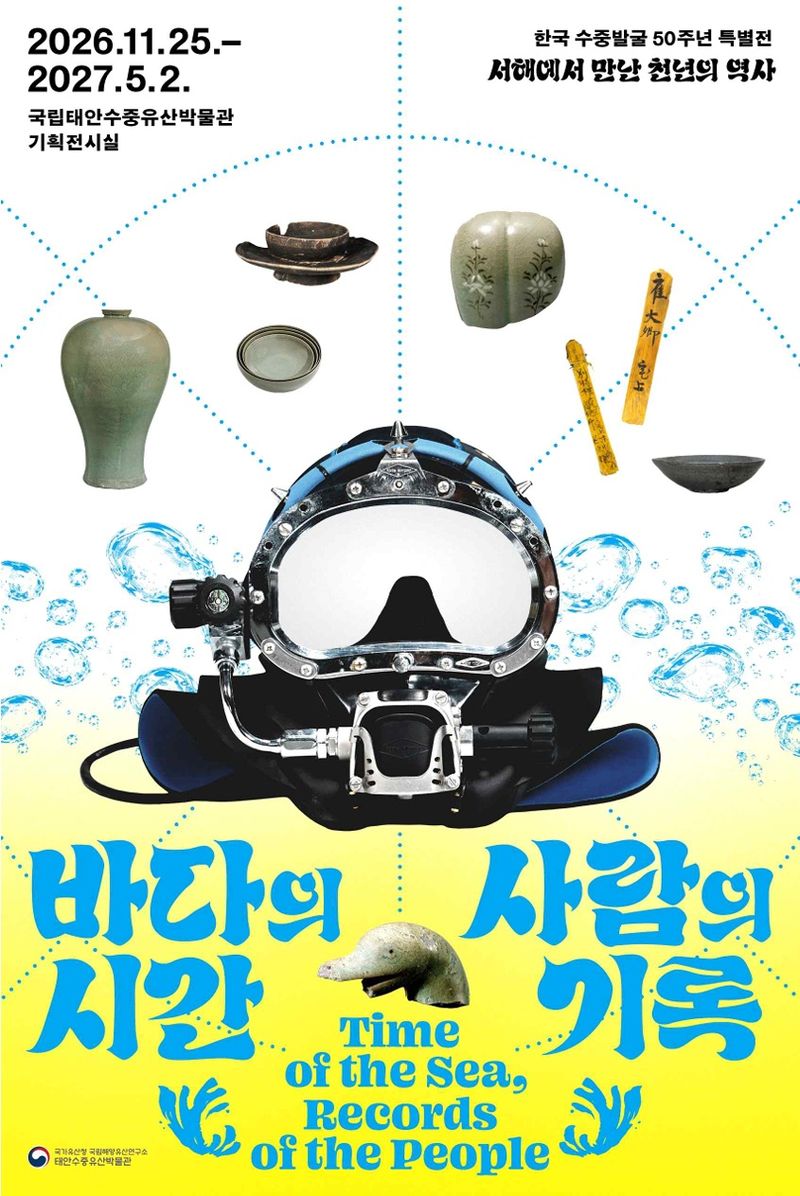
According to the Korea Heritage Service’s National Research Institute of Maritime Heritage on the 23rd, the special exhibition “Time of the Sea, Records of People: A Thousand Years of History Encountered in the Yellow Sea” will run from the 25th through May 2 next year in the special exhibition gallery of the Taean Underwater Heritage Museum. The exhibition centers on artifacts recovered from the Taean Shipwreck, Mado Shipwrecks Nos. 1–4, Daebudo Shipwreck No. 2, and the waters around Wonsando.
Of the 28 wooden and bamboo tablets recovered from the Taean Shipwreck and Mado Shipwrecks Nos. 1–4, 26 had not been displayed because they are sensitive to changes in the environment. The museum will exhibit these artifacts, which have completed conservation treatment, from opening day through Dec. 6. Wooden and bamboo tablets are records inscribed on wood and bamboo, respectively. Those used as cargo tags record details such as where the goods were sent from, who was to receive them, and the type and quantity of items.
A wooden tablet from Mado Shipwreck No. 1 names the military officer Gwon Geuk-pyeong as the recipient of the meju. The ship carried grain collected from areas around Naju, Haenam County, and Jangheung to Gaegyeong, the capital of Goryeo.
The treasure known as the “Celadon Plum-Shaped Bottle with Lotus Stem Design,” recovered from Mado Shipwreck No. 2, was found with a bamboo tablet attached to its neck. The tablet says that honey was being sent to O Mun-bu, who lived in Gaegyeong. A bamboo tablet on another vase found on the same ship says it held sesame oil to be sent to O Mun-bu.
Remains of soybean paste and mussels in a jar, along with persimmon seeds and grains, offer a glimpse of what people ate in the past. Chinese ceramics from the Song and Yuan dynasties with ink inscriptions and jars with handles provide evidence of trade along maritime routes.
Equipment used by researchers at excavation sites is also on display. At the entrance, visitors can see an “umbilical hose” connecting divers to the exploration vessel and the researchers’ “Underwater Heritage Protection Pledge.” The first section of the exhibition introduces sonar, magnetometers, and remotely operated vehicles (ROVs). Operated remotely from a research vessel, the ROVs use cameras and lights to film shipwreck remains and the surrounding seabed, sending footage in real time. The exhibition also uses displays to show work carried out aboard the dedicated excavation vessel Nuri-an.
The starting point of underwater excavation in Korea was the 1976 investigation of the Sinan Shipwreck. A year earlier, Chinese ceramics had been caught in a fisherman’s net while he was fishing off Sinan, South Jeolla Province. The excavation of the Sinan Shipwreck, launched after the discovery was reported, continued for nine years through 1984. Near the end, the exhibition looks back on the achievements of 50 years of excavation and considers the heritage still beneath the sea and the future of underwater archaeology.
Admission is free. The museum is open from 9 a.m. to 6 p.m., with last entry at 5 p.m. It is closed every Monday.
[email protected] Jang In-seo Reporter