Eliminating 'Water Blind Spots' in Tunnel Fires... KICT Develops Rotary Water-Mist System
- Input
- 2026-11-23 08:56:23
- Updated
- 2026-11-23 08:56:23
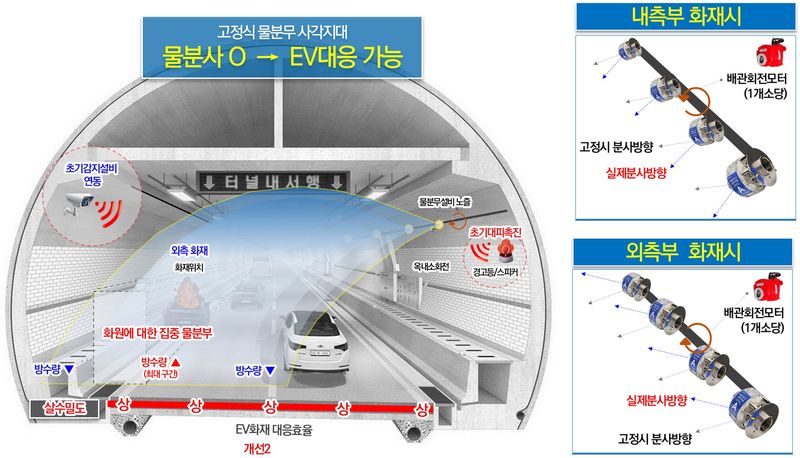
[Financial News] A firefighting technology has been developed that can spray enough water even when a fire breaks out at the edge of the roadway.
According to the Korea Institute of Civil Engineering and Building Technology (KICT) on the 23rd, a research team at its Fire Safety Research Division, led by Yoo Yong-ho, developed a “next-generation water-mist system” that changes the direction of water sprays to match the fire’s location. When connected to CCTV or an automatic fire detection system inside a tunnel, it receives information about where the fire has broken out and adjusts the nozzle direction automatically. It can concentrate the water spray on the fire, or rotate the piping back and forth in an up-and-down motion to distribute water evenly across the full width of the tunnel.
Existing water-mist fire suppression systems spray water through nozzles fixed along the sides. As a result, some areas, such as the shoulder outside the traffic lanes, are not reached by enough water. South Korean standards require at least 6 liters of water per minute per square meter of road surface. However, measurements by the research team at the full-scale tunnel fire test facility of the Fire Safety Research Division in Hwaseong, Gyeonggi Province, found that the existing system fell short of this standard in some areas. The new system exceeded the standard in every area measured, and battery-fire tests also confirmed that it was effective in suppressing the spread of fire.
Fire engines have difficulty entering tunnels, and there are limits to using fire blankets or immersion tanks. That makes the early response of fire suppression systems inside tunnels all the more important. Water-mist fire suppression systems are mandatory in tunnels with a disaster prevention grade of 1 or higher.
As electric vehicle adoption grows, responding to vehicle fires has become a more urgent challenge. According to National Fire Agency data, electric vehicle fires increased 6.6-fold, from 11 in 2020 to 73 in 2024. There have also been cases of electric vehicle fires in enclosed spaces causing extensive damage, such as the fire at an apartment’s underground parking garage in Cheongna, Incheon, in August 2024. With underground road construction increasing, particularly in the Seoul metropolitan area, the need to prepare for tunnel fires is growing.
KICT President Park Sun-kyu said, “This will help ensure a certain level of fire suppression performance or higher, regardless of where a fire breaks out, by supplying water evenly across the entire width of tunnel roadways.” He added, “As underground roads expand, we will work hard to develop fire safety technologies so the public can use them with peace of mind.”
[email protected] Jung Kyung-soo Reporter