“KOSPI Could Even Fall Below 4,000”... Securities Firms Throw in the Towel
- Input
- 2026-11-23 08:59:18
- Updated
- 2026-11-23 08:59:18
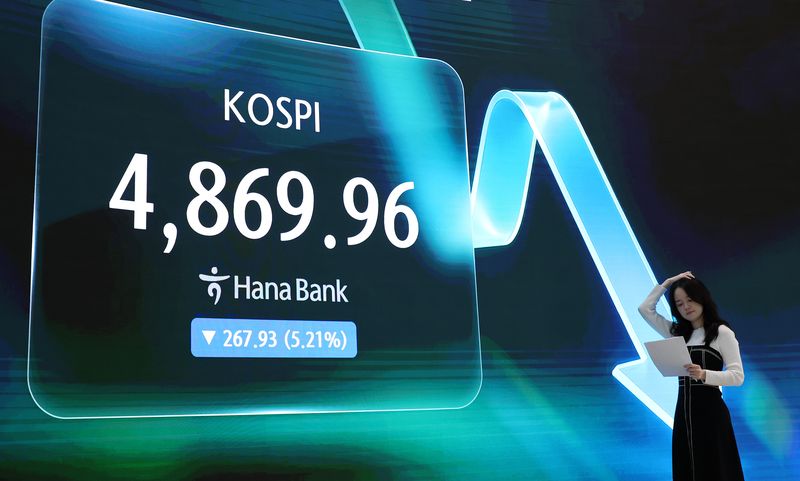
[Financial News] The securities industry’s outlook for the KOSPI is sinking with no floor in sight. Expectations for a year-end rebound have disappeared, and analysts are warning of even the possibility that the KOSPI could fall below 4,000, assuming a shock on a par with the Global Financial Crisis (GFC). The view is that South Korea’s stock market has entered a full-fledged bear market as foreign selling and collapsing investor sentiment dominate the market. NH Investment & Securities’ Research Division said on the 23rd that the KOSPI could fall not only into the low 4,000s but even into the high 3,000s. It pointed out that the shock triggered by NVIDIA that recently roiled the stock market may not be a problem confined to a single company, but could instead be part of a realignment of leadership in the artificial intelligence (AI) industry.
Researcher Kim Yong-gu of Yuanta Securities Korea Co., Ltd. sharply lowered his forecast range for the KOSPI next year to 4,000–7,300, describing the outlook as “a shock comparable to the bursting of the dot-com bubble or the 2008 GFC” and saying, “Uncertain investor sentiment is overwhelming companies’ actual performance and growth prospects, leaving a market in which no positive news has any effect.”
NH Investment & Securities’ Research Division said it expects that “since AI investment itself has not collapsed, the point at which demand is reallocated to Korean semiconductors could provide a catalyst for an index rebound.”
The problem is that there are no buyers left to lead a rebound. According to Hyundai Motor Securities, as of the 20th, the KOSPI’s decline from its peak stood at 46.6%. That was close to the 54.5% drop during the 2008 GFC and the 55.7% decline during the 2001 bursting of the dot-com bubble and the September 11 attacks (9/11 attacks).
Foreign investors’ net sales of KOSPI shares totaled 223 trillion won this year. They sold 190 trillion won worth of shares in Samsung Electronics and SK hynix alone, accounting for about 85% of overall net sales. Individual investors were net buyers of more than 100 trillion won on the KOSPI and bought 54 trillion won worth of domestic equity exchange-traded funds (ETFs), excluding inverse ETFs.
Researcher Kim Jae-seung of Hyundai Motor Securities said, “With the KOSPI below the 5,000 mark, a considerable number of individual investors are likely to be sitting on losses,” and analyzed, “Since they also stepped in to buy the dip around 6,000–6,500 during the second-half correction, their capacity for additional purchases is limited.” He added, “There are no clear buyers to support the index’s downside, making it difficult to expect dip-buying or a rebound.”
The earliest point at which foreign selling pressure is expected to ease was projected to be mid-to-late December. The view is that pressure on market flows may ease only after the U.S. Federal Open Market Committee (FOMC) meeting on the 9th of next month and the fund movements related to Anthropic’s inclusion in major indexes such as the Russell, Financial Times Stock Exchange (FTSE) and Nasdaq 100 are complete.
Researcher Kim said, “I view the FOMC meeting on December 9 and the completion in mid-to-late December of rebalancing related to inclusion in major indexes as important turning points for easing foreign selling pressure,” and advised, “Until clear buyers emerge and a bottom is confirmed, investors should refrain from buying in anticipation of a short-term rebound, preserve their cash reserves and respond accordingly.”
[email protected] Han Young-jun Reporter