KOSPI Plunges 46% From Its Peak... “As Low as the 4,200 Mark in the Worst Case”
- Input
- 2026-11-23 08:46:56
- Updated
- 2026-11-23 08:46:56
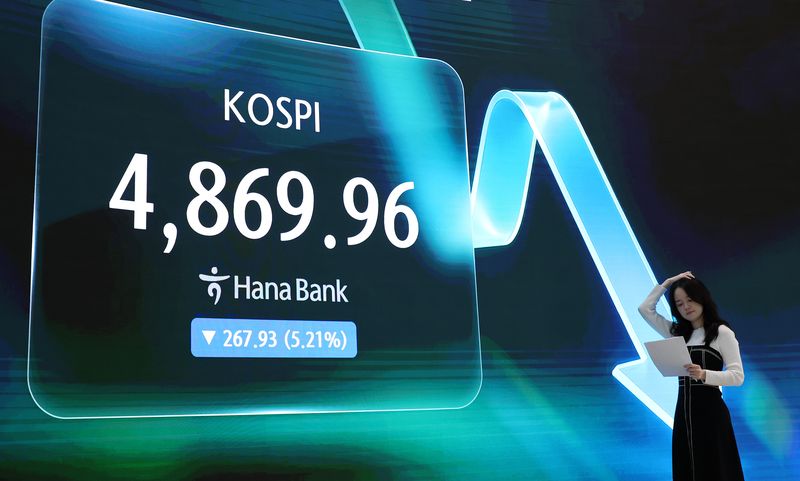
[Financial News] The KOSPI has fallen more than 46% from its peak, and analysts say that in the worst case it could be pushed down to the 4,200–4,300 range. That would be about 12–14% below its closing level on the 20th, based on the assumption that the KOSPI’s price-to-book ratio (PBR) falls to around its low during the global financial crisis. However, analysts say a short-term rebound remains possible, given the steep losses over a short period and the government’s preparations to activate the securities market stabilization fund.
According to the Korea Exchange, the KOSPI closed at 4,869.96 on the 20th, down 267.93 points (5.21%) from the previous trading day. Its closing level was 46.6% below its peak. This time, it took 4.5 months for the index to fall at least 40% from its peak. It took 8.4 months during the collapse of the dot-com bubble, and 10.5 months and 11.5 months during the credit card crisis and the global financial crisis, respectively.
Han Ji-young, an analyst at KIWOOM Securities Co., Ltd., said, “This correction is unusual in that losses comparable to those seen in past financial crises or bubble collapses were concentrated in a much shorter period,” adding, “The fact that the decline was steeper than in any previous case could itself provide a catalyst for a rebound.”
The KOSPI’s 12-month forward price-to-earnings ratio (PER) is 3.4 times, below its low of 6.27 times during the global financial crisis. This is because share prices plunged before earnings forecasts for semiconductor companies were significantly lowered. However, if concerns about the profitability of AI investments and funding uncertainty lead to downward revisions in earnings forecasts, the PER will rise again even if share prices remain unchanged.
Han said, “Doubts about the earnings of AI-related semiconductor companies remain, so it is difficult to identify a bottom based on the PER alone,” adding, “We need to try to identify a valuation floor using the forward PBR, which is less sensitive to changes in future earnings.”
The KOSPI’s forward PBR, which measures share prices against expected net assets, currently stands at about 0.91 times. Applying a lower multiple of around 0.8 times, its low during the global financial crisis, puts the index’s floor at an estimated 4,200–4,300 points.
The market stabilization fund is seen as a short-term supply-and-demand factor. At an emergency meeting on macroeconomic and financial issues (the F4 meeting) on the 22nd, the government decided to review the activation mechanism so it could put the fund into operation depending on market conditions. The specific timing and scale of any deployment have not been decided.
Han said, “We believe that simply sending a strong message to the market that the fund could be activated may help stabilize investor sentiment,” adding, “Given the perception that share prices are exceptionally oversold by historical standards and the possibility of deploying the fund, the worst-case scenario is unlikely to materialize.”
[email protected] Bae Han-geul Reporter