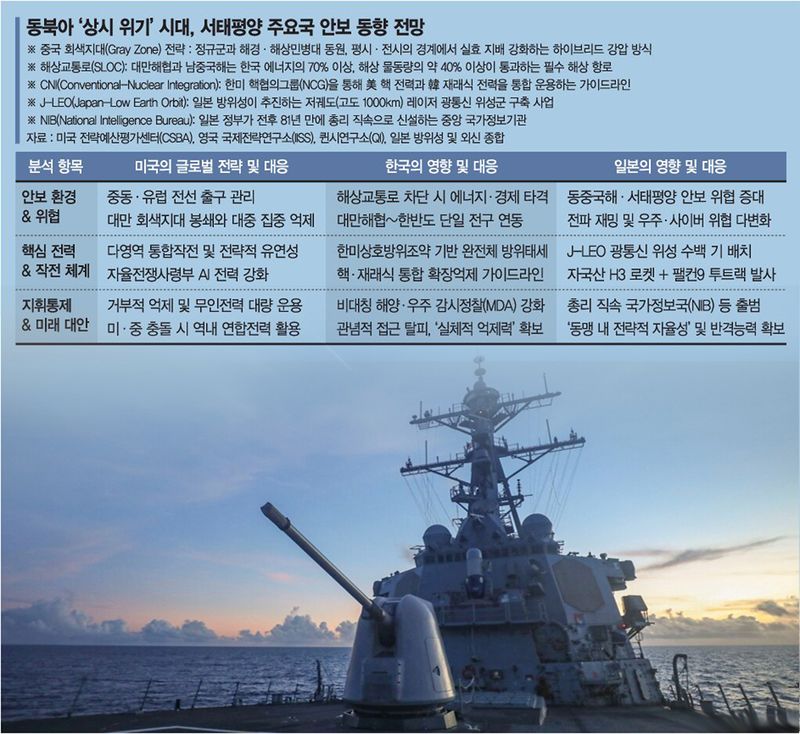
A U.S. Seventh Fleet Aegis guided-missile destroyer, USS Barry (DDG-52), conducts a security operation while transiting the Taiwan Strait in November 2020. As Washington shifts its military center of gravity to the Indo-Pacific, competition for maritime dominance and military tensions between the U.S. and China around the Taiwan Strait and the Western Pacific are also escalating. Provided by the U.S. Navy [Financial News] The history of war has always begun with unexpected chains of reactions spiraling out of control. Just as the ancient Peloponnesian War escalated from a naval blockade, modern geopolitical conflicts do not remain localized either. Beyond the smoke of war in the Middle East and Eastern Europe, the attention of major powers is converging on Northeast Asia and the Western Pacific. As the U.S. shifts its military center of gravity to the Indo-Pacific and the expansion of North Korea, China, and Russia converges, the Taiwan Strait and the Korean Peninsula are beginning to function as a single theater of operations. The assessment that we have entered an era of “persistent crisis,” in which the line between peace and war has blurred, is gaining traction.
■ The Axis of Conflict Shifts from the Middle East and Europe to Northeast AsiaThe essence of the U.S.-China-Russia triangle taking shape after the Asia-Pacific Economic Cooperation (APEC) summit is “selecting and concentrating on fronts.” The U.S. is refining its foreign security priorities with the midterm elections as a turning point. In the protracted Russo-Ukrainian War, it continues to pressure its European allies to share defense costs and strengthen their own deterrence, seeking leverage in negotiations for an end to or freeze of the war. In the Middle East, a clear shift is underway toward “managed deterrence,” using overwhelming military power and AI-driven precision-strike capabilities to contain Iran's nuclear and missile threats. According to analyses by realist think tanks such as the Quincy Institute, the U.S. policy of suspending the Lindsey Graham Act, which imposes sanctions on Russia and Iran, while allowing Russian diesel exports was also seen as a pragmatic use of transactional leverage. The move was intended to stabilize diesel prices in the U.S. and create a strategic off-ramp to bring Moscow to the negotiating table over the Russo-Ukrainian War. Washington's ultimate aim in easing its burdens in the Western Hemisphere and western Eurasia is to concentrate on deterring China. This is also why the U.S. Department of Defense (War Department) emphasizes the “strategic flexibility” of U.S. Forces Korea and U.S. forces in the Indo-Pacific, as well as Combined Joint All-Domain Operations (CJADO).
Russia and China are also demonstrating a strategic partnership linking the Eurasian continent and the Western Pacific in response to these U.S. moves. Under the pretext of joint Chinese-Russian maritime and air patrols, they are making incursions into South Korean and Japanese air defense identification zones over the East Sea and East China Sea increasingly aggressive, routine, and regular. Meanwhile, North Korea's advancing intercontinental ballistic missile (ICBM) capabilities and its deepening military ties with Russia are making Northeast Asia's security equation even more complicated. Beneath the diplomatic talks among the U.S., China, and Russia, an intense military contest is unfolding at the same time, involving advanced reconnaissance satellites, hypersonic missiles, and nuclear submarines.
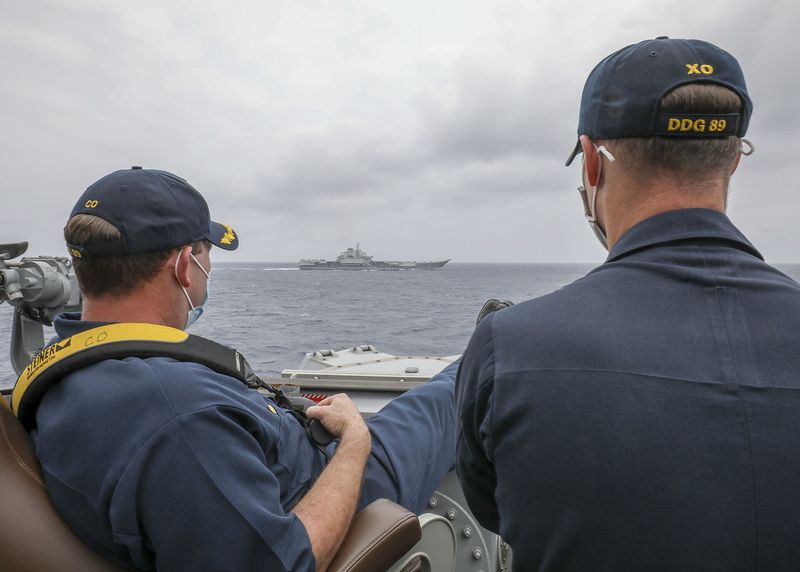
In April 2021, the captain (left) and executive officer of the U.S. Navy Aegis destroyer USS Mustin (DDG-89) keep a close watch on China's aircraft carrier Liaoning as it sails in waters just ahead of them in the Philippine Sea. As close encounters and intense brinkmanship between the U.S. and Chinese navies over control of the Western Pacific become routine, the risk of accidental clashes in the region is also growing. Provided by the U.S. Navy ■ China Opts for a “Starvation Strategy” Instead of a Full-Scale Invasion of TaiwanThe strategic and tactical evolution of China's People's Liberation Army (PLA), evident recently in the Taiwan Strait, is cause for concern. A “full-scale invasion” scenario involving a large amphibious fleet appears to be falling out of favor as the less attractive option. Instead of limiting itself to intermittent provocations, China is employing an advanced “gray-zone blockade and isolation” strategy, using successive, sustained large-scale encirclement drills to suffocate its opponent. Since the 2nd, the Chinese military has staged “combat-oriented joint exercises” in the Taiwan Strait, the South China Sea, and the Western Pacific without prior notice or even announcing the exercise (operation) name. It conducted the largest drills of their kind, deploying about 100 vessels—including carrier groups, missile destroyers, coast guard and maritime militia ships—49 military aircraft, precision-strike assets from the Rocket Force, and unmanned drones to blockade Taiwan. The intensive exercises, which lasted at least 10 days, began a gradual withdrawal on the 18th ahead of the APEC summit in Shenzhen.
Taiwan is an island that relies on seaborne imports for more than 97% of its energy and around 70% of its food. Taiwan's economy could be paralyzed in just a few weeks if the Chinese navy and coast guard were to inspect LNG carriers and container ships entering major Taiwanese ports under the pretext of “law enforcement,” disrupt undersea communications cables, and declare no-fly zones in the skies extending beyond Taiwan's air defense identification zone. The U.K.-based International Institute for Strategic Studies (IISS) noted, “China's gray-zone blockade is the most difficult kind of hybrid threat to counter because it is cloaked in ‘non-war military actions’ that make it ambiguous whether the U.S., Japan, and the Western camp should decide to intervene militarily.” The strategy aims to keep squeezing the lifeline of sea lines of communication (SLOCs) without firing a single missile, until the opponent capitulates from within. Analysts say it is entrenching a “persistent crisis” in the Taiwan Strait, blurring the line between peace and war.
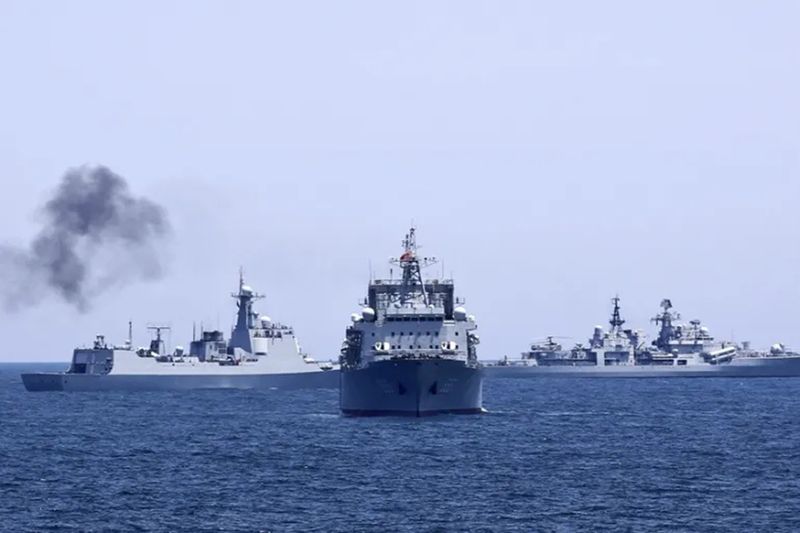
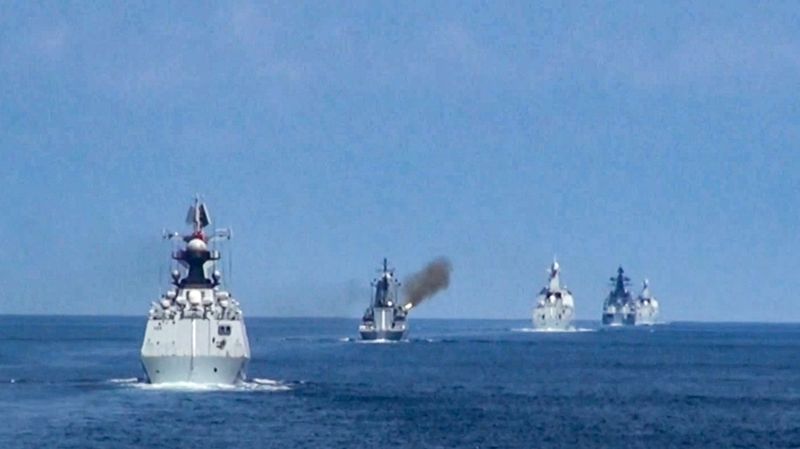
In July 2023, a Chinese Navy missile destroyer and Russian Pacific Fleet forces conduct large-scale joint live-fire and maneuvering exercises in the East Sea. As shows of force by joint Chinese-Russian fleets become more frequent beyond the Taiwan Strait and into the Korea Strait and the East Sea, the maritime security crisis surrounding the Korean Peninsula is also becoming persistent. Provided by the Russian Ministry of Defense ■ The Korean Peninsula Is Not a Distant Problem: A Structural EntanglementThese naval blockades and armed clashes are not someone else's problem. The Korean Peninsula and Taiwan lie on opposite sides of the East China Sea, and about 40% of South Korea's total seaborne cargo volume, along with key energy transport routes carrying Middle Eastern crude oil and natural gas, passes through the Taiwan Strait and the South China Sea. If sea lanes in this region are blockaded, South Korea's export routes for semiconductors and automobiles and its industrial energy supply chains would both take a direct hit. Even from an economic-security perspective alone, a crisis in the Taiwan Strait is directly linked to a crisis for our survival.
The military operational connection is even more direct. If a high-intensity armed conflict breaks out between the U.S. and China in the Taiwan Strait, U.S. Forces Korea's air, naval, and reconnaissance assets, as well as its ammunition stockpiles, are likely to be diverted to reinforce forces in the region. Conversely, from China's perspective, the possibility cannot be ruled out that it would apply direct or indirect pressure—including tolerating or encouraging North Korean limited provocations—to counter U.S. bases in South Korea and Japan, which serve as rear-area logistics hubs and key alliance outposts, and U.S. surveillance and reconnaissance assets. Security research organizations such as the Center for Strategic and Budgetary Assessments (CSBA) have assessed that “the Korean Peninsula and the Taiwan Strait are already linked as a single integrated operational space within the U.S. military's missile defense network and its C5ISRT reconnaissance, command, and control systems.” This means it is not a crisis we can avoid simply by drawing a line and saying, “We will focus only on issues on the Korean Peninsula.” That is why we must face the structural reality that, regardless of our intentions, we will be swept into the heart of a geopolitical maelstrom.
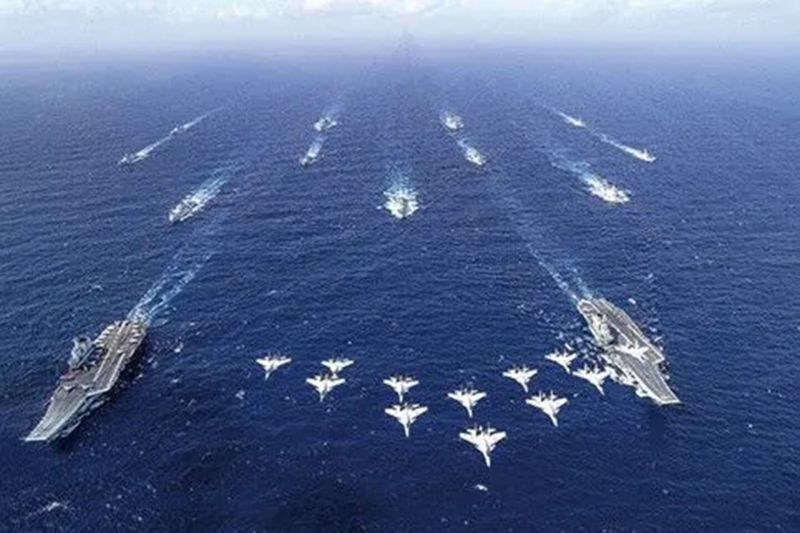
In October 2024, the carrier groups of the Chinese People's Liberation Army Navy's Liaoning (left) and Shandong conduct their first-ever joint dual-carrier maneuvering exercise in the South China Sea alongside formations of J-15 aircraft. By demonstrating the ability to project power across air and sea, they are making the threat of a maritime blockade and the cutting off of supply routes in the Western Pacific in a contingency increasingly concrete. Provided by the Chinese People's Liberation Army Navy ■ South Korea Needs to Redefine Its Strategic Position Around “Credible Deterrence”Now that all of Northeast Asia is turning into a state of persistent crisis, South Korea's security policy must move beyond an “abstract approach” and begin with a clear-eyed understanding of the harsh balance of power. It must accurately read the rapidly changing global battlespace, the balance of forces within the Indo-Pacific theater, and even the strategic intentions behind the surface-level policy shifts of its allies. For South Korea, whose strategic depth is extremely limited, victory or defeat will depend not on command-authority provisions on paper, but on “credible deterrence” capable of detecting an enemy's provocations in a contingency immediately and neutralizing them early, as well as seamless “technological and operational interoperability” among allies. In the face of a complex crisis compounded by North Korea's advancing nuclear and missile capabilities, North Korea-Russia military cooperation, and China's maritime expansion, maintaining the cohesion of the steadfast ROK-U.S. Combined Defense Posture is the first principle of national survival. Japan, for its part, has clearly stated its strategic position that a Taiwan contingency would constitute a crisis for its own survival and that it would move to counter China, while accelerating efforts to secure counterstrike capabilities (long-range capabilities to strike enemy bases) and strengthen its defenses. South Korea, too, must dramatically enhance its own “asymmetric maritime and space reconnaissance and surveillance capabilities” and “ability to protect sea lanes.” The ROK-U.S. Alliance is the world's only fully integrated military alliance, combining an open-ended defense treaty, a permanent integrated command, and extended deterrence (nuclear-conventional integration, CNI). Securing overwhelming advanced defense capabilities and sovereignty in the maritime and space domains on this solid foundation, and contributing to maintaining the global order in a manner commensurate with our national power, is seen as the way to ensure South Korea's security and survival in an era of “persistent crisis.” The thicker the fog, the more precisely the compass must point.
In July 2023, five Chinese and Russian naval vessels in a line formation conduct a joint live-fire naval gunnery exercise in the East Sea. As high-intensity joint operational drills using live ammunition are repeated close to the Korean Peninsula, going beyond a simple show of navigation, the risk of military clashes and security concerns in the region are also growing. Provided by the Russian Ministry of Defense [email protected] Lee Jong-yoon Reporter