Taking Advantage of the Hormuz Blockade... The 'Donroe Doctrine' Makes a Play for Energy Dominance [Global Report]
- Input
- 2026-11-22 18:38:22
- Updated
- 2026-11-22 18:38:22
The Strait of Hormuz was a passageway for one-fifth of the world's crude oil supply, but after shipping was disrupted, pipelines and loading operations in the Red Sea continued to be used. These routes, however, have also been exposed to the risk of attacks by Yemen's pro-Iran armed group, the Houthi rebels. In a report on the 21st, local time, the United Kingdom's Financial Times (FT), citing multinational maritime data provider Kpler, said the volume of crude oil passing through the Strait of Hormuz in the second week of this month was about half the level in the first week.
■ Energy Landscape Upended by Middle East Crisis
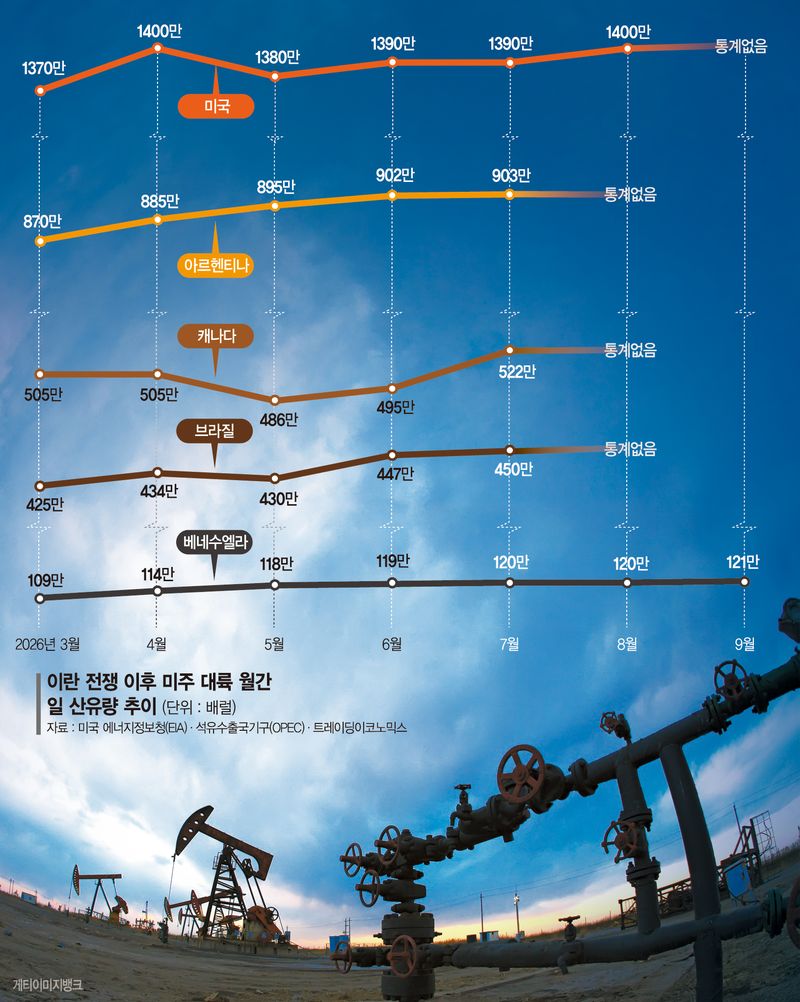
Middle Eastern crude oil exports are now at 80% of their level before the Iran war, and a new region has emerged as a force in the global oil market. That region is the Americas, encompassing North, Central and South America. As supplies of Middle Eastern oil have declined over the past eight months or so, the Americas have emerged as an important source of supply and benefited from the changing global energy landscape.
S&P Global Vice Chairman Daniel Yergin told FT in an interview last month, “Even the Gulf states in the Middle East will seek to diversify through investment in the Americas,” adding, “This crisis is reshaping supply chains and spurring energy development in new regions.”
With the possibility that disruptions to Middle Eastern energy supplies will be prolonged, importing countries are facing a new reality in which they need to secure stable supplies. Taking advantage of this situation, energy exporters across the Americas—from the United States and Canada to Brazil and Argentina—are setting production records. Production in Venezuela and Suriname, which have attracted large-scale investment from Western oil companies, is expected to surge. Meanwhile, U.S. exports of crude oil and petroleum products, including diesel, have also increased by 15%, particularly to Europe, Asia and Oceania. In a report released in mid-October, Norwegian energy intelligence firm Rystad Energy projected that by the end of this year, energy production in countries across the Americas would be 10% higher than it was two years earlier.
Some countries in the Americas, including Venezuela and Argentina, are being reshaped in line with the vision of the so-called “Donroe Doctrine” championed by U.S. President Donald Trump. The strategy aims to build an Americas-centered sphere of influence, backed by abundant energy resources, to counter established global energy powers such as those in the Middle East.
Experts say the energy boom in the Americas is reshaping South America's economic landscape while establishing the region as a powerful counterweight to the Middle East. Although the Americas cannot fully replace the Middle East's low-cost supply, they are expected to moderate global price increases and limit the pricing power of the Organization of the Petroleum Exporting Countries (OPEC).
Attacks on oil tankers and oil infrastructure in the Strait of Hormuz have already reduced global crude oil supplies by more than 2 billion barrels. Supply disruptions originating in the Middle East have driven long-term increases in the prices of crude oil, liquefied natural gas (LNG) and petroleum products. As a result, global investors and customers are moving quickly to diversify their portfolios, including by signing supply contracts with companies in the Americas and increasing investment in the region.
Rystad Energy analyst Schreiner Parker also said, “The increase in production in the Western Hemisphere has taken away the medium-term pricing power of the Gulf Cooperation Council (GCC), including Saudi Arabia,” and forecast that “Venezuela, Argentina, Guyana, the United States and Canada will play key roles.”
■ Investment Picks Up in Energy Producers Across the Americas
Argentina has emerged as the biggest beneficiary as development of Vaca Muerta, one of the world's largest shale oil deposits, begins to pay off. Thanks to active efforts to attract investment by Argentine President Javier Milei, a Trump ally, Argentina's total exports, including oil, topped $10 billion (about 13.46 trillion won) in September for the first time since records began. French energy company TotalEnergies announced a $10 billion investment in offshore development and the expansion of gas projects, while U.S. shale oil magnate Harold Hamm also unveiled plans to invest about $2 billion. In a recent interview with FT, Hamm said, “For global energy security, we need to be able to balance supplies from the Middle East,” adding, “We can expect to see production increase through U.S. energy companies' investment in energy development in South America.” With support from Chevron's investment, crude oil production at Argentina's El Trapial field has increased eightfold over the past three years, from 5,000 barrels per day to 40,000 barrels per day. Chevron plans to invest an additional $13.8 billion over the next 10 years. In September, the U.S. Export-Import Bank (EXIM) announced $7 billion in financing to support the development of Argentina's energy resources and critical minerals.
Since the arrest of former Venezuelan President Nicolás Maduro in January, the U.S. Trump administration has been inviting global oil companies and seeking to attract $100 billion in investment to restore production to 3 million barrels per day, the level before democratization. Venezuela's daily production this year is about 1.2 million barrels, up 10%. Global energy companies including the United Arab Emirates' state-owned Abu Dhabi National Oil Company (ADNOC), Shell and BP have signed initial contracts with the Venezuelan government. Chevron plans to invest $7 billion over five years to more than double production to 600,000 barrels per day.
Canada is drawing attention as a stable investment destination with relatively low geopolitical risk. According to a survey by ATB Cormark Capital Markets, four out of five institutional investors said risks originating in the Middle East had increased their preference for investing in Canadian energy companies.
A Shell-led consortium plans to invest more than $20 billion to expand an LNG plant in British Columbia, increasing annual export capacity to as much as 28 million tonnes. Major projects, including a large pipeline linking Alberta to the West Coast, are also on the verge of receiving a series of approvals.
Energy data firm Wood Mackenzie forecasts that the United States, too, will rapidly increase crude oil production as the Iran conflict drags on. It projects that shale oil production will reach 11.8 million barrels per day by December 2027, about 1 million barrels per day higher than before the war.
Rystad Energy analyst Parker emphasized, “In today's new world order, geographic location has become just as important as geological reserves,” adding, “Oil-producing countries on the Atlantic will be the biggest beneficiaries.”
Ana Simonato, Chevron's director in Argentina, said, “The war in the Middle East has clearly shown the importance of strategic diversification in energy,” and stated that countries in the Americas, including Argentina and Canada, are increasingly becoming a new source of hope for global energy supplies.