Of 40 Forced Delistings This Year, 72% Were on KOSDAQ [KOSDAQ's 'More Listings, More Delistings' Policy Kicks Into Gear]
- Input
- 2026-11-22 18:32:22
- Updated
- 2026-11-22 18:32:22
■ Forced Delistings at Their Highest Since 2013
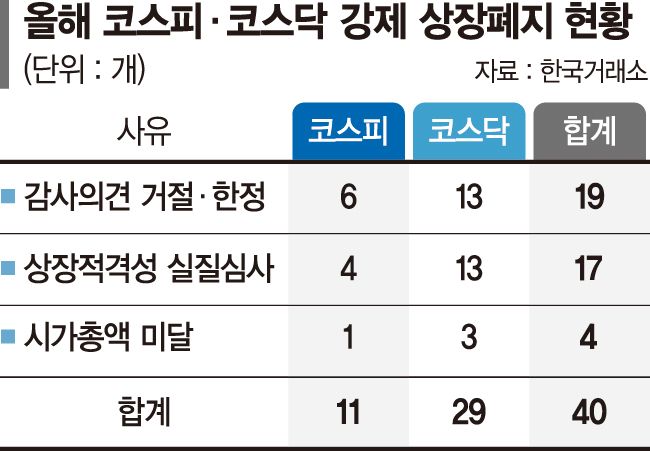
An analysis by Financial News on the 22nd of Korea Exchange (KRX) delisting data found that, from the start of this year through that day, 29 KOSDAQ-listed companies and 11 KOSPI-listed companies had been delisted for failing to meet listing-maintenance requirements. KOSDAQ accounted for 72.5% of the total. Delistings involving SPACs, mergers, dissolutions, or incorporation into wholly owned subsidiaries were excluded from the tally. Even if there are no further forced delistings, the total is already the highest since 2013, when 31 companies were delisted (eight from KOSPI and 23 from KOSDAQ).
From January through September this year, 36 companies were delisted, up 89.5% from 19 in the same period last year. In October, Suseong Webtoon and D.A. Technology were additionally delisted from KOSDAQ, while Busan Jugong and Hanchang were delisted from KOSPI. No companies were delisted for failing to meet listing-maintenance requirements between the start of this month and the 22nd.
By reason, disclaimers and qualified audit opinions accounted for 19 delistings, close to half of the total. Seventeen companies were delisted after undergoing a substantive review of their listing eligibility, which examines factors such as business viability and management transparency, while four were delisted for falling short of the market-cap threshold. From January through September this year, 18 delistings were related to audit opinions, 14 more than the four in the same period last year. Audit opinion-related cases accounted for 14 of the 17 additional delistings over the same period.
■ Market-Cap-Shortfall Delistings a Wild Card; Decision Expected This Month
The minimum market capitalization required to maintain a listing has also risen this year. KOSDAQ's market-cap threshold increased twice, from 4 billion won last year to 15 billion won in January this year and 20 billion won in July. The KOSPI threshold also rose to 30 billion won in July. These changes are part of the financial authorities' 'more listings, more delistings' policy, which aims to help innovative companies go public and accelerate the exit of troubled companies. On KOSDAQ, Koiz and Wonpoong Mulsan were delisted in September, and Suseong Webtoon in October, for falling below the 20 billion won market-cap threshold.
However, after the Seoul Southern District Court granted some companies' applications for injunctions to suspend the effect of their delistings in October, the exchange deferred subsequent delisting procedures for companies designated as administrative issues for falling short of the market-cap threshold. As many as 87 listed companies were designated as administrative issues under the market-cap and share-price thresholds tightened last July. In January next year, the market-cap thresholds are set to rise once more, to 50 billion won for KOSPI and 30 billion won for KOSDAQ. The court is scheduled to conclude its hearing on delistings for market-cap shortfalls on the 27th and is expected to issue a decision as early as this month.
An Yu-mi, a senior researcher at the Korea Capital Market Institute, said, "Some KOSDAQ companies designated as administrative issues for falling below market-cap or share-price thresholds had sound financial conditions. It is necessary to review the results of applying the current thresholds and the characteristics of companies actually delisted, and to continue monitoring the impact of any further increases in the thresholds on companies and the market."
[email protected] Choi Doo-seon Reporter