South Korea Makes Money Only from Goods... “Exports Must Shift to a Model That Also Includes Overseas Investment Income”
- Input
- 2026-11-22 18:27:22
- Updated
- 2026-11-22 18:27:22
According to the Ministry of Trade, Industry and Energy on the 22nd, the increase in trade surpluses resulting from export growth is emerging as a source of trade tensions with major trading partners. This is because those countries are demanding investment, production and job creation within their own borders.
The United States is a prominent example. In connection with the South Korea–United States Tariff Negotiations, South Korea is pursuing strategic investment in the United States with a total cap of $200 billion. Economic cooperation is expanding beyond exporting products to the United States to include investing in local infrastructure and securing business returns. Vietnam and India are also calling for increased local investment and parts procurement, among other things. From January to October this year, South Korea’s trade surpluses reached $47.9 billion with Vietnam, $15.7 billion with India, $6.4 billion with Türkiye and $5 billion with Mexico. Türkiye is understood to have raised even the possibility of withdrawing concessions under the South Korea–Türkiye Free Trade Agreement (FTA) or scrapping the agreement. Kang Gam-chan, head of the Ministry of Trade, Industry and Energy’s Trade and Investment Office, recently said, “It seems the time is approaching to gradually shift the export structure toward investment and to reshape it into a form of industrial cooperation that benefits both sides,” adding, “The United States is a prominent example, and other countries are gradually changing as well.”
Japan offers a precedent for this kind of change. In the past, Japan ran large trade surpluses through manufacturing exports, but as it expanded overseas investment, investment income became a key component of its current account surplus. Analysts say South Korea has also entered the early stages of a similar shift. According to the Bank of Korea report “The Effects of Overseas Investment and Investment Income on Exchange Rates,” South Korea’s investment income balance has remained in surplus since 2011. The report said that although South Korea still relies heavily on its goods balance, the growing share of primary income means “it can be seen as being in the process of moving from a goods-balance-centered structure to one that also includes investment income.”
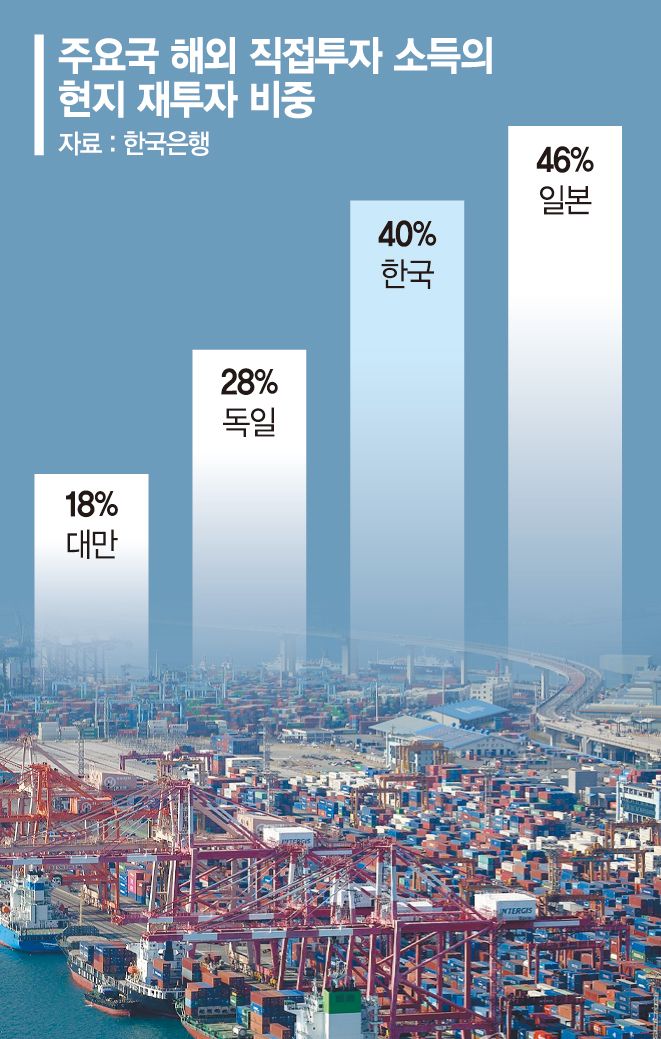
However, expanding overseas investment does not automatically lead to growth in the domestic economy. If profits earned abroad are reinvested locally, income may rise in balance-of-payments statistics while the funds actually flowing into the country remain limited. Since 2010, the share of income from overseas direct investment reinvested locally has averaged 40% in South Korea and 46% in Japan, higher than in Germany (28%) and Taiwan (18%). In other words, increased investment income does not directly translate into a stronger domestic growth base or exchange-rate stability.
Along with bringing profits earned abroad back into the country, maintaining the domestic production base is also considered a key challenge. Kang stressed, “It is necessary to maintain production bases in Korea in the form of mother factories (parent plants), including advanced factories and research and development, while also establishing production capacity overseas.”
[email protected] Ji-young Park Reporter