As Share Prices Slide, Listed Firms Face Delisting Threat... Newly Designated Companies Under Supervision Increase Fivefold [KOSDAQ (Korea Securities Dealers Automated Quotations)’s ‘High Birth, High Death’ Phase Enters Full Swing]
- Input
- 2026-11-22 18:25:23
- Updated
- 2026-11-22 18:25:23
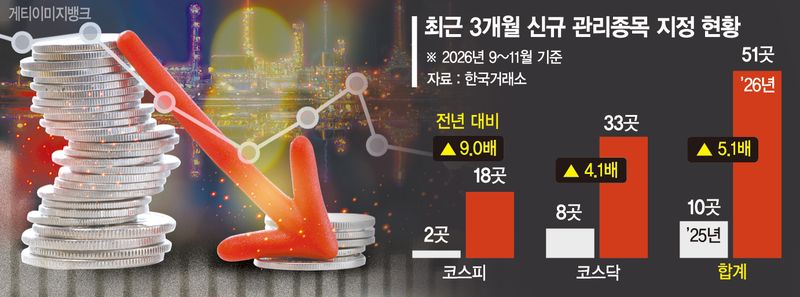
■ A surge in companies falling short of market-cap requirements... Share-price declines threaten continued listing
According to disclosure data from Korea Exchange (KRX) on the 22nd, a total of 51 listed companies on the KOSPI Market and KOSDAQ were newly designated as issues under supervision from September to November this year. That was 5.1 times as many as the 10 recorded during the same period last year. Most of the companies newly designated this year are small- and mid-cap firms listed on KOSDAQ.
A notable feature of recent designations as issues under supervision is that companies are failing to meet market-cap and share-price requirements. On KOSDAQ, until last year, a company was designated as an issue under supervision if its market capitalization remained below ₩4 billion for 30 consecutive trading days. This year, the threshold was raised to ₩15 billion, and it was tightened further to ₩20 billion starting July 1. A new rule was also introduced under which a company is designated if its share price remains below ₩1,000 for 30 consecutive trading days.
In November, NPK, Agent AI and Jinyoung were designated as issues under supervision for falling short of market-cap requirements. Daeho Special Steel was also placed under supervision for failing to meet the market-cap requirement for its class shares.
In the past, designations as issues under supervision were often linked to internal problems at individual companies, such as embezzlement, breach of trust or a disclaimer of an audit opinion. Recently, however, cases in which falling share prices and weakening investment demand in the market lead to risks to continued listing have come to the fore.
■ Net losses abound despite growth in revenue and operating profit
The operating foundations of KOSDAQ companies have not collapsed across the board. According to KRX, the 1,254 December year-end companies included in the analysis posted consolidated revenue of ₩89.8088 trillion in the third quarter of this year, up 21.09% from a year earlier, while operating profit rose 28.41% to ₩4.3897 trillion. However, net results swung from a profit of ₩2.9692 trillion in the third quarter last year to a loss of ₩1.2875 trillion this year. Companies reporting net losses accounted for 57.97% of the total.
This means that quite a few companies have seen their bottom-line profitability worsen despite growth in their overall scale. This is why the market has little choice but to focus on sustained earnings-generating capacity, financial stability and cash flow rather than simple revenue growth.
As investment demand concentrates on a handful of leading sectors, including semiconductors, small- and mid-cap stocks with weaker prospects for improved earnings have fallen out of the market’s attention. Stocks with low trading liquidity can see sharp price swings even when buying demand weakens only slightly, leaving them vulnerable when it comes to defending their market capitalization.
■ Delisting pressure mounts if financing dries up
The problem comes after a company is designated as an issue under supervision. If investors grow more cautious, trading may contract and it may become harder to attract new funds. Raising external financing, including through rights offerings or convertible bond (CB) issuance, can also become more difficult.
If a company that has fallen short of market-cap requirements because of a share-price decline also loses investor demand after being designated as an issue under supervision, it may become even harder to regain the requirements for continued listing.
The problem, ultimately, is a vicious cycle: “poor performance and weakening earnings-generating capacity → declining investment demand → falling share prices → failure to meet market-cap requirements → designation as an issue under supervision → financing difficulties.” As companies approach their year-end closing and external audit season early next year, further risks to continued listing may come to the fore, particularly for those with weak financial health.
A securities industry official added, “With investment demand concentrated in some growth sectors and high-quality companies, small- and mid-cap stocks without support from earnings-generating capacity and cash flow may struggle to defend their share prices and market capitalization. Rather than looking only at whether a company has been designated as an issue under supervision, investors should also assess its actual business competitiveness and ability to maintain its listing.”
[email protected] Kang Jung-mo Reporter