KOSPI’s “Deep Freeze”: Trading Value and Investor Deposits Hit Yearly Lows
- Input
- 2026-11-22 18:09:34
- Updated
- 2026-11-22 18:09:34
According to the Korea Exchange, KOSPI closed at 4,869.96 on the 20th, down 267.93 points (5.21%) from the previous trading day. Foreign investors were net sellers for six consecutive trading days, from the 13th through the 20th. They sold shares worth 5.0593 trillion won on KOSPI during that period.
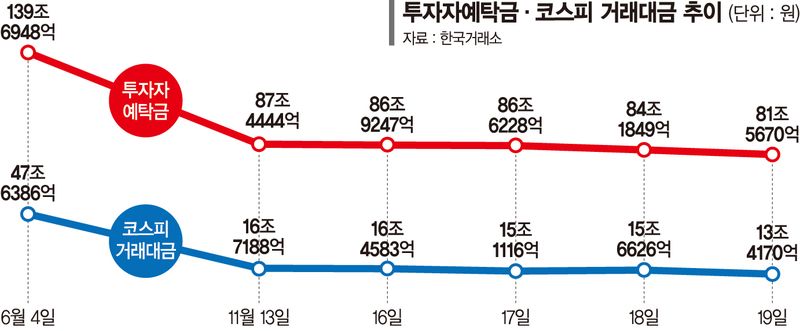
Trading remained subdued even as the index briefly rebounded. On the 19th, when KOSPI topped the 5,100 mark, trading value was 13.417 trillion won, the second-lowest figure this year. The only day with lower trading value was October 26, at 12.9911 trillion won. Trading value reached just 14.9492 trillion won even on the 20th, when the index plunged more than 5%. Average daily trading value from the 16th to the 20th was 15.1197 trillion won, down 17.1% from 18.2429 trillion won the previous week.
As trading slowed, cash awaiting investment in the stock market also fell into the 81-trillion-won range. According to the Korea Financial Investment Association (KOFIA), investor deposits fell for five consecutive trading days, from 92.2347 trillion won on the 12th to 81.567 trillion won on the 19th, a yearly low. That was a decline of 58.1278 trillion won (41.6%) from the yearly high of 139.6948 trillion won recorded on June 4. Investor deposits are funds investors keep in brokerage accounts for stock trading and other purposes, and are a key indicator of cash awaiting investment in the stock market and investor sentiment.
The problem is that, with investor sentiment subdued, there is no clear alternative source of buying to stem KOSPI’s decline. Institutional investors’ weekly net flows (the 16th–20th) also shifted from net purchases of 28.6 billion won the previous week to net sales of 454.7 billion won, while individual investors and other corporations absorbed the shares on offer. Individual investors net bought 2.5785 trillion won on KOSPI from the 16th to the 20th, and their total purchases were 22.3268 trillion won, down 9.8% from the previous week. Over the same period, other corporations’ net purchases on KOSPI totaled 2.3937 trillion won, down 151 billion won from the previous week. Of that amount, 82.8%, or 1.983 trillion won, went into a single stock, SK hynix. Other corporations’ net purchases of all other KOSPI stocks combined, excluding hynix, amounted to just 410.7 billion won.
As the fallout from sharp declines in U.S. semiconductor stocks intensified after the domestic market closed, foreign selling is expected to continue on the 23rd. On the 20th (local time), the Nasdaq Composite fell 5.3%, while the Philadelphia Semiconductor Index plunged about 11%.
Analysts in the securities industry believe the situation will persist for the time being. Regarding Anthropic’s listing, Kim Seong-no, an analyst at BNK Securities, said, “It’s a situation in which other stocks have to be sold to make room for newly listed stocks, which signals that liquidity in the U.S. market is not what it used to be.” He added, “Given this weakening in liquidity, the reality is that foreign selling in the Korean market is bound to continue for the time being.”
[email protected] Joo Won-gyu Reporter