Trading Below 50 Million Won a Day ... Number of Stocks in a 'Trading Drought' Quadruples
- Input
- 2026-11-22 18:09:32
- Updated
- 2026-11-22 18:09:32
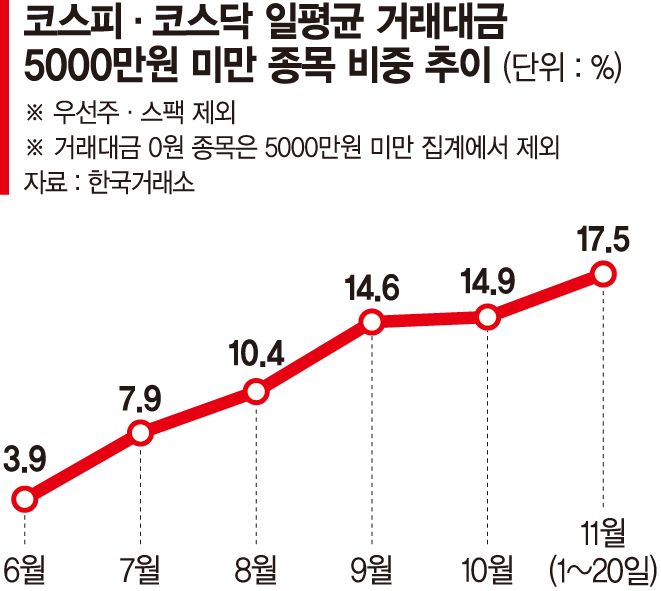
According to the Korea Exchange (KRX) on the 22nd, from the start of this month through the 20th, 453 of the 2,583 stocks listed on the KOSPI and KOSDAQ markets (excluding preferred shares and SPACs) had average daily trading value of less than 50 million won. The figure excludes stocks that saw no trading, including those suspended from trading, and was up 348.5% from 101 in June.
As trading value in South Korea’s stock market has fallen in the second half of the year, liquidity in individual stocks also appears to be drying up. The share of all stocks with average daily trading value below 50 million won was just 3.9% in June, but rose steadily to 7.9% in July, 10.4% in August, 14.6% in September and 14.9% in October, before climbing to 17.5% this month.
By market, the contraction was especially pronounced on KOSDAQ. This month, 363 stocks on KOSDAQ had average daily trading value below 50 million won, accounting for 20.7% of all listed stocks (1,753). In other words, one in five KOSDAQ-listed stocks sees less than 50 million won in trading in a day. In June, there were just 80 such stocks, or 4.6% of the total.
On KOSPI, the number of stocks with average daily trading value below 50 million won rose from 21 in June to 90 this month. Their share of all stocks increased from 2.5% to 10.8%.
Liquidity is drying up even in stocks that were previously actively traded. A total of 520 stocks saw their trading value fall by 80% or more this month compared with June. Of these, 184 recorded declines of 90% or more.
As the trading slump persists, concerns are growing that investors may find it harder to turn their holdings into cash. When trading is thin, there may not be enough buyers to absorb sell orders, making it difficult for investors to sell shares at the prices they want.
An official at a securities firm said, “If there isn’t enough liquidity to support active trading, investors have no choice but to hesitate to invest in those stocks,” adding, “This could once again lead to a contraction in trading, repeating the vicious cycle.”
Securities industry watchers identified a recovery in the weakened supply-demand balance as the top priority for a stock market rebound. They expect a shift by foreign investors to net buying to be a key variable.
[email protected] Seo Min-ji Reporter