Payments in Korea by Foreigners, Overseas Funding ... Securing Use Cases Is ‘Top Priority’ [Korean Won Stablecoin ‘Golden Time’]
- Input
- 2026-11-22 18:08:11
- Updated
- 2026-11-22 18:08:11
■ From Payments by Foreigners to Corporate Settlements
According to the Ministry of Culture, Sports and Tourism on the 22nd, foreign nationals spent 15.9416 trillion won in the tourism sector through September this year, a 47.7% surge from 10.794 trillion won in the same period last year.
The number of foreign visitors to Korea topped 10 million in 2012 and surpassed 20 million this year. The financial sector is also focusing on “foreign visitors to Korea” as a potential user group for won stablecoins.
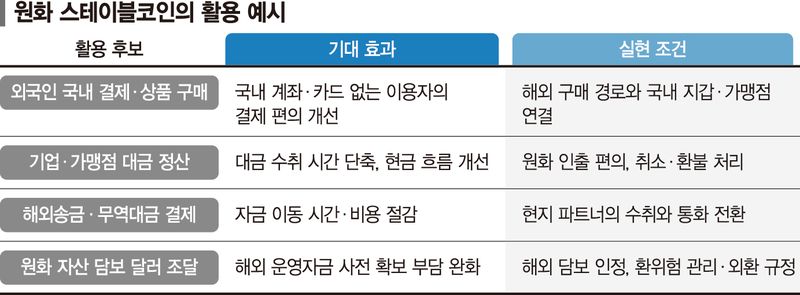
For tourists and international students visiting Korea who do not have a domestic bank account or card, payment access would improve if they could connect won stablecoins to a domestic prepaid wallet and use them. Foreign nationals living overseas could also use won stablecoins to buy cosmetics or K-pop-related products from Korean online retailers.
A bank official said, “In Korea, cards, simple payments and bank transfers are already convenient, so there isn’t much inconvenience for a new payment method to address.” The official added, “By contrast, if overseas users have a way to buy won stablecoins and can use a wallet holding them to pay at domestic merchants or online retailers, won stablecoins will become more useful and see wider use.”
The banking sector sees greater potential for use in business-to-business transactions. That is because the time and cost involved in moving money for supply chain finance, domestic and international payments, and the settlement of sales proceeds directly affect how companies manage their funds.
A bank official explained, “In business-to-business transactions, there are opportunities to reduce time and costs, such as in supply chain finance and payments for international trade. If merchant settlements are also shifted to near-real-time, costs can be reduced while cash flow improves.”
Some have also floated the idea of raising dollars needed for companies’ overseas operations by using won-denominated assets as collateral.
For example, a company could borrow dollars overseas using its won stablecoins or tokenized money market funds (MMFs) as collateral. Rather than sending operating funds to overseas offices in advance, it could raise money as needed, reducing the burden of keeping funds parked in multiple locations. This would only be possible if overseas financial institutions accepted won-denominated assets as collateral and could manage the risks of exchange-rate fluctuations and collateral liquidation. Foreign exchange rules allowing cross-border collateral provision and fundraising would also be needed.
■ It Must Be Cheaper and More Convenient Than Existing Methods
For these potential uses to develop into actual businesses, there must be a viable revenue model for providers that connect customers to won stablecoins. Not only issuers but also wallet and payment providers and overseas partners need incentives to divide up roles and attract customers. They will also need the conditions to test their services and build operational experience to meet emerging demand, such as automated payments using artificial intelligence (AI).
In addition, total costs—including customer verification, currency exchange and redemption into won—must be reduced, and the time it takes to actually receive payment must be shorter than with existing payment networks. Even if merchants receive funds faster, the benefits of adoption will diminish if refunds are difficult when transactions are canceled or goods are returned, or if transferring funds to a bank account is costly.
It is also important to have the infrastructure to easily convert won stablecoins into other currencies. For overseas remittances or payments, local partners must be able to accept won stablecoins and convert them into the required currency in a timely manner. In other words, the competitiveness of won stablecoins must be demonstrated not only at the issuance or transfer stage, but throughout the entire process of completing a transaction.
Jongsub Lee, a professor at Seoul National University, said, “For a business to circulate and take off, there has to be room to earn a margin. If regulation comes to people in the distribution industry only as a very heavy cost, the ecosystem cannot survive.” He added, “Legislation should allow diverse businesses to operate legally and help build an industrial ecosystem. Rather than simply regulating, it should foster the industry.”
[email protected] Reporter Ye Byung-jung Reporter