Chinese Firms Face NVIDIA Chip Shortages... Step Up Efforts to Build AI Chip Supply Chains [Jensen Huang Risk Hits AI Ecosystem]
- Input
- 2026-11-22 18:06:04
- Updated
- 2026-11-22 18:06:04
■ Chinese AI and neocloud sectors both hit
The U.S. business news outlet The Information reported on the 19th, citing people familiar with the matter, that Chinese company Moonshot AI, known for developing the AI model Kimi K3, canceled a contract worth $150 million (about 200 billion won) to use NVIDIA AI semiconductors through a data center in Indonesia. Moonshot AI had planned to lease NVIDIA’s latest AI semiconductor, the B300, from an Indonesian cloud service provider as early as next year. In 2023, the administration of U.S. President Joe Biden barred American companies, including NVIDIA, from exporting high-performance AI semiconductors to China. Chinese AI companies consequently developed and operated AI using neocloud providers that ran data centers based on NVIDIA AI semiconductors in nearby regions such as Southeast Asia and Japan. Neocloud providers build AI data centers and specialize in leasing the facilities’ computing resources to other AI companies.
Moonshot AI canceled the contract because of U.S. government measures blocking access. In an announcement on the 16th, the U.S. Department of Commerce said companies seeking to provide the computing capacity of U.S.-made semiconductors and servers to countries of concern to U.S. national security, including China, must obtain U.S. government approval regardless of where the semiconductors and servers are located. The department warned that existing neocloud providers would also face sanctions in the future if they failed to obtain U.S. government approval within 90 days. In a report on the 21st, U.S. outlet Business Insider (BI) said the measures could undermine the foundations of neocloud companies. BI also said NVIDIA had provided neocloud companies with financial support in the form of advance payments to promote its products, and predicted that the support could be reduced as a result of the Jensen Huang scandal.
Western media reported early this month that former NVIDIA CEO Jensen Huang, who resigned on the 12th, had an affair with 42-year-old businesswoman Alice Huang, who is suspected of being a Chinese spy. They also alleged that Alice Huang used her ties with Jensen Huang to smuggle large quantities of NVIDIA AI semiconductors, whose import into China is banned, into the country, and helped Chinese AI companies such as Alibaba gain access to data centers using NVIDIA products.
■ Chinese big tech firms focus on in-house development
Tencent President Martin Lau, whose company operates the AI model Hunyuan, said at its third-quarter earnings presentation on the 18th that tighter U.S. regulations had made it more difficult for Chinese companies to access advanced computing resources. He added that development of Tencent’s next-generation AI model could also face setbacks in the short term. However, Lau said, “In the long run, all Chinese companies will have to rely on domestic supply chains and domestically made semiconductors,” adding, “China’s semiconductor industry is already developing very rapidly.” Lau predicted, “Because this (U.S.) regulation will inevitably direct all development capabilities toward accelerating the buildout of (China’s) domestic supply chains, the pace will accelerate even further.”
Alibaba CEO Eddie Wu also said at the company’s third-quarter earnings presentation on the 19th, referring to the new U.S. regulations, “Some short-term impact in the early stages of implementation is inevitable, but we will expand our supply chain and shift to large-scale mass production within the next two years.” Wu said, “By 2027, I will ensure that all of Alibaba’s AI model training, including pre-training and post-training, is supported by semiconductors we developed ourselves.”
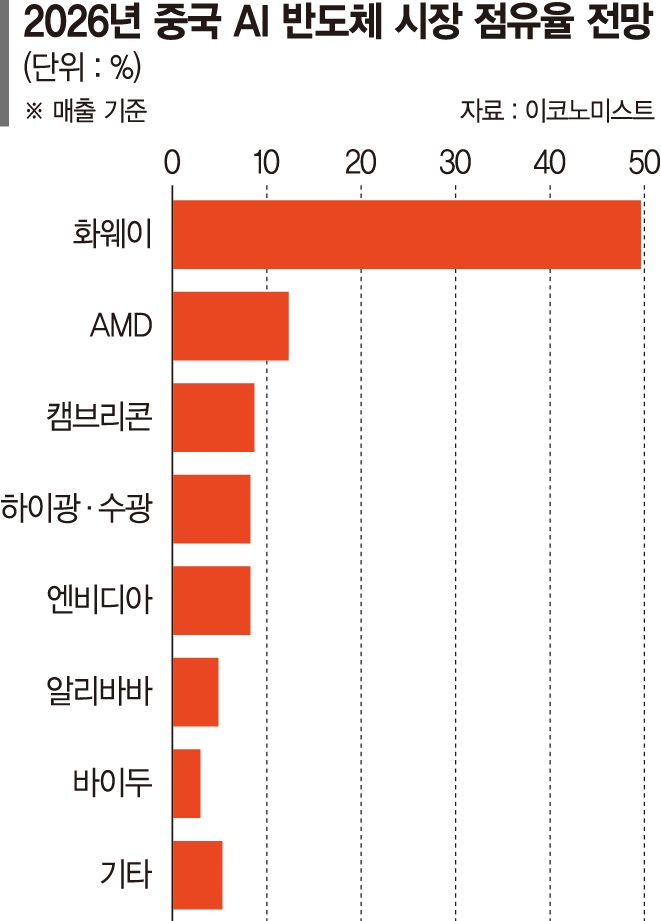
Chinese AI company DeepSeek is training its next-generation AI model, V5, on semiconductors from Chinese company Huawei. Huawei has announced plans to launch new AI semiconductors in 2028 and 2029 as well. However, Chinese AI semiconductors still lag behind NVIDIA’s in performance. According to U.S. research firm Epoch AI, the computing capacity of the data center Huawei built in China’s Inner Mongolia Autonomous Region is only about 7% that of SpaceX’s Colossus 2 data center in Tennessee.
[email protected] Park Jong-won Reporter