Ruling Party: “Cho Hee-dae Impeachment Motion to Pass in the National Assembly by Year’s End”... Timing to Be Coordinated With Budget Schedule
- Input
- 2026-11-22 18:05:09
- Updated
- 2026-11-22 18:05:09
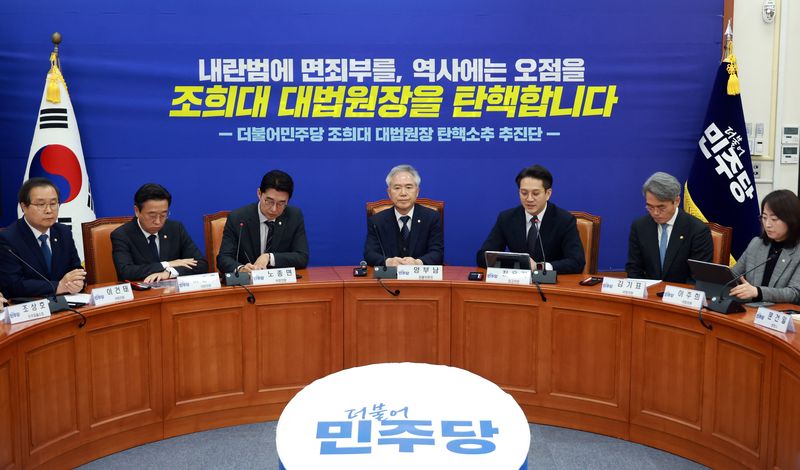
The Democratic Party of Korea’s “Cho Hee-dae Supreme Court Chief Justice Impeachment Task Force” held a press briefing at the National Assembly on the 22nd and outlined its plans for drafting and processing the impeachment motion. Task force head Yang Bu-nam said, “We will finalize the impeachment motion as soon as possible and do our utmost to ensure it is passed by the National Assembly before December is over.”
The task force claimed that Chief Justice Cho had arbitrarily interpreted the Constitution and laws and engaged in political activity through his rulings following the 2024 South Korean martial law crisis. In particular, the Supreme Court’s decision to overturn and remand the case against former Prime Minister Han Duck-soo, who was charged with performing a key role in the insurrection, with a view toward partial acquittal became the decisive trigger for the impeachment drive.
However, the task force made clear that the substance of the ruling in former Prime Minister Han’s case itself would not be cited as grounds for impeachment. This is seen as a response to criticism that impeachment is being pursued to challenge the outcome of an individual trial. Instead, the task force plans to closely examine whether there were procedural flaws in the proceedings leading to the ruling.
The Democratic Party of Korea is also considering as grounds for impeachment the judiciary’s response during the 2024 South Korean martial law crisis, the process by which the Supreme Court overturned and remanded President Lee Jae Myung’s case under the Public Official Election Act, the refusal to renominate a Supreme Court justice candidate, alleged misuse of official operating expenses, and refusal to testify before the National Assembly. The task force plans to review the constitutionality and legality of these matters and reflect its findings in the impeachment motion.
The key issue is when to introduce the impeachment motion. Noh Jong-myun, the task force’s deputy head, said, “Once the motion is introduced, it must be reported at the next plenary session,” adding, “We have no choice but to coordinate the filing schedule with when the budget is processed.” An impeachment motion is reported at the first plenary session after it is introduced and, if it is not referred to the Legislation and Judiciary Committee, must be put to a vote after 24 hours have elapsed and within 72 hours of being reported. If it is not put to a vote within that period, the motion is automatically discarded. The filing of the motion is therefore bound to be directly tied to the plenary session schedule.
A particular concern is that the statutory deadline for passing next year’s budget is December 2. If the impeachment motion also comes before a plenary session in the final stages of budget deliberations, the standoff between the ruling and opposition parties could intensify further and affect the budget’s passage.
Meanwhile, Kim will mark his 100th day in office on the 24th. As Kim himself has made the push to impeach Chief Justice Cho official, the issue has emerged as a major factor in the political landscape after his 100th day. On the 20th, Kim said that although violations of the Constitution and laws by Chief Justice Cho had accumulated over time, he had put off impeachment based on political judgment, but the situation had reached a point where it was difficult to tolerate any longer. He thus characterized the impeachment drive as an unavoidable measure, rather than merely a political choice.
It is also a concern that doubts have been raised even within the party about the effectiveness of impeachment and the timing of the push. Critics say that, since the move was prompted by a Supreme Court ruling, it must be backed by a legal rationale strong enough to dispel controversy that it infringes on judicial independence. In particular, the possibility that calls for the party leadership to take responsibility could emerge if the Constitutional Court rejects the impeachment cannot be ruled out.
The People Power Party is also mounting fierce opposition. It accuses the Democratic Party of Korea of deciding on the outcome of impeachment first and then looking for grounds, and criticizes the move as political pressure on the judiciary. If the ruling and opposition parties clash head-on over impeachment, negotiations on major issues, including extending the retirement age and real estate legislation, could also be disrupted.
Seoul Mayor Oh Se-hoon of the People Power Party criticized the move, saying, “By impeaching Chief Justice Cho, they intend to put the finishing touch on taking control of the judiciary in order to eliminate the president’s trial,” and, “On the day the impeachment motion against the chief justice passes, the train of public judgment bound for President Lee Jae Myung will set off.” The People Power Party held an outdoor rally in Daegu on the 21st to condemn the attempt to impeach Chief Justice Cho. About 40 people, including party leaders and lawmakers from the People Power Party, attended.
[email protected] Kim Hyeong-gu, Lee Hae-ram Reporter