Korean Air Merger to Put More Flights in the Air... Expected Annual Revenue of KRW 300 Billion
- Input
- 2026-11-23 17:17:54
- Updated
- 2026-11-23 17:17:54
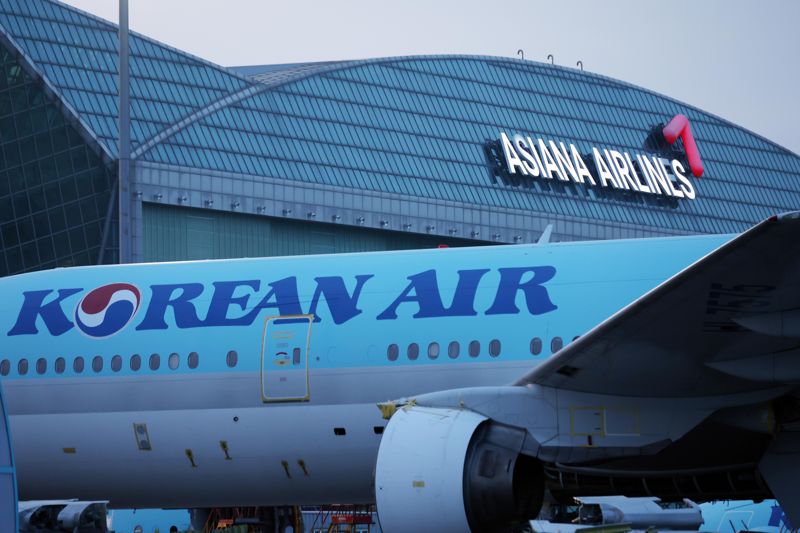
[Financial News] The launch of the combined Korean Air is three weeks away. At first glance, some may worry that choices will shrink, but in fact the combined airline will benefit from synergies that expand both passenger and cargo routes beyond the simple sum of the two airlines’ networks. On that basis, Korean Air forecasts annual revenue gains of at least KRW 300 billion.
Four flights a day to New York, more than when operated separately
According to aviation industry sources on the 23rd, the combined Korean Air will offer a greater variety of flights than the two airlines do when operating separately. With the airlines brought under one operation, it can increase flexibility in departure times, adjust overlapping schedules and rearrange aircraft accordingly, allowing it to increase flight frequencies.A prime example is flights from Incheon International Airport to JFK Airport in New York. Korean Air currently operates two flights a day, while Asiana Airlines operates one. Once the combined airline launches, it plans to rearrange aircraft and routes to increase service to four flights a day. Departures will also be spread evenly between the morning and afternoon.
Flights to Sydney, Australia, and Jakarta, Indonesia, which both Korean Air and Asiana Airlines currently operate mainly in the evening, will be split between morning and afternoon departures once routes are adjusted under the combined Korean Air. Flights to Sydney will depart at 8 a.m. and 8 p.m., and those to Jakarta at 9 a.m. and 3 p.m.
Other major long-haul routes will also operate at least once a day. Flights to Los Angeles (LA) in the US will run four times a day, while flights to San Francisco, Seattle and Honolulu will run twice a day. In Europe, service to Paris, France, will increase to 11 times a week, and service to London, the United Kingdom, to 14 times a week. Flights to Frankfurt, Germany; Prague, Czech Republic; Rome and Milan, Italy; and Istanbul, Türkiye, will also operate daily.
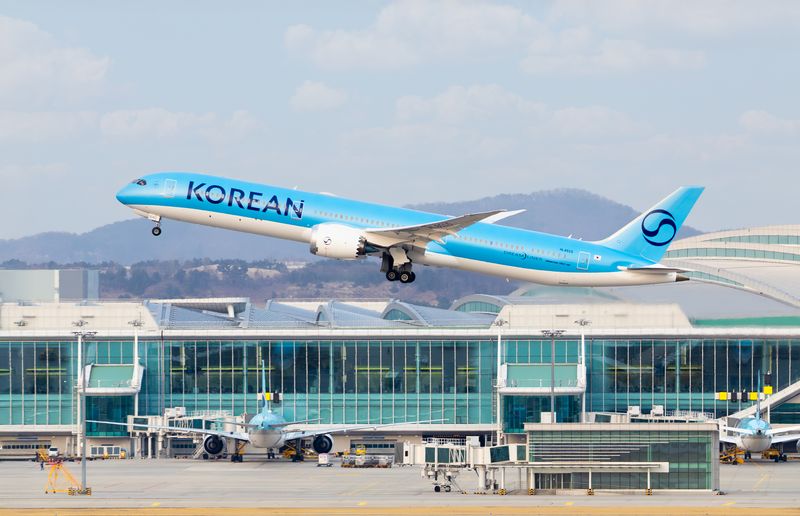
The route network will also expand as 11 international routes, including Barcelona, Spain, and Clark, the Philippines, which Asiana Airlines operated on its own, are added to the combined airline. It also plans to launch new routes to Melbourne, Australia, and Hiroshima, Japan, and increase short-haul services to destinations including Tokyo, Osaka, Fukuoka and Kobe.
With the launch of the combined Korean Air expected to bring a substantial expansion of international services, transfer traffic through Incheon is forecast to surge. Travelers will be able to choose from around 260 flights in total to 13 cities in the Americas, including codeshare flights with Delta Air Lines, as well as routes to 65 cities in Asia, including China. The network also connects to 14 cities in Europe.
Transfers between the US and China are increasing, and large numbers of travelers from the Americas and Europe bound for various Asian countries are also expected to pass through Incheon. Korean Air has already consolidated its operations at Terminal 2 at Incheon International Airport to capture transfer traffic. If the combined Korean Air draws more transfer passengers, low-cost carriers (LCCs) are also expected to benefit.
That is the context behind Hanjin Group Chairman Walter Cho’s confidence, expressed last October at the Asia Pacific Aviation Center (CAPA) Asia Aviation Leaders Summit: “With the merger, we will be able to diversify flight schedules so that they better fit customers’ own itineraries.”
More cargo through transfers from belly cargo to freighters
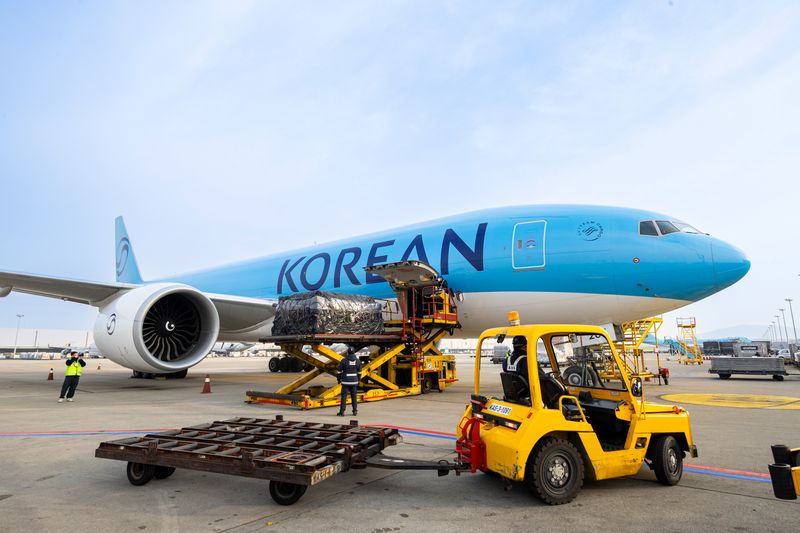
Korean Air plans to maximize the benefits of linking belly cargo with freighters. It will identify additional demand in each region, fill belly cargo holds more fully than before, and generate additional cargo revenue by increasing transfers at Incheon International Airport.
Korean Air completed a renovation of the cargo terminal at Incheon International Airport last month, anticipating a sharp increase in the volume of cargo handled once the combined airline launches. It replaced aging facilities and introduced automated equipment.
Korean Air expects annual revenue to increase by at least KRW 300 billion through greater efficiency in its passenger and air transport operations following the merger. The total volume of air travel demand flowing into South Korea is also expected to grow, bringing the industry along with it. “What stands out about the launch of the combined Korean Air is the synergy built on economies of scale,” an aviation industry official said. “It will boost the global competitiveness of not only Korean Air but also the country’s other carriers, and provide an opportunity for South Korea to become a major aviation hub in Northeast Asia.”
[email protected] Kim Yun-ho Reporter