Moa Town, Rapid Integrated Planning, and Now Min-Dobok Too ... “Policy Proliferation” in Redevelopment [The Shadow of Min-Dobok (Part 2)]
- Input
- 2026-11-24 14:49:11
- Updated
- 2026-11-24 14:49:11
[Financial News] The number of redevelopment approaches for aging residential areas in Seoul has continued to grow, sparking debate over overlapping schemes. This comes as the government has also introduced private urban complex development (Min-Dobok), while the Seoul Metropolitan Government eases restrictions on existing redevelopment programs such as Moa Town and Rapid Integrated Planning.
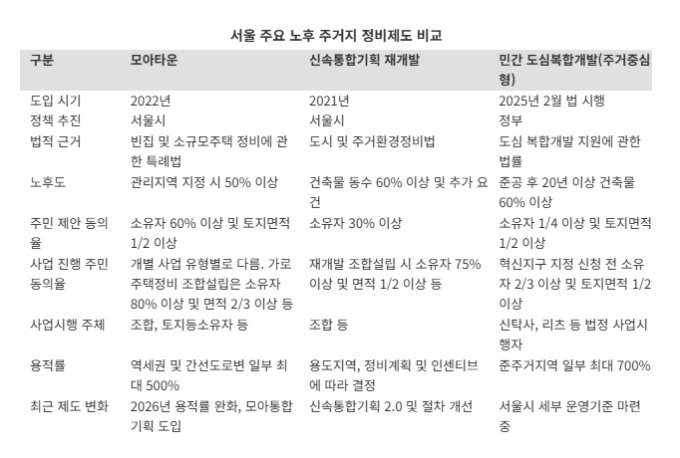
According to industry sources on the 23rd, the main schemes used to develop aging residential areas in Seoul include Moa Town, Rapid Integrated Planning, and Min-Dobok. Although they differ in project scale and who leads them, they share the goal of renewing aging low-rise residential areas and expanding housing supply.
In detail, the schemes differ in their target areas, how they are carried out, and who implements them. Requirements for resident consent, standards for easing floor-area-ratio limits, and approaches to ensuring project viability also vary by scheme, so development conditions may differ even in the same area depending on which one is used.
Although the requirements for each scheme differ, some target areas overlap, raising concerns about confusion among residents. Residents have to compare the consent requirements and viability of multiple schemes, and conflicts could be repeated unnecessarily as development is relaunched under a new scheme even in areas where previous redevelopment projects fell through due to resident opposition.
In Seoul’s Banpo 1-dong, Seocho District, efforts to pursue Moa Town and Rapid Integrated Planning have both fallen through, but there has recently been movement toward development through Min-Dobok. Samjeon-dong in Songpa District also saw a project abandoned or stalled amid resident opposition during earlier efforts to pursue Moa Town, and there has recently been movement to pursue Min-Dobok there.
Industry sources say that projects derailed once by conflict among residents are highly likely to face the same opposition even if the redevelopment approach changes. Questions have been raised about whether relaunching a project under a new scheme is effective without resolving the existing conflict.
Meanwhile, redevelopment approaches are becoming even more complex as regulations under existing schemes are eased and procedures improved.
In July, the Seoul Metropolitan Government eased floor-area-ratio restrictions for Moa Town projects near transit stations and along arterial roads to a maximum of 500%. Then in October, it introduced “Moa Integrated Planning,” which applies the Rapid Integrated Planning approach to Moa Town. Critics say that changes to requirements for existing projects, along with the addition of new development approaches, could make it difficult for residents to assess how the schemes differ and which would be more advantageous.
Professor Ko Jun-seok of the Sangnam Institute of Management at Yonsei University pointed out, “There are far too many types of redevelopment projects. Even if several schemes are integrated and pursued as one, it is difficult to be sure that projects will proceed smoothly.” He added, “Rather than continually introducing new project approaches, it is necessary to consider easing requirements under existing schemes, such as consent thresholds.”
Political factors are seen as one reason for the growing number of redevelopment project types. Moa Town and Rapid Integrated Planning are policies introduced and pursued by the Seoul Metropolitan Government, while Min-Dobok was introduced under separate legislation enacted by the National Assembly.
Professor Ko said, “The question of whether the Seoul Metropolitan Government or the Ministry of Land, Infrastructure and Transport secures the lead role in redevelopment projects also plays a part,” adding, “With responsibility for pursuing policies divided between different bodies, similar development schemes tend to keep appearing.”
[email protected] Choi A-young Reporter