Same KOSPI 4,800 Level, Yet 26 Fewer Stocks in the ₩1 Trillion Market-Cap Club and 7 in 10 Fall
- Input
- 2026-11-22 15:57:34
- Updated
- 2026-11-22 15:57:34
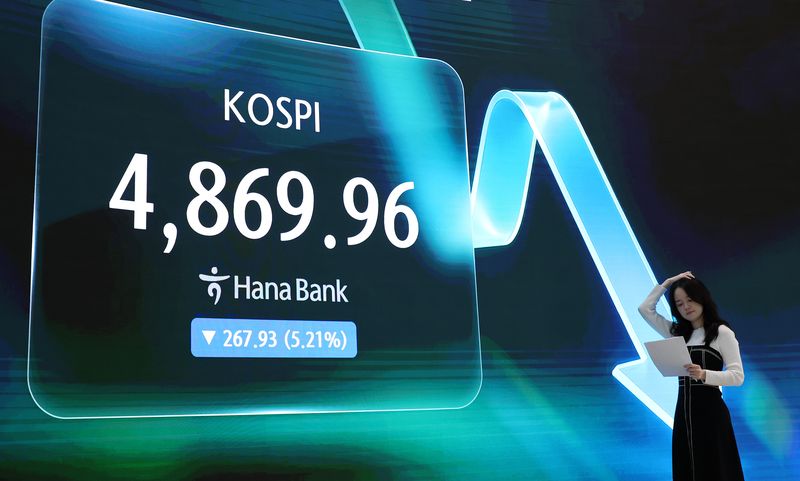
[Financial News] Although the KOSPI has fallen back to around 4,800, a level similar to last January, the number of stocks with market capitalizations of at least 1 trillion won on the KOSPI Market has fallen by 26 from then. Concerns are growing that the market’s overall resilience has weakened, as 7 out of 10 stocks whose prices can be compared between the two points in time remain below their January levels.
According to the Korea Exchange (KRX) on the 22nd, 211 stocks on the KOSPI Market had market capitalizations of at least 1 trillion won on the 20th. That was 26 fewer (11.0%) than the 237 stocks on January 16, when the KOSPI closed at 4,840.74. On the 20th, the KOSPI finished trading at 4,869.96, down 267.93 points (5.21%) from the previous trading day. On a closing basis, it was the lowest in about 10 months, since January 16.
Across South Korea’s stock market as a whole, the number of stocks with market capitalizations of at least 1 trillion won also fell, from 329 on January 16 to 287 on November 20, a decrease of 42. Over the same period, the number of stocks with market capitalizations of at least 10 trillion won fell from 68 to 56. Total market capitalization on the KOSPI Market fell from 4,004.88 trillion won to 3,991.3979 trillion won, dropping below 4,000 trillion won.
The divergence from the index is clearer when looking at individual stock prices. Of the 932 stocks listed on the KOSPI Market on both dates, 671 (72.0%) were down from January 16. A total of 251 stocks (26.9%) rose, while 10 (1.1%) were unchanged.
The semiconductor stocks with the largest market capitalizations remained above their January levels. Samsung Electronics Co., Ltd. rose 23.0%, from 148,900 won to 183,100 won, while SK hynix gained 47.2%, from 756,000 won to 1,113,000 won. The index fell back to a level similar to January, but while the two stocks with large market-cap weights held on to a substantial portion of their gains, many stocks fell below their share prices at the time.
Analysts say that while the KOSPI has returned to a level similar to January, the declines in individual stocks have approached levels seen in past crises. Among the KOSPI 200 constituents, 81% had fallen at least 40% from their respective peaks. That is close to the levels seen during the COVID-19 pandemic (85%) and the Global Financial Crisis (88%).
Lee Jae-man, a researcher at Hana Securities, explained, “Fear triggered by Nvidia can be seen as having reached an extreme level,” adding, “Price corrections in individual stocks other than Samsung Electronics and SK hynix have already progressed to an extreme crisis level.”
[email protected] Bae Han-geul Reporter