Plan to Raise National Share of Firefighters’ Personnel Costs to 30% ... “National-Local Cost-Sharing Ratio Should Be Set by Law”
- Input
- 2026-11-22 15:14:09
- Updated
- 2026-11-22 15:14:09
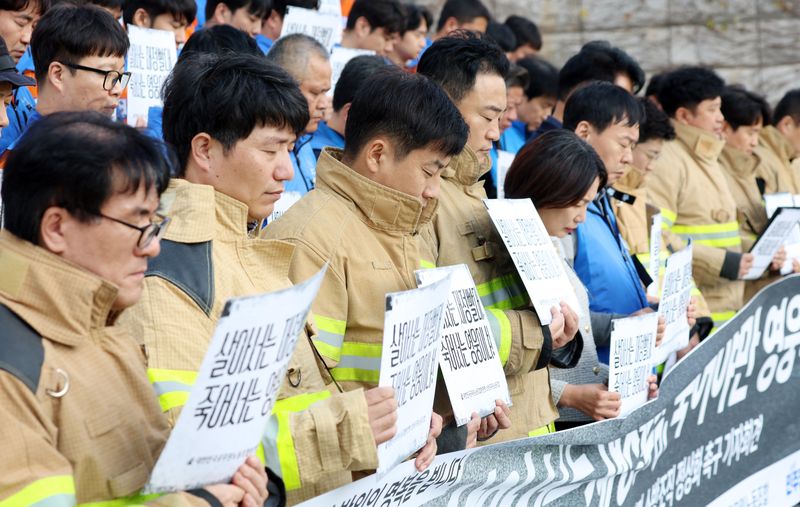
[Financial News] The government has announced plans to expand central government funding for firefighters’ personnel costs, prompting a proposal to set the national and local governments’ respective shares by law and encourage local governments to use personnel-cost savings to invest in firefighting equipment and facilities.
With the National Assembly’s Security and Public Administration Committee newly adding 2.0331 trillion won in personnel-cost support to next year’s budget, plans must also be drawn up to address the fiscal costs of expanding the national government’s share and to ensure local investment in fire services. An analysis found that an additional 17.6232 trillion won would be needed over the next five years even if the national government covered only half the personnel-cost shortfall.
According to the National Assembly on the 22nd, the Security and Public Administration Committee approved a proposal on the 16th to increase funding for firefighters’ personnel costs by 2.0331 trillion won. The measure is intended to ease the personnel-cost burden concentrated on local governments, even after firefighters became national civil servants. However, the increase must still be reviewed by the Special Committee on Budget and Accounts and the full Assembly before it is finalized.
According to a report titled “The Current State of Firefighting Finances and Tasks Ahead,” published by the National Assembly Budget Office (NABO) on the 19th, firefighters’ personnel costs this year totaled 6.5129 trillion won, of which the national government covered 549.6 billion won (8.4%) and local governments 5.9633 trillion won (91.6%). The local share rose 3.8 percentage points from 87.8% in 2021.
Rising personnel costs are also reducing the resources available for investment in firefighting equipment and facilities. This year, fire service budgets for cities and provinces nationwide totaled 8.5968 trillion won, up 1.9075 trillion won from 2021. Over the same period, personnel costs grew by an annual average of 7.0%, while spending on fire policy projects increased by just 0.4%. The share of project spending in the overall fire service budget also fell from 30.5% to 24.2%.
If the current system remains in place, the burden on local governments is expected to grow further. NABO estimates that local governments will cover 6.5152 trillion won (93.9%) of next year’s 6.9377 trillion won in personnel costs, with their share reaching 8.2802 trillion won (94.3%) in 2031.
Expanding the national government’s share will require substantial funding. NABO estimates that if the national government covers 50% of the personnel-cost shortfall—excluding amounts covered by the existing Fire Safety Grant and the Local Resource and Facility Tax—an additional 17.6232 trillion won will be needed from 2027 to 2031. The cost would be 28.1972 trillion won if the share were raised to 80%, and 35.2464 trillion won if the entire shortfall were covered. These estimates were calculated separately from the Security and Public Administration Committee’s increase proposal.
The funding structure is also seen as an area in need of improvement. Current national funding for personnel costs is tied to the individual consumption tax on tobacco, making it difficult to increase support reliably even as personnel costs rise. NABO proposed specifying the scope and share of national and local government contributions in law, as well as covering any decline in the Fire Safety Grant from the national government’s general account. It also said safeguards are needed to ensure that increased central government funding leads to improvements in fire services. If the national government takes on more personnel costs, local governments could reduce the funds they transfer from their general accounts to the fire services.
NABO analysts Lee Ye-yeon and Moon So-hee recommended that “the scope and share of national and local government contributions to firefighters’ personnel costs be specified in law, and that stable funding independent of the individual consumption tax on tobacco be secured.” They added that “it is also necessary to consider setting a minimum for transfers from the general account to the fire policy project budget, so that the reduced personnel-cost burden on local governments resulting from expanded central government funding leads to investment in the fire services.”
[email protected] Lee Bomi Reporter