Trace Gases Left at Fire Scenes Help Detect Signs of Arson... Police and Fire Authorities Hold Joint Training
- Input
- 2026-11-23 12:00:00
- Updated
- 2026-11-23 12:00:03
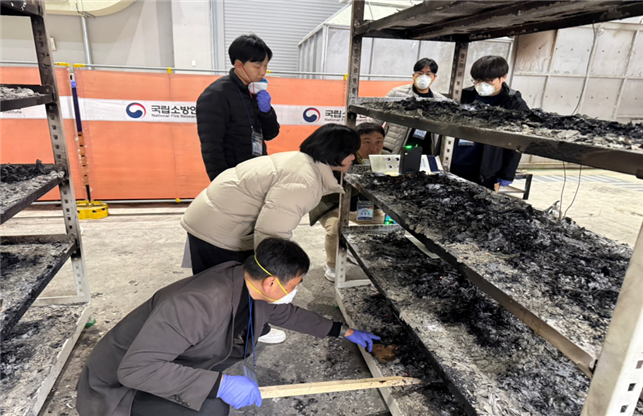
[Financial News] Police and fire authorities held a joint training exercise to analyze trace gas components left at fire scenes, determine whether fuel had been used and estimate the point of origin. The aim was to strengthen their ability to determine the causes of arson by using forensic techniques to secure gas evidence at burned scenes.
The Institute of Public Safety Policy Research at the Korean National Police University, together with the National Fire Research Institute of Korea, held a hands-on workshop using portable gas samplers and a practical challenge at a simulated fire scene over two days starting on the 18th, the institute said on the 23rd.
The event was organized to address arson crimes involving fuel. Forensic investigators from police agencies across the country and fire investigators took part, learning how to use the gas samplers and sharing methods for collecting and analyzing evidence at fire scenes.
Portable gas samplers are devices that collect gas components left at fires, explosions or accident scenes. Analyzing trace amounts of gas collected at a fire scene can help determine whether fuel was used and establish the cause of the fire. The results are used in conjunction with other forensic evidence collected at the scene.
The equipment and collection tubes were developed through a multi-agency research and development project carried out by police and fire authorities from 2017 to 2024. Performance improvements are now being pursued through an upgrade project running from 2024 to 2028.
The exercise simulated an arson involving fuel on shelving in an actual logistics warehouse. Participants collected samples at the scene using gas samplers, estimated the point of origin based on the analysis results, and competed to see how accurately they could locate it.
Teams made up of forensic investigators from provincial and metropolitan police agencies and fire investigators from Daejeon Fire Headquarters reviewed the analysis results together. They assessed whether the gas had been collected from appropriate locations, whether experimental and control groups had been distinguished, and whether samples needed to analyze fuel components had been secured.
The National Fire Research Institute of Korea was responsible for setting up the simulated fire scene, conducting the fire experiments and managing safety. The Center for Forensic Science at the Korean National Police University’s Institute of Public Safety Policy Research handled training in equipment operation, analysis of the collected samples and interpretation of the results.
The Institute of Public Safety Policy Research is accredited by the Korea Laboratory Accreditation Scheme (KOLAS) as a testing laboratory. The accredited testing laboratory system evaluates laboratories’ technical competence in accordance with international standards to ensure the credibility of test results.
Im Hee-jung, head of the Center for Forensic Science at the Institute of Public Safety Policy Research, said, “To clearly establish the facts in fuel-related arson crimes, which have recently become more sophisticated, it is more important than anything to secure flawless evidence at fire scenes and provide scientific proof.” She added, “We plan to actively share advanced fire investigation techniques developed under the institute’s leadership with relevant agencies, including fire services, and continue expanding cooperation between police and fire authorities to strengthen their capabilities in joint field investigations.”
[email protected] Kim Ye-ji Reporter