U.S. Semiconductor Stocks Plunge 10%, Stoking ‘Black Monday’ Fears... Could the KOSPI Slide to 4,700?
- Input
- 2026-11-22 15:51:47
- Updated
- 2026-11-22 15:51:47
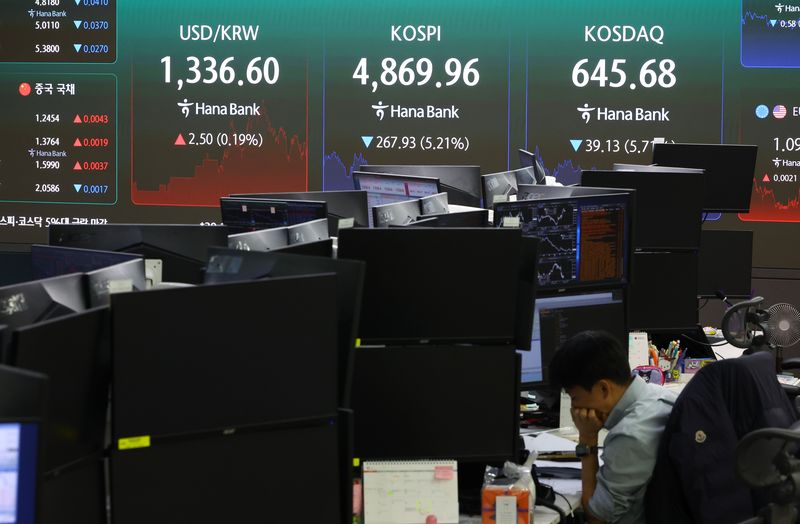
[Financial News] The KOSPI fell nearly 8% last week amid net selling by foreign investors in the 4.5 trillion won range, while the Philadelphia Semiconductor Index plunged more than 10% over the weekend. Concerns are growing that another ‘Black Monday’ could follow if foreign selling concentrates on Samsung Electronics and SK hynix.
According to the Korea Exchange (KRX) on the 22nd, the KOSPI ended last week (the 16th to the 20th) at 4,869.96, down 420.57 points (7.95%) from the previous week. It fell 5.21% on the 20th alone. Last week, foreign investors and institutions were net sellers in the main board market, selling 4.5159 trillion won and 454.7 billion won, respectively. Individuals and other corporations were net buyers, purchasing 2.5784 trillion won and 2.3936 trillion won, respectively.
The concern is the wave of selling on the New York stock market, which opened after the domestic market closed last week. On the 20th (local time), the Nasdaq Composite fell 5.28%, and the Philadelphia Semiconductor Index plunged 10.73%. Nvidia and Micron fell 14.01% and 13.89%, respectively, while SK hynix’s American depositary receipt (ADR) also dropped 13.11%. After Samsung Electronics and SK hynix had fallen 7.01% and 5.92%, respectively, in regular trading on the domestic market that same day, additional headwinds piled up in the U.S. market.
If the KOSPI falls another 3.49% from its closing level on the 20th, it will reach the 4,700 mark. Since Samsung Electronics and SK hynix account for about 49% of the KOSPI’s market capitalization, declines in the two stocks have a significant impact on the index.
According to market analysts, the two stocks accounted for 68% of the KOSPI’s market-capitalization decline from its peak. If foreign investors continue selling after the market opens and losses in the two stocks deepen, it could become difficult to defend the 4,700 level. Conversely, if sell orders are absorbed near the opening price and the declines narrow, the KOSPI could rebound somewhat from its intraday low.
Market analysts say foreign selling in the KOSPI could continue for some time as liquidity in the U.S. stock market weakens. With investors’ available funds so constrained that they have to sell existing holdings to buy the recently listed Anthropic, selling pressure could also mount on Korean stocks, which are relatively low on their investment priority list.
Kim Seong-no, a researcher at BNK Securities, said, “The sharp downturn in global stock markets was affected by the Nvidia issue as well as Anthropic’s listing.” He explained, “Investors are having to sell other stocks to add newly listed stocks to their portfolios, which is a sign that liquidity in the U.S. market is not what it used to be.” He added, “Given this weakening of liquidity, it is true that selling in the Korean market is bound to continue for some time.”
Analysts are also leaving open the possibility of rebound buying on the KOSPI from the 4,500-to-4,700 range, following its excessive decline. The index has fallen from its peak by as much as it did during the collapse of the information technology (IT) bubble, and its forward price-to-book ratio (PBR) for the next 12 months is also close to 1.
Some analysts say the index could rebound if market interest rates fall, one possible consequence of a sharp drop in the index.
Lee Jae-man, a researcher at Hana Securities, said, “One possible consequence of a sharp drop in the index is that market interest rates could also fall.” He added, “If earnings forecasts do not actually deteriorate significantly, lower market interest rates could trigger a rebound in the index.”
[email protected] Bae Han-geul Reporter