The Courtroom Door Is Closed, but the Waiting Room Door Is Open [Puzzling Juvenile Trials]
- Input
- 2026-11-23 06:00:00
- Updated
- 2026-11-23 06:00:04
After stepping down from the bench
“○○○ juvenile is hereby placed under Disposition No. 0.”When I was a judge, I said this sentence dozens of times every week. In 2016, I was in the Juvenile Division of Suwon District Court, and from 2019 to 2022, in the Juvenile Division of Suwon Family Court. Back then, I knew only two juvenile courtrooms firsthand. I had visited Seoul Family Court, Daejeon Family Court, and Gwangju Family Court for academic conferences or seminars, but I had never actually opened a courtroom door and gone inside.
Things changed when I took off my judicial robes and became a lawyer. I began handling juvenile cases and school-violence cases, and appearing at family courts across the country as an “assistant.” Only then did I realize that every family court had its own courtroom size, layout, and atmosphere. Even though they apply the same Juvenile Act, some courtrooms feel like quiet counseling rooms, while others feel like cold interrogation rooms.
I also saw something that had been out of sight from the bench: the waiting room, just outside the courtroom door.
Closed doors: trials without a public gallery
The Constitution says trials must be open to the public. Hearings in juvenile protection cases, however, are an exception. Article 24, Paragraph 2 of the Juvenile Act expressly states that hearings are not public. The aim is to protect the privacy and healthy development of children who are still growing up. As a result, juvenile courtrooms often have no public gallery, or one that is not actually used. The outcomes of dispositions are also generally not made public. But keeping a hearing private does not mean that no one outside the courtroom can learn what disposition was imposed.
Only a handful of people can enter the courtroom: the juvenile-division judge and court staff, the juveniles subject to protective proceedings and their guardians, and assistants like me. The situation is much the same even when the victim’s side wants to observe the hearing. Usually, they are allowed in briefly before it begins, just long enough to have an opportunity to express their views to the court.
The door is firmly closed like this. At least, the courtroom door is.
From No. 1 to No. 10, restrictions on freedom generally increase with higher numbers
Most juvenile cases do not have a separate “sentencing date.” As soon as the hearing ends, the judge announces the disposition in front of the juvenile, their guardian, and the assistant. There are ten possible dispositions, numbered from 1 to 10. In general, higher-numbered dispositions tend to restrict a juvenile’s freedom in daily life more, though it is difficult to compare their nature or burden uniformly based on the numbers alone.
The first dispositions are served while the juvenile lives at home. Disposition No. 1 entrusts the juvenile’s care to a guardian or someone who can protect the juvenile in the guardian’s place, such as a commissioned protection committee member. It lasts six months, and the court may extend it once for up to another six months. There are two types of commissioned protection committee members. “Non-custody-taking” members, who have another guardian in place, meet the juvenile about twice a month to check on their daily life. “Custody-taking” members take in juveniles who have no guardian to care for them, or who cannot be placed with their guardian, and live with them in a group home or similar setting. Disposition No. 2 is an attendance order, requiring the juvenile to receive education or counseling at a probation office, youth counseling and welfare center, or similar institution. The statutory maximum is 100 hours, and it can only be imposed on juveniles aged 12 or older. Disposition No. 3 is a community service order. The statutory maximum is 200 hours, and it can only be imposed on juveniles aged 14 or older. The actual number of hours and the place of service vary by case. For example, the juvenile may perform service at a disability welfare center or a senior welfare center.
Dispositions Nos. 4 and 5 are probation. No. 4 lasts one year and No. 5 lasts two; only the duration differs. They may also come with special conditions, such as “Do not ride a motorcycle,” “Do not go out at night,” or “Enroll in a smoking cessation program.”
From Disposition No. 6 onward, the juvenile leaves home. No. 6 places the juvenile under care at a child welfare facility or another juvenile protection facility. It lasts six months, and the court may extend it once for up to another six months. Since the juvenile must live at the facility, their personal liberty is restricted during that period. Unlike juvenile reformatories, however, some facilities are run by private organizations, and life there is often more like attending a boarding school. No. 7 places the juvenile in a hospital, sanatorium, medical rehabilitation juvenile reformatory, or similar institution. It lasts six months, and the court may extend it once for up to another six months. Dispositions Nos. 8, 9, and 10 involve placement in a juvenile reformatory. No. 8 is for up to one month, No. 9 for up to six months, and No. 10 for up to two years. No. 10 can only be imposed on juveniles aged 12 or older.
The overview is shown in the diagram below.
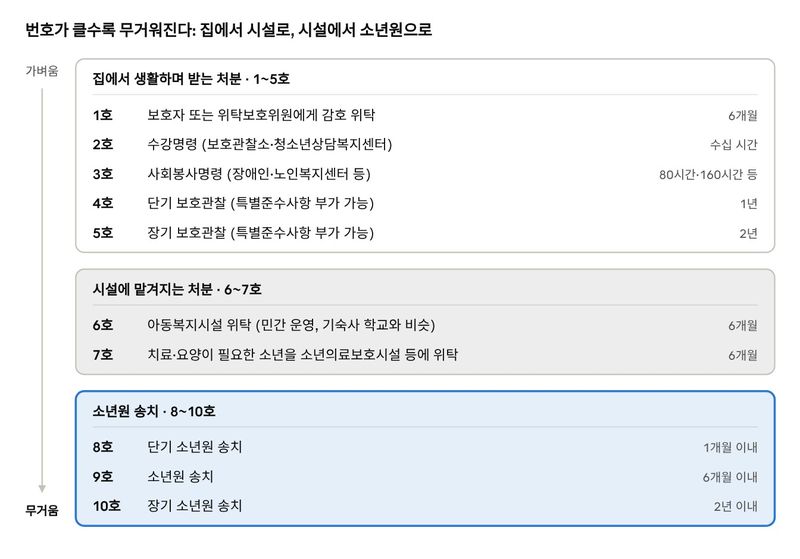
“It’s Disposition No. X.” What comes next?
That is where the problem begins. In court, the judge says, “You are subject to Disposition No. X,” and briefly explains the reason for it. But the judge does not go through every detail: what the disposition entails, which institution will carry it out, or where the juvenile must go and what they must do starting the next day.
It is not because the judge is indifferent. Family courts handle so many juvenile cases that, in practice, it is difficult to explain in detail every time which institution will carry out each disposition and what follow-up steps are involved. Even if the judge explained everything, it would be hard for a juvenile and their parents, tense in an unfamiliar courtroom, to take it all in on the spot. The same goes for lawyers unfamiliar with juvenile cases. To be honest, even I only came to understand how each disposition worked in practice after I had spent several months in a family court’s Juvenile Division.
For the judge, it is a routine repeated every week; for the family, it is the first time they have ever stood in a courtroom. The staff member who explains things in the waiting room outside the courtroom bridges that gap. Usually, two court officers divide the work. The officer inside the courtroom checks the disposition imposed by the judge on a preprinted form. Even frequently imposed special conditions are already printed on it, so they only need to be marked. The note is then passed to the other officer in the waiting room, who carefully explains things to the juvenile and guardian as they leave the courtroom: which disposition they received, which institution to contact and where to go, and how long it will last.
This role has a history of its own. When I first joined the Juvenile Division, there were not enough staff, so private volunteers sometimes took on these explanations. But problems arose, including excessive lecturing, personal feelings getting involved, and inappropriate contact. As I understand it, court staff now handle the explanations themselves. I have also heard that, further back, some lawyers familiar with juvenile cases would stay in the waiting room, kindly explain the procedures, and then discreetly hand out their business cards at the end to take on cases.
In any case, this is how dispositions made inside the courtroom are conveyed outside it.
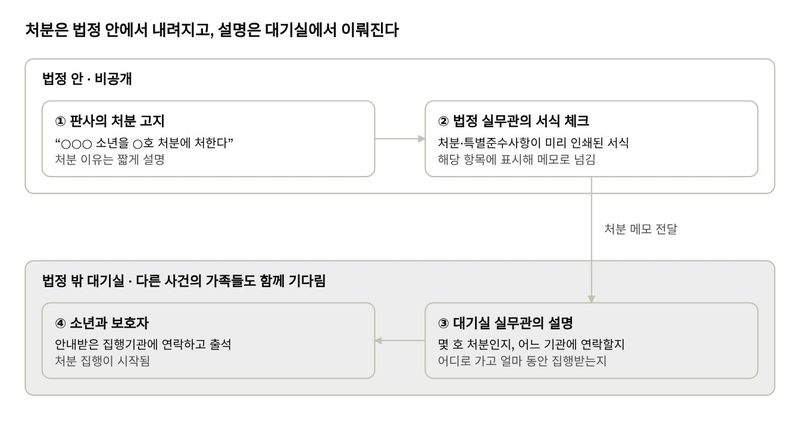
The waiting room’s loophole: “This kid got Disposition No. X!”
Yet it is in this very process that the secret so carefully guarded inside the courtroom quietly slips out.
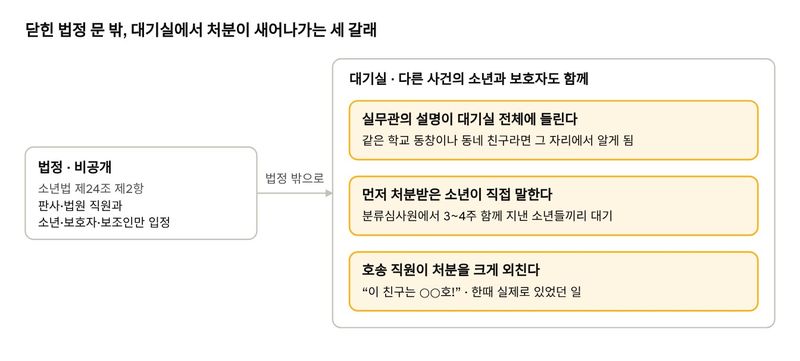
The courtroom door is firmly shut, but details of a disposition can leak out through three routes in the waiting room.
Unlike the courtroom, the waiting room is crowded with juveniles and guardians who have come for other cases. When a staff member explains a disposition to one family, people elsewhere in the waiting room may be able to hear, depending on the volume of the staff member’s voice and the layout of the space. Of course, most people are not interested in someone else’s disposition. Their own names will soon be called, so they are hardly likely to be listening to someone else’s conversation.
But what if the child they run into in the waiting room is a former classmate from the same middle school? What if it is a neighborhood friend they have known for years? At that moment, the disposition details are conveyed to that person in full.
The situation is even more difficult for juveniles who have been placed at a Juvenile Classification and Review Center and return for a continued hearing. They may have spent several weeks together in one place and already know one another’s names and circumstances to some extent. When they come to court, they wait together in a separate waiting room, and sometimes a juvenile who has already received a disposition would tell the others the result themselves. I do not know whether this has since been corrected, but at one time, Ministry of Justice transport staff would bring a child into the waiting room and loudly call out, “This kid got Disposition No. X!” It was as if the courtroom doors were bolted shut while a loudspeaker blared in the waiting room.
As I visit different family courts as an assistant, I have come to pay close attention to this. In my experience, some courts take great care to ensure that disposition details do not leak outside, while in others I have seen what seemed to be a priority on procedural convenience. I cannot say that the legal principle of holding hearings in private applies to the waiting room in exactly the same way. But given the purpose of that principle, care should be taken not to expose disposition details unnecessarily. A partition, a separate space for explanations, or the simple consideration of lowering one’s voice could help.
The school violence committee is no different
Just as courtrooms differ from one family court to another, the School Violence Countermeasures Committee (the school violence committee) differs from one education support office to another. As I have attended committee hearings across the country, I have met two kinds of people.
On one side are chairpersons who lead proceedings with dignity and discipline worthy of a courtroom, and committee members who ask gentle, reasonable questions so that a tense student can open up. On the other side, there are also committee members who push legally untenable arguments and deliberately scold or emotionally pressure students, much like investigators.
The same is true of courtrooms. After traveling around the country for several years, I have built up quite a bit of experience. I have encountered panels that view cases with an open mind and from multiple angles, as well as panels that give the impression they have not reviewed the records thoroughly or that handle proceedings perfunctorily. These assessments are based only on my experience with the panels I have encountered. On days when I appear before the former, I feel at ease regardless of the outcome; on days when I appear before the latter, even the walk to the courtroom feels heavy.
At a school violence committee hearing I attended recently, I met some people who were a welcome sight. They were not simply rushing to get a case off their hands; they first examined the substance of the case from multiple angles and sincerely considered what disposition the student most needed.
Closing the doors of a juvenile courtroom and listening to a student all the way through at a school violence committee meeting ultimately come from the same conviction: that the purpose of this system is not to punish a child, but to help them get back on their feet. I hope to meet more people like that in the courtroom, the waiting room, and the school violence committee’s meeting room.

[email protected] Kim Young-kwon Reporter