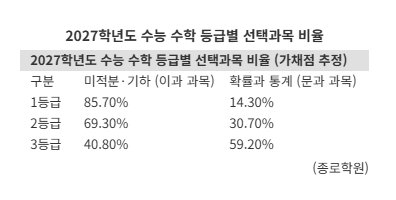
2027 Regular Admissions Also Face Fears of Science-Track Students ‘Invading’ Humanities Departments... 85.7% of Top-Tier Math Scorers Took Calculus or Geometry
- Input
- 2026-11-22 11:22:44
- Updated
- 2026-11-22 11:22:44
Science-track subjects are also expected to have a higher maximum standard score, the score awarded to students who achieve a perfect mark in math. A standard score rises when a test is more difficult or when the average performance of students who chose that subject is higher. This year, the maximum standard score for Calculus and Geometry is projected to be 139, two points above the 137 expected for Probability and Statistics.
As a result, Calculus is set to have a higher maximum standard score than Probability and Statistics for the sixth consecutive year, from 2022, when the integrated CSAT for humanities and science tracks was introduced, through this year. The gap between the two subjects’ maximum standard scores was 3 points in both 2022 and 2023, 11 points in 2024, 5 points in 2025, and 2 points in 2026.
Lim Seong Ho, head of Jongro Academy, said, “Top students with strong math skills are concentrated in Calculus and Geometry, and seem to have solved math problems better this year too than those who chose Probability and Statistics.” Lim predicted, “With the CSAT’s ability to distinguish among students weakening in Korean and strengthening relatively in math this year, the trend of science-track students, who include many high math scorers, cross-applying to humanities departments in regular admissions will continue.”
Competition in regular admissions is expected to intensify further this year, the final year in which the current college admissions system applies. Major universities are also running unified admissions tracks that select new students without distinguishing between humanities and science tracks.
Lim said, “In unified admissions tracks that do not distinguish between humanities and science, large numbers of students who chose Calculus and Geometry, which tend to yield relatively higher math scores, are likely to be admitted.” Lim advised, “Because this is the final admissions cycle under the current system, science-track students are likely to engage in intense strategic calculations. Humanities-oriented applicants should carefully weigh the chances of cross-applications by science-track students and the relative advantages and disadvantages created by the math-score gap when developing their regular-admission strategies.”
[email protected] Kim Man-gi Reporter