CSAT’s ‘Visual Monitoring’ Breached... Will Advanced Equipment Such as Radio-Wave Detectors and Jammers Be Deployed Next Year?
- Input
- 2026-11-22 15:15:03
- Updated
- 2026-11-22 15:15:03
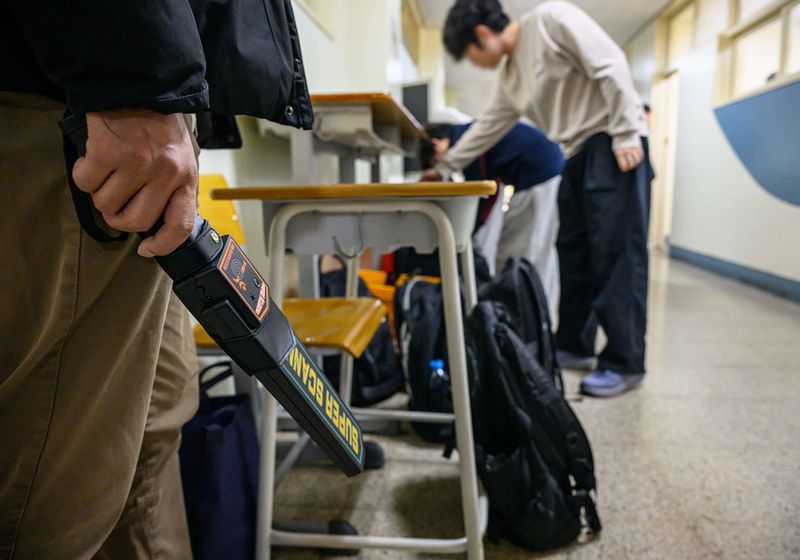
[Financial News] With cheating using advanced devices such as miniature cameras and smart glasses uncovered during the 2027 College Scholastic Ability Test, calls are growing for the full introduction of advanced proctoring equipment, including radio-wave detectors and jammers, starting with next year’s CSAT. Critics say the limitations of “analog, visual monitoring” were starkly exposed despite the government’s all-out effort, which included adding proctors and conducting full inspections of clothing and glasses.
According to education officials on the 22nd, this year’s CSAT saw intensive management and supervision, including the addition of about 8,400 proctors and stickers being placed on collar buttons. However, authorities failed to prevent the entry of cleverly concealed high-tech devices. Complaints are pouring in from schools that there are clear limits to teachers’ ability to detect evolving methods of cheating with their own eyes.
Kang Ju-ho, chairman of the Korean Federation of Teachers’ Associations (KFTA), criticized the process, saying, “Revised instructions, such as ‘only graphite pencils may be used,’ did not arrive until late in the afternoon on the eve of the CSAT, leaving schools in considerable confusion until the morning of the exam.” He added, “Telling teachers to catch examinees armed with advanced devices using only their eyes is no different from telling us to fend off people coming with guns and knives with our bare hands.”
Calls are growing, particularly among politicians and teachers’ organizations, for the full-scale introduction at every test site of advanced security equipment, including radio-wave detectors and jammers, heat-shielding devices, and metal detectors. Kang proposed, “In addition to revising laws and regulations to allow the introduction of radio jammers, a provisionally named ‘National Exam Security Center’ should be established under the prime minister to centrally manage specialized personnel, equipment, and budgets.”
Education authorities, by contrast, say that although they already implemented feasible technological measures this year, major legal and practical obstacles stand in the way of full searches on the scale of airport security or the blanket introduction of equipment. Radio jammers, in particular, could conflict with the current Radio Waves Act’s ban on interfering with communications, while also raising concerns about infringing on the communications rights of nearby residents and disrupting emergency calls.
Lee Hae-suk, director of the Ministry of Education’s Higher and Lifelong Education Policy Office, emphasized, “At this CSAT, too, we combined what people can do with technological measures, including sending disaster alert messages, detecting and blocking Wi-Fi, and using metal detectors on examinees displaying suspicious behavior, in addition to visual monitoring.”
Regarding calls for every examinee to undergo a full inspection using security gates and other equipment at the entrance to each test site, Lee explained, “Body searches require a separate legal basis. Searching each of the 300–400 examinees at a test site one by one at the entrance would take a long time, creating the problem of having to completely revise the CSAT timetable itself.”
Lee added, “Under the coordination of the Office for Government Policy Coordination, we plan to discuss at an interagency level ways to ensure fairness in national examinations, including the CSAT.” She said, “We will take a comprehensive look at the spatial limitations of schools and the set exam procedures, while keeping open the possibility of introducing these measures, and will develop additional feasible technological safeguards before next year’s CSAT.”
[email protected] Kim Man-gi Reporter