Chinese-Made EV Share in Korea Climbs to 33.9% in Four Years... 'Golden Window' for Domestic Production Tax Credit Nears
- Input
- 2026-11-22 13:35:32
- Updated
- 2026-11-22 17:22:01

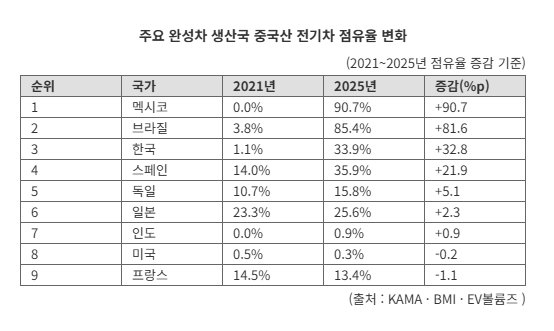
[Financial News] As South Korea has emerged as the third-fastest among the world's major auto-producing countries in terms of the penetration of Chinese-made EVs, calls are growing for urgent tax support to protect the domestic auto production base. With the United States and Japan moving to protect their own auto industries through tariffs and tax credits, critics say South Korea must not miss the golden window to introduce a domestic production tax credit.■ Chinese-made EV share in South Korea surges 32.8 percentage points in four yearsAccording to statistics from the Korea Automobile & Mobility Association (KAMA) and global research firms on the 22nd, Chinese-made EVs accounted for 1.1% of South Korea's electric vehicle market in 2021 and 33.9% last year, a sharp 32.8-percentage-point increase in four years. Among the world's 10 largest auto-producing countries, as ranked by the International Organization of Motor Vehicle Manufacturers (OICA), the increase was the third-largest after Mexico (90.7 percentage points) and Brazil (81.6 percentage points), excluding China.
Unlike Mexico and Brazil, which have served as production bases for global automakers, South Korea has built an independent industrial ecosystem centered on domestic brands such as Hyundai Motor Company and Kia Corporation, spanning research and development, production and employment, raising particular concern. If Chinese-made EVs accelerate their encroachment on the market, the impact could spread beyond domestic automakers to the entire upstream and downstream industrial chain, including parts, materials and batteries.
Major auto-producing countries are already taking active steps to protect their domestic industries. The United States imposes a total tariff of 127.5% on Chinese-made EVs, while the European Union (EU) applies tariffs of up to 45.3%. France has overhauled its EV subsidy program to favor vehicles produced locally. Since 2024, Japan has provided a tax credit of 400,000 yen per domestically produced EV.
Amid these policy responses, the market share of Chinese-made EVs fell by 0.2 percentage points in the United States and 1.1 percentage points in France. Japan's increase was limited to 2.3 percentage points. South Korea, by contrast, applies only its 8% basic tariff to Chinese-made EVs. Given its export-dependent industrial structure, the country is also in a difficult position to use trade measures as stringent as those adopted by major economies.■ 'Domestic production tax credit' emerges as a practical responseAccordingly, a domestic production tax credit that provides tax benefits for EV production in South Korea is emerging as a practical response.
The tax subcommittee of the National Assembly's Finance, Economy and Planning Committee is currently discussing a proposal to include EVs among those eligible for the domestic production tax credit. Lee Hyoung-il, Deputy Prime Minister and Minister of Economy and Finance, also said during a visit to the technical research center of Hyundai Motor Company and Kia Corporation on the 2nd that he would give thorough consideration to related support measures during discussions in the National Assembly.
As of 2024, the auto industry accounted for 14.1% of the value of shipments in South Korea's manufacturing sector and generated approximately 1.56 million direct and indirect jobs. Maintaining an EV production base is therefore directly linked not only to the competitiveness of automakers but also to protecting domestic manufacturing and jobs. Experts stress that, as Chinese-made EVs become increasingly price-competitive, institutional foundations to support domestic production should be established early.
Professor Kim Pil-su of Daelim University College's Department of Future Automotive Engineering said, “It is fortunate that discussions are moving toward bringing the auto sector, which was initially excluded, back into the tax-credit program, but the key is what rate the actual credit will be set at,” and stressed, “The government should not stop at tax credits; it should implement a range of measures in parallel, including support for auto-parts companies, research and development (R&D) cost assistance, and easing financing burdens, to create an environment conducive to production and investment in South Korea.”
[email protected] Kim Dong-ho Reporter