Cheong Wa Dae Responds to Opposition Criticism of 'Frequent Overseas Trips': 'Look at the Frenetic Diplomacy of Foreign Leaders'
- Input
- 2026-11-22 11:06:22
- Updated
- 2026-11-22 11:06:48
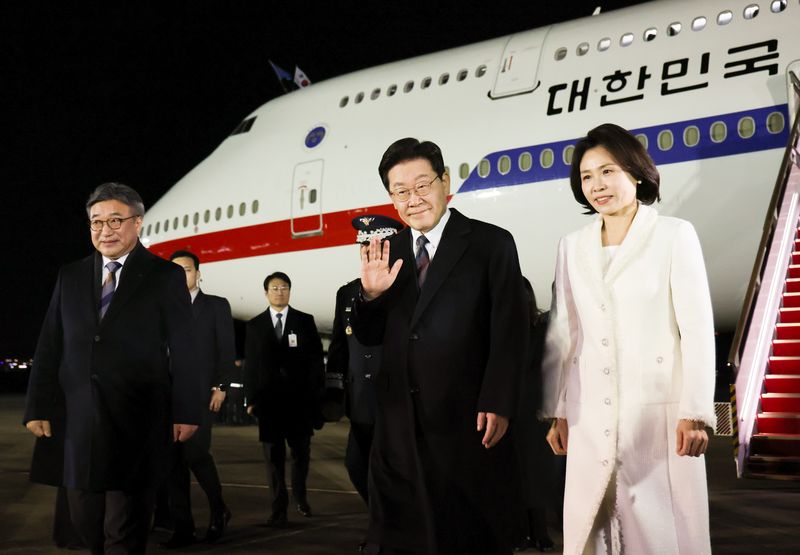
[Financial News] Cheong Wa Dae said on the 22nd, addressing opposition parties that had criticized President Lee Jae Myung's frequent overseas trips, “I would like to encourage them to look up and broaden their perspective to include the frenetic summit diplomacy of foreign leaders.”
Seong Ki-hong, senior presidential secretary for public relations and communication, posted a message on X (formerly Twitter) that day titled 'Pragmatic Diplomacy for the National Interest Shines at APEC, Along with Charm Diplomacy.' He emphasized this while explaining the diplomatic achievements of this Asia-Pacific Economic Cooperation (APEC) summit.
Seong cited the example of Canadian Prime Minister Mark Carney's overseas trips, noting, “At a recent parliamentary audit, the opposition criticized President Lee, saying, 'He has already made 14 trips to as many as 23 countries. He has spent one day out of every six abroad.'”
Citing a report in The Wall Street Journal (WSJ) dated the 20th, Seong explained, “Since taking office in March last year, Canadian Prime Minister Mark Carney has pursued overseas summit diplomacy, visiting 32 countries across five continents. He has visited some countries more than once, so the number of trips is even higher. He spent 113 days abroad for summit diplomacy. One day out of every five days in office was devoted to overseas summit diplomacy.”
He added, “The WSJ described Carney's overseas diplomacy as 'an effort to crisscross the globe, expand the country's security and trade partnerships, and reduce the Canadian economy's excessive dependence on the United States.' It also included the assessment that 'overseas summit diplomacy is not something nice to do, but something that must be done.'”
Seong noted, “Since the end of the Cold War, and particularly in the 21st century, summit diplomacy involving overseas trips has increased in every country. Researchers at the University of Denver in the United States once analyzed more than 100,000 instances of overseas summit diplomacy by leaders of more than 200 countries around the world from 1990 to 2024. According to the report, leaders' overseas visits rose from an annual average of 1,508 in the 1990s to 2,734 a year from 2010 onward, an increase of more than 80%.”
He pointed out that this was because “as the Cold War's bipolar system has broken down and the international order has become multipolar, the issues leaders must resolve directly—including trade and investment, supply chains, security and advanced technology cooperation—have continued to grow.”
Assessing President Lee's summit diplomacy, Seong said, “Early in his presidency, President Lee focused on using summit diplomacy to restore national dignity, which had been brought low by the insurrection, and to convey the message 'Democratic Korea is back' to the international community. He is increasingly focused on turning restored diplomatic ties into tangible gains for the national interest and results that the public can feel. He is moving beyond the restoration of diplomacy to diplomatic achievements, and beyond normalizing relations to maximizing the national interest.”
Seong said, “This APEC summit diplomacy offers a concentrated illustration of how 'pragmatic diplomacy for the national interest' is conducted. First and foremost, it is an independent and proactive diplomacy that forges its own path toward the Korean Peninsula's destiny and peace.”
He added, “At the APEC summit, the world's attention was focused on the first-ever trilateral summit among the leaders of the U.S., China and Russia. Recalling the history of the Korean Peninsula's fate being determined by great powers more than 80 years ago, some feared that 'Korea being sidelined' could become a reality.”
He emphasized, “But things were different now from back then, when Korea was nowhere to be seen. President Lee was on the stage this time. Before the trilateral summit among the U.S., China and Russia, President Lee met the leaders of the United States, China and Russia one after another. The media also described this as 'a proactive diplomatic effort to explain the government's position on Korean Peninsula issues directly.'”
On economic and trade matters, he said, “The follow-up negotiations on services and investment under the China–South Korea Free Trade Agreement, which had dragged on for eight years and eight months, reached a substantive conclusion. This created an opportunity to expand the two countries' companies' access to each other's markets and open new avenues for economic cooperation.” He added that newspaper headlines had also described the overseas diplomacy as having “renewed the commitment to peace and secured practical benefits.”
He also highlighted the presidential couple's 'charm diplomacy.' Seong said, “The presidential couple's 'charm diplomacy' (Charm Diplomacy) was also part of it. From the moment First Lady Kim Hye-kyung arrived in China, her unpretentious, warm demeanor and hanbok fashion captured the hearts of Chinese internet users. Fan communities named after the presidential couple have even appeared online in China.”
He explained, “The influential Hong Kong newspaper South China Morning Post (SCMP) described this phenomenon as a 'couple fandom' among Chinese people supporting the presidential couple. The newspaper also reported that it had become a trend among young Chinese visiting Seoul to seek out the wall surrounding the National Assembly of the Republic of Korea that President Lee climbed to stop martial law during the 'night of insurrection' in 2024 and take proof photos.”
Seong said, “Winning the goodwill and trust of people in other countries is also an important diplomatic asset. This time, the presidential couple played leading roles in soft power.” He assessed that this “showed that summit diplomacy is both a forum for negotiations to secure the national interest and a stage for public diplomacy that brings the people of other countries emotionally closer.”
Finally, he emphasized, “Summit diplomacy safeguards the nation's destiny, enhances South Korea's standing and creates future growth drivers,” calling it “another front for people's livelihoods beyond the country's borders.”
He added, “There is a saying: 'Politics stops at the water's edge.' It means that, when the national interest is at stake, we must join forces beyond partisan interests. South Korea's diplomatic clout will grow further when the ruling and opposition parties work together to advance the national interest.”
[email protected] Choi Jong-geun Reporter