New-Town Childcare Centers Allowed to Operate Infant Classes Only... Could This Ease the Enrollment Crunch?
- Input
- 2026-11-22 10:03:55
- Updated
- 2026-11-22 10:03:55
[Financial News] The chronic “childcare center enrollment crunch” in new towns attracting dual-income couples and young people is expected to ease. The government has decided to lift outdated regulations in the childcare sector to help reduce career interruptions caused by parents leaving their jobs to raise children.
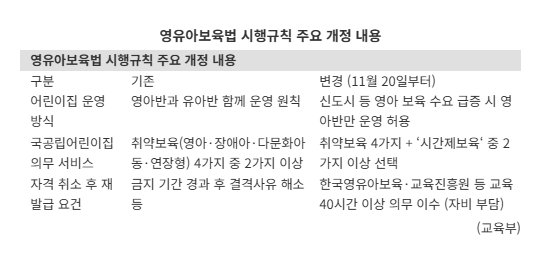
The Ministry of Education said on the 22nd that it had promulgated and brought into force on the 20th a partial amendment to the Enforcement Rule of the Infant Care Act, allowing childcare centers in areas where demand for infant care is surging, such as new towns, to operate infant classes only.
The most notable change is more flexible operations tailored to childcare demand. Until now, childcare centers were generally required to operate both infant classes for younger children and preschool classes attended by slightly older children. As a result, even in areas where the number of infants, including newborns, suddenly increased because of new-town development or large-scale residential construction, centers had to maintain preschool classes, limiting their ability to expand capacity in infant classes. Going forward, in areas where demand for infant care has surged or is expected to surge, centers may temporarily suspend preschool classes and operate infant classes only.
The threshold for accessing part-time childcare will also be lowered. Parents caring for their children at home can leave them at a childcare center only for the time they need, such as while visiting a hospital or working short-term. Previously, national and public childcare centers were required to operate at least two of four types of “care for vulnerable groups” to provide public childcare in their communities: infant care, care for children with disabilities, care for children from multicultural families, and extended-hours care. The amendment adds part-time childcare as a new option among these required services. As a result, when operators of national and public childcare centers are newly selected or re-designated, they may choose part-time childcare as one of the required services, which is expected to expand access to part-time childcare at centers favored by parents.
Measures to strengthen safety in the field will also take effect alongside efforts to expand childcare services. Childcare center directors and childcare teachers whose credentials were revoked for child abuse or other reasons must complete at least 40 hours of training run by the Korea Institute for Early Childhood Care and Education Promotion and other organizations to regain their credentials after the prescribed period of disqualification has passed. The training covers understanding children’s rights, types and cases of child abuse, and childcare staff ethics, among other topics. Participants must pay the training costs themselves.
Education Minister Choi Kyo-jin said, “Even after this amendment, we will continue to communicate with the childcare sector, address difficulties in the field, and identify regulatory reforms that can improve the quality of childcare.”
[email protected] Kim Man-gi Reporter