Smart Glasses Cheating Spurs Calls to Revamp the CSAT... Short-Answer and Essay Questions, Qualification Exam Floated
- Input
- 2026-11-22 08:57:25
- Updated
- 2026-11-22 08:57:25
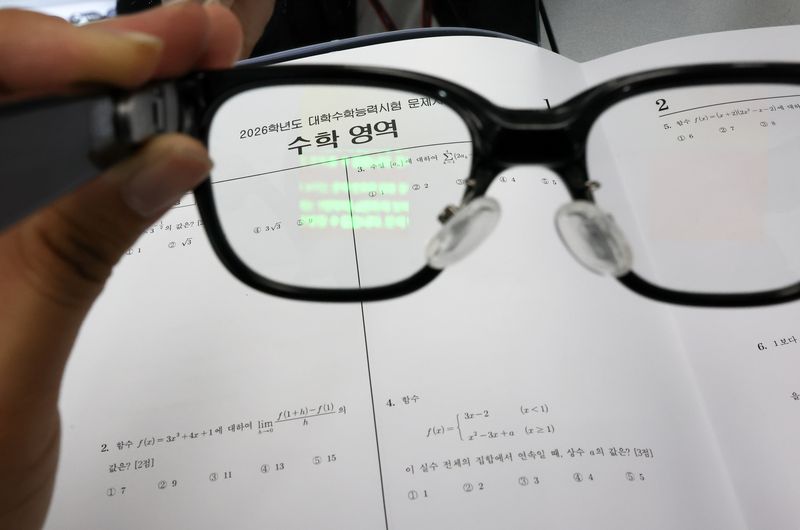
[Financial News] In the 2027 College Scholastic Ability Test (CSAT), cheating using smart glasses and miniature cameras was uncovered, bringing renewed calls to reform the CSAT’s assessment system. As President Lee Jae-myung calls for a comprehensive overhaul of the national examination system, the National Education Commission is considering expanding short-answer and essay-based assessments, starting with school grades. Some in the education community are also calling for the CSAT to be replaced with a qualification exam for university admission.
According to the Ministry of Education on the 22nd, a total of 111 cases of cheating involving electronic devices were uncovered during the CSAT held on the 19th. One case involving smart glasses and one involving a miniature camera and wireless earbuds were confirmed. The government implemented measures to prevent cheating using electronic devices, including blocking public Wi-Fi around test sites and sending emergency disaster alert messages.
On the 20th, President Lee ordered the development of comprehensive measures to prevent cheating that exploits artificial intelligence (AI), saying, “The national examination system must be comprehensively and swiftly overhauled from A to Z to keep pace with changing circumstances.”
The Korean Federation of Teachers’ Associations, the Teachers’ Labor Union Federation, and the Korean Teachers and Education Workers Union also said that education and assessment methods should be reviewed to meet the demands of the AI era.
Last August, the National Education Commission reported to President Lee a work plan that included consideration of switching the CSAT to absolute grading and introducing short-answer and essay-based questions. It has since gathered feedback through forums such as discussions with members of its public participation committee.
One proposal under consideration is to expand short-answer and essay-based assessments in school grades, giving schools time to adapt. Some education offices, including the Seoul Metropolitan Office of Education (SMOE), are also pushing to expand such questions in schools. Before introducing them in the CSAT, officials would need to ensure consistent grading and consider the potential for increased private education costs as well as teachers’ workload in setting and grading questions.
Seoul Superintendent of Education Geun-sik Chung and Gyeonggi Province Superintendent of Education Min-seok Ahn, among others, have expressed support for switching the CSAT to absolute grading and introducing a university-admission qualification exam to ease excessive competition for university places and school ranking.
If the CSAT becomes a qualification exam that determines whether students meet a certain standard, the weight of university-specific essay tests and interviews could increase. As universities gain greater discretion in selecting students, key issues will include how to ensure fairness in each university’s assessments and how much more preparation students will have to do for university-specific exams.
[email protected] Bae Han-geul Reporter